Hi, what do you want to do?






Physics Classroom
The Physics Classroom: Wavelike Behaviors of Light
How light waves demonstrate their wave nature by reflection, refraction, and diffraction.
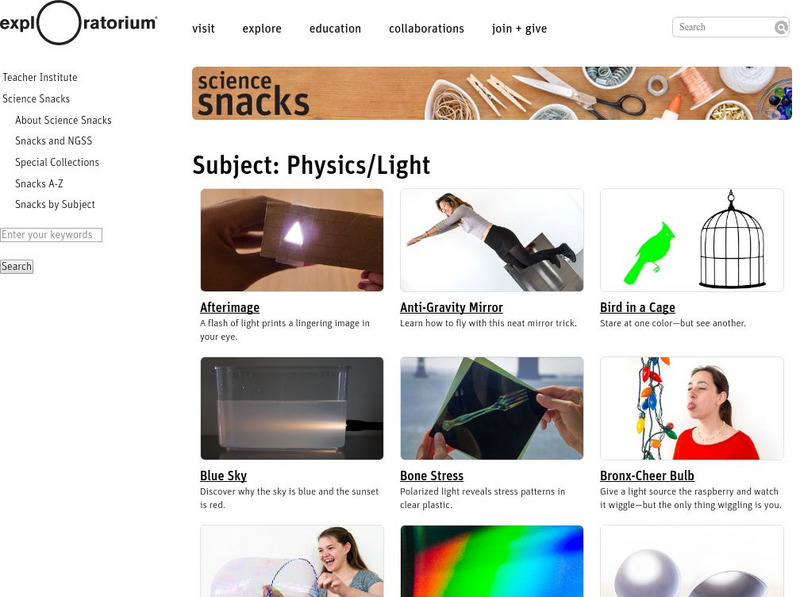
Exploratorium
Exploratorium: Science Snacks: Physics/light
Here is a large collection of simple science class activities for understanding the physics of light.
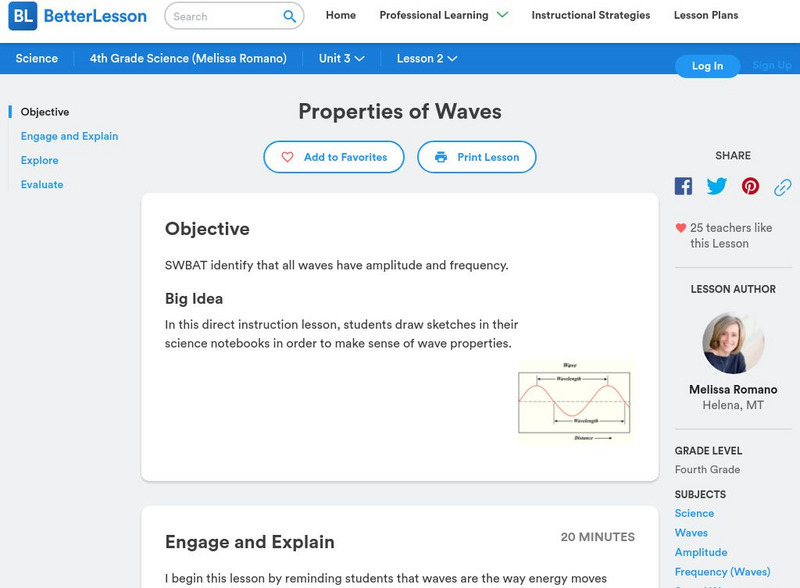
Better Lesson
Better Lesson: Properties of Waves
In this direct instruction lesson plan, students draw sketches in their science notebooks in order to make sense of wave properties. Resources include a slideshow presentation on the properties of waves and multiple examples of student...
Science Buddies
Science Buddies: How Does the Intensity of Light Change With Distance?
How far would you have to travel so that the light of the full sun would provide "daylight" no brighter than twilight on Earth? This project describes a method to verify the inverse square law: how light, sound, electrical signals, and...
Better Lesson
Better Lesson: Waves Performance Assessment Part 1
Students will use a variety of objects to participate in a partner activity and communicate using light and sound waves. Resources include a video, pictures and videos of the lesson in action, and examples of student work.
Physics Classroom
The Physics Classroom: Light Waves/color: Two Point Source Interference Pattern
Students investigate the underlying causes of two-point source interference pattern. They also discover that the spatial separation between the antinodal and nodal lines in the pattern is related to the wavelength of the waves.
Physics Classroom
The Physics Classroom: Light Waves and Color: The Path Difference
After looking at a representative two-point source interference pattern with accompanying order numbers, students investigate the rationale behind the numbering system, and develop some mathematical equations that relate the features of...
Physics Classroom
The Physics Classroom: Light Waves and Color: Polarization
Through illustrated practice problems and video clips, students learn about polarization of light.
Physics Classroom
The Physics Classroom: Light Waves and Color: Color Subtraction
In this physics tutorial, students learn how materials that have been permeated by specific pigments will selectively absorb specific frequencies of light in order to produce a desired appearance.
NASA
Nasa: Tour of the Electromagnetic Spectrum: Visible Light
Visible light waves are the only electromagnetic waves we can see. We see these waves as the colors of the rainbow. Each color has a different wavelength. Red has the longest wavelength and violet has the shortest wavelength. When all...
Science Buddies
Science Buddies: Measuring the Speed of 'Light' With a Microwave Oven
In this experiment, you will measure the speed of light using a microwave oven, some egg white, and a ruler. This short project proves to be an extremely interesting choice for a science lab, with pictures for illustration, and thorough...
Museum of Science
The Atom's Family: Radiometer
Help Dracula find out about light waves by using a virtual radiometer.
Science Struck
Science Struck: How Does Light Travel Through Space and Other Media?
A detailed discussion of the nature of light, how it can travel through a vacuum, and how the speed of light is affected when light travels through a medium.
Physics Classroom
The Physics Classroom: Light Waves and Color: Blue Skies and Red Sunsets
Students will focus on the interaction of sunlight with atmospheric particles to produce blue skies and red sunsets.
CK-12 Foundation
Ck 12: Fundamentals of Light
[Free Registration/Login may be required to access all resource tools.] Students investigate the fundamentals of light including its source, how it is defined for measurements, how we perceive color, and the situations that make an...
TeachEngineering
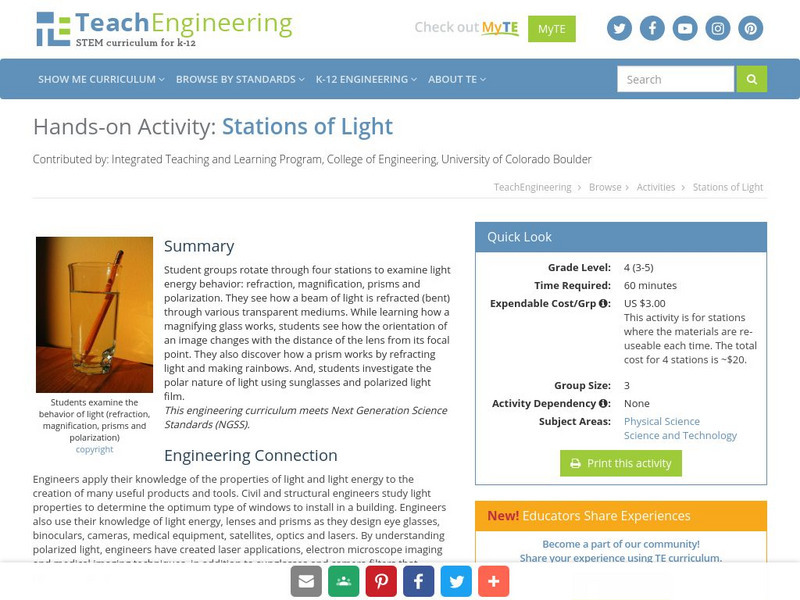
Teach Engineering: Stations of Light
Student groups rotate through four stations to examine light energy behavior: refraction, magnification, prisms and polarization. They see how a beam of light is refracted (bent) through various transparent mediums. While learning how a...
Science Buddies
Science Buddies: Don't You Fret! Standing Waves on a Guitar
In this project, you will investigate the physics of standing waves on guitar strings. You will learn about the different modes (i.e., patterns) of vibration that can be produced on a string, and you will figure out how to produce the...
Science Buddies
Science Buddies: How Does Color Affect Heating by Absorption of Light?
Light is an example of an electromagnetic wave. Electromagnetic waves can travel through the vacuum of interstellar space. They do not depend on an external medium-unlike a mechanical wave such as a sound wave which must travel through...
Science Buddies
Science Buddies: Measuring Vibrational Frequency With Light
Strike a key on the piano, and you hear the string vibrating. Just about any object vibrates when it's knocked, but how much and how fast? This project helps you find out. You'll build a simple light-sensing circuit for measuring the...
TeachEngineering
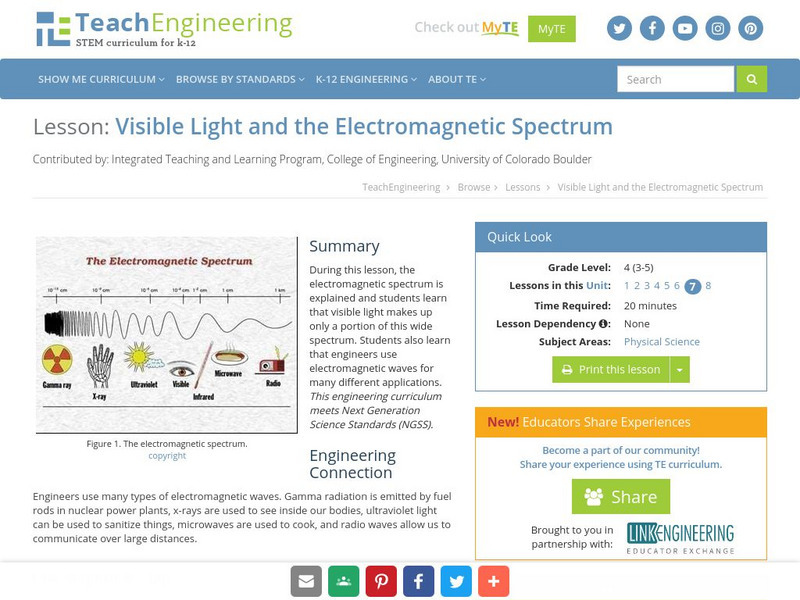
Teach Engineering: Visible Light and the Electromagnetic Spectrum
In this lesson, the electromagnetic spectrum is explained and students learn that visible light makes up only a portion of this wide spectrum. Students also learn that engineers use electromagnetic waves for many different applications.
Science Struck
Science Struck: Wavelength of Light
Describes the characteristics of light, presents two formulas for calculating its wavelength, and provides a table of the different wavelength ranges across the electromagnetic spectrum.
TeachEngineering
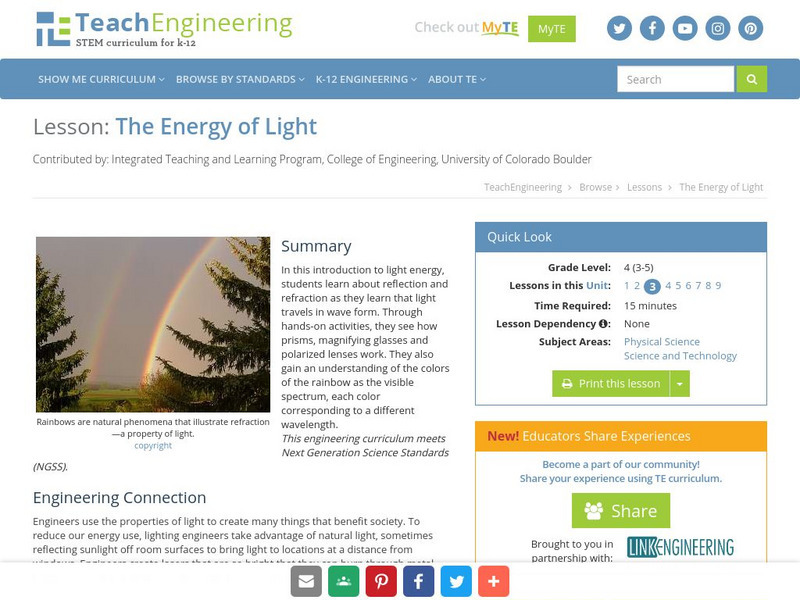
Teach Engineering: The Energy of Light
In this introduction to light energy, students learn about reflection and refraction as they learn that light travels in wave form. Through hands-on activities, they see how prisms, magnifying glasses and polarized lenses work. They also...
Ducksters
Ducksters: Physics for Kids: Behavior of Light as a Wave
Kids learn about the behavior of light as a wave in the science of physics including reflection, refraction, and diffraction.
Better Lesson
Better Lesson: Refraction Extravaganza!
Fourth graders learn how light waves bend differently in different mediums.
Other popular searches
- Sound and Light Waves
- Properties of Light Waves
- Light Waves Activity
- Light Waves Lab
- Sound & Light Waves
- Interactions of Light Waves
- Light Waves Powerpoint
- Light Waves Astronomy
- Waves Light Waves
- Electromagnetic Waves Light
- Reflection of Light Waves
- Light Waves Verses Particle.