Hi, what do you want to do?





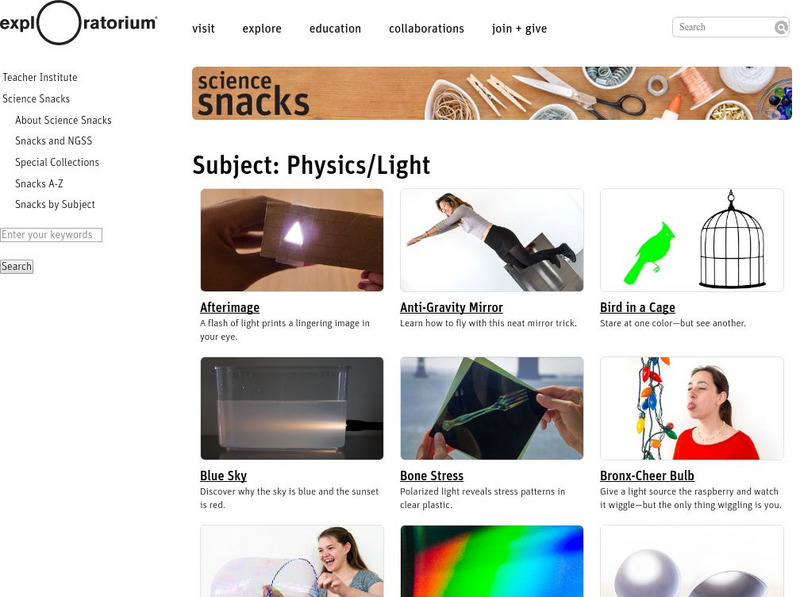
Exploratorium
Exploratorium: Science Snacks: Physics/light
Here is a large collection of simple science class activities for understanding the physics of light.

Museum of Science
The Atom's Family: Radiometer
Help Dracula find out about light waves by using a virtual radiometer.
Better Lesson
Better Lesson: Waves Performance Assessment Part 1
Students will use a variety of objects to participate in a partner activity and communicate using light and sound waves. Resources include a video, pictures and videos of the lesson plan in action, and examples of student work.
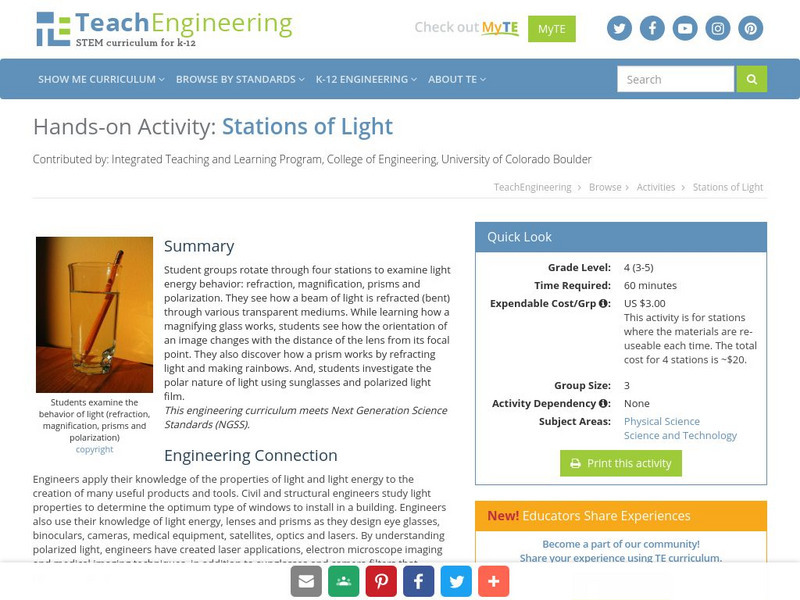
TeachEngineering
Teach Engineering: Stations of Light
Student groups rotate through four stations to examine light energy behavior: refraction, magnification, prisms and polarization. They see how a beam of light is refracted (bent) through various transparent mediums. While learning how a...
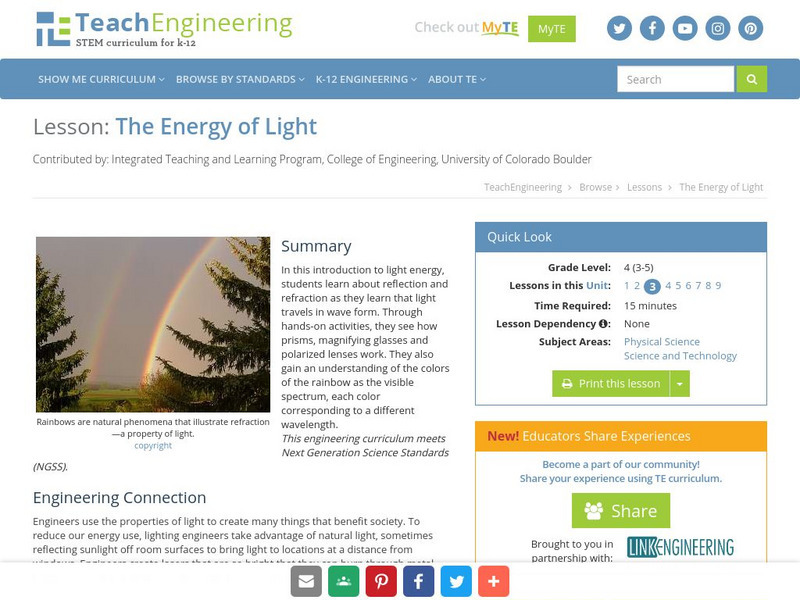
TeachEngineering
Teach Engineering: The Energy of Light
In this introduction to light energy, students learn about reflection and refraction as they learn that light travels in wave form. Through hands-on activities, they see how prisms, magnifying glasses and polarized lenses work. They also...

Exploratorium
Exploratorium: Science Snacks: Moire Patterns
In this activity, students will use Moire patterns to demonstrate wave interference.
NASA
Nasa: Probing Earth Through the Clouds
This site from the National Aeornautics and Space Administration provides a fun activity for the subject. "Clouds often hide large areas of the Earth's surface. We can use radar to make detailed maps of Earth right through clouds or...

TeachEngineering
Teach Engineering: The Visual Spectrum
In this activity, students make simple spectroscopes (prisms) to look at different light sources. The spectroscopes allow students to see differing spectral distributions of different light sources.
Optical Society
Optical Society of America: Optics for Kids: Interference in a Ripple Tank
An investigation, using a ripple tank, into how waves behave when they collide with each other. With an explanation of what is observed, and a link to an article on refraction.