Hi, what do you want to do?






Curated OER
Acid and Base Problems
In this acid and base worksheet, students use seven steps to calculate concentrations of ions in acidic and basic solutions. They also determine the type of acid or base.

Curated OER
Back Titrations
In this chemistry worksheet, students calculate the titrations of various types of chemistry problems. The questions include background information.

Curated OER
Estimating Errors in Chemistry
Estimating Errors in Chemistry is a detailed handout that illustrates the importance of calculating the percent error when working in the chemistry lab. There are no actual problems to solve, just notes and examples of calculations. Hand...

Curated OER
Stoichiometry
For this stoichiometry worksheet, students practice calculating moles, molarity, and the concentration of a solution in molarity. This worksheet has 12 multiple choice questions and 3 problems to solve.

Curated OER
Molarity Worksheet
In this molarity worksheet, students fill in unknowns such as mass of solute, moles of solute, volume of solution and molarity of solution in a chart with given solvents. They also calculate the molarity of solutions in other problems.

Curated OER
Chemical Equations
In this chemical equations worksheet, students determine the empirical formulas for chemical compounds and balance chemical equations. This worksheet has 1 fill in the blank question and 4 problems to solve.

Curated OER
Calorimetry Exercises
For this calorimetry worksheet, learners determine the specific heat and the heat of neutralization in the 2 problems they solve.

Curated OER
AP Chemistry-Gas Law Practice
In this gas worksheet, students find pressures, partial pressures, volumes, temperatures and number of moles of gases using the various gas laws.

Curated OER
Determination of Equivalent Weight of an Acid
In this chemistry worksheet, students look for the weight of acid and examine its mass using chemical equations and a laboratory procedure.
Chemistry Collective
Chem Collective: Textbook Style Limiting Reagents Problems
Textbook-style practice limiting reagent exercises with that can be used as a way to "predict and check" your answers using the virtual lab.
Chemistry Collective
Chem Collective: Textbook Style Limiting Reagents Problem Ii
In this activity, students practice with experiments involving limiting reagents and the test their knowledge to determine the concentration of an unknown solution.

Frostburg State University
General Chemistry Online: Limiting Reactant Problem
Explains the essence of limiting reactant problems using a sample problem: How can an amount of product (KNO3) be predicted from amounts for two reactants (KCl and HNO3)? Shows the work and explains how to solve these types of problems.
Chemistry Collective
Chem Collective: Stoichiometry and Solution Preparation Problem
In this limiting reagents problem, students mix together solutions in different ratios in an attempt to produce a final solution that contains only 1 product.
Chemistry Collective
Chem Collective: Unknown Concentration of Dna Solution Problem
In this advanced limiting reagent problem, students use the virtual lab to determine the concentration of a solution of DNA by reacting it with known amounts of a fluorescent dye which binds to the DNA.
Chemistry Collective
Chem Collective: Predicting Dna Concentration
In this limiting reagents problem, students are given specific concentrations of DNA solutions and are asked to predict what products and reactants will remain after a specific volumes are mixed and reaction has occurred.
Chemistry Collective
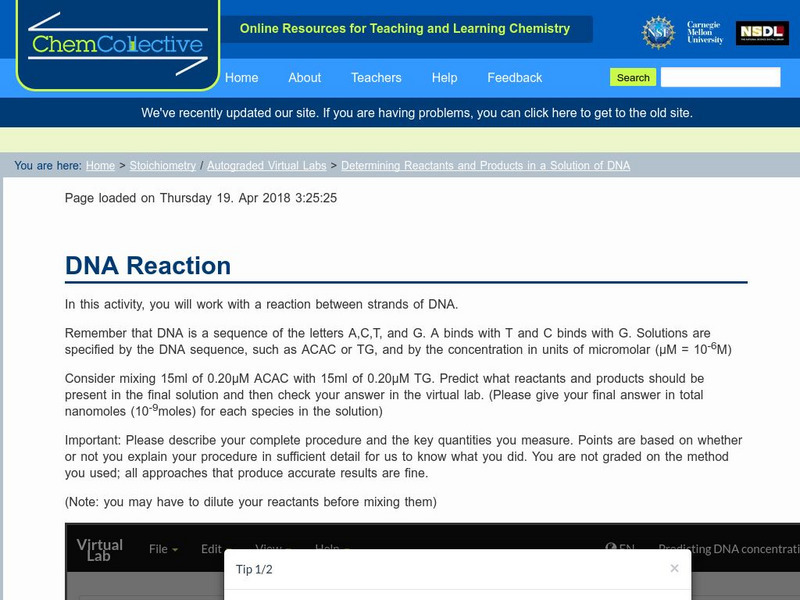
Chem Collective: Determining Reactants and Products in a Solution of Dna
In this limiting reagents problem, students are given specific concentrations of DNA solutions and are asked to predict what products and reactants will remain after a specific volumes are mixed and reaction has occurred.
Chemistry Collective
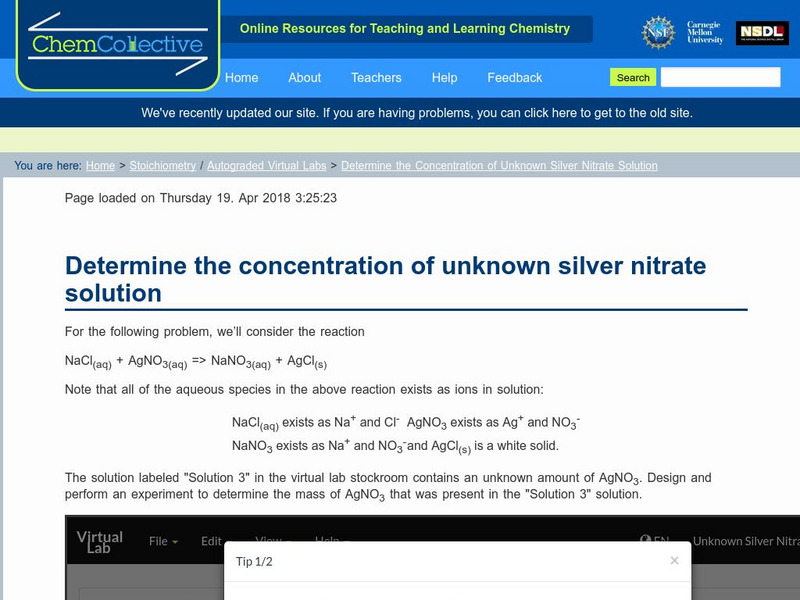
Chem Collective: Determine the Concentration of Unknown Silver Nitrate Solution
In this limiting reagents problem, students are asked to determine the amount of silver nitrate dissolved in a solution by performing a reaction with solid NaCl. In this randomized activity, each student is given a different unknown...
Chemistry Collective
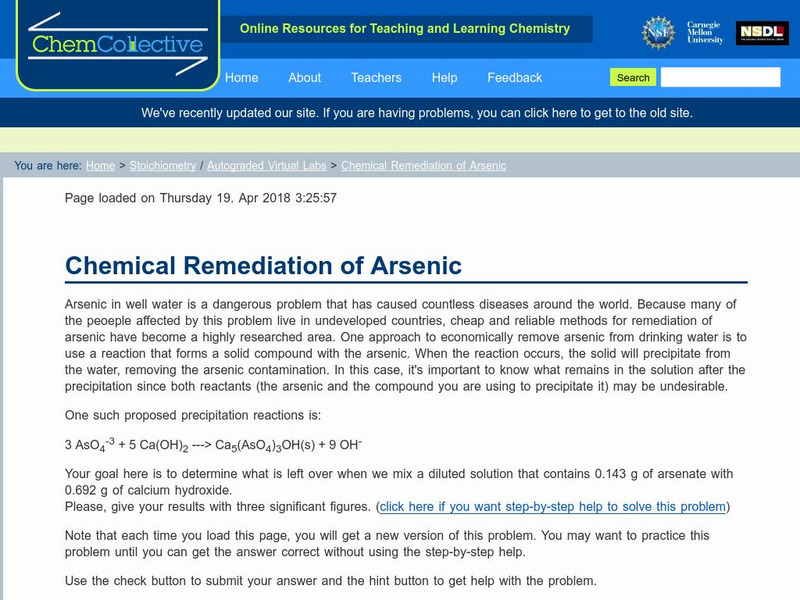
Chem Collective: Chemical Remediation of Arsenic
In this problem, students determine the limiting reagent in a reaction involving the remediation of arsenic from drinking water.
Chemistry Collective
Chem Collective: Current Collection of Virtual Lab Problems
A collection of over 30 virtual chemistry problems with accompanying interactive activities. Each problem includes a word file for potential differentiation in your classroom.

Carnegie Mellon University
Chem Collective: Stoichiometry Bridge Course
This is a complete course in chemical stoichiometry, set in a scenario that shows how stoichiometry calculations are used in real-world situations. This course has been designed to not only help you strengthen your skills with...
Chemistry Collective
Chem Collective: Stoichiometry Applet
One of the first numerical problems encountered in introductory chemistry is that of "limiting reagents". This applet serves as a supplement to such calculations, providing imagery that helps students see beyond the rote mathematics.
Chemistry Collective
Chem Collective: Equilibrium Simulation
This applet is similar to the stoichiometry simulation but applies to chemical reactions that do not go to completion. The calculation of the equilibrium state of such reactions is typically covered months after students learn how to...
Frostburg State University
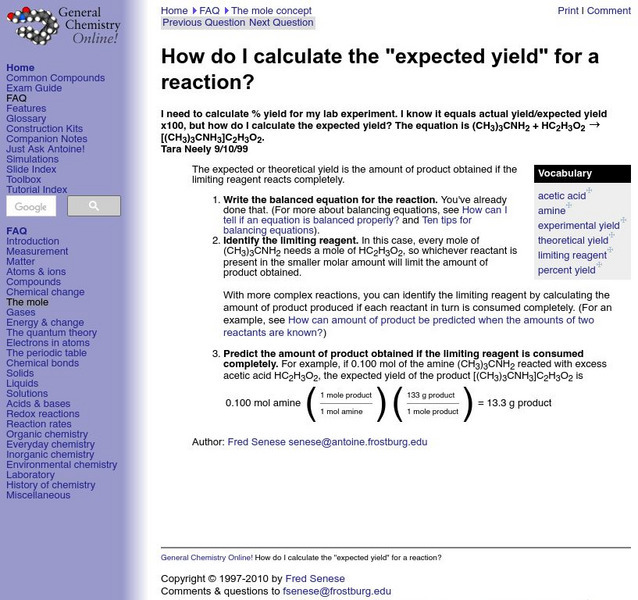
General Chemistry Online: Expected Yield
Frostburg State University provides an example of a problem dealing with how to find expected yield. Includes step-by-step directions on how to solve the problem.

Science Struck
Science Struck: A Simple Guide on How to Calculate Theoretical Yield
Explains vocabulary used when talking about the yield of a chemical reaction and models how to calculate the theoretical and the percentage yield in an example problem.