
Better Lesson
Better Lesson: W.3.3: Write Narratives to Develop Real or Imagined Experiences
Links to 47 lessons and activities that build student skills in standard W.3.3: Write Narratives to develop real or imagined experiences or events using effective technique, descriptive details, and clear event sequences.
Leaf Group
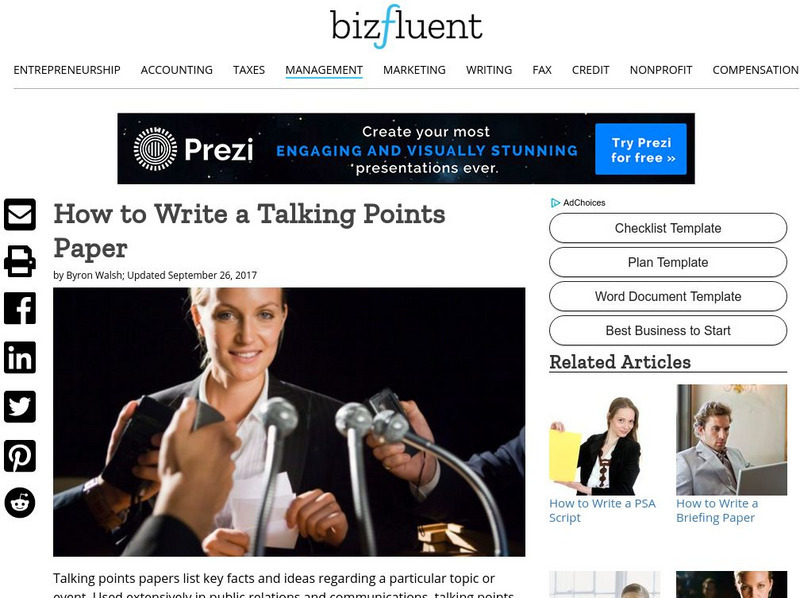
E How: How to Write a Talking Points Paper
This article by Byron Walsh focuses on writing a talking points paper for a public speaker which consists of researched, accurate information provided in bulleted lists with follow up sentences on specific topics.
![Florida Center for Reading Research:ask and Answer [Pdf] Unit Plan](https://content.lessonplanet.com/knovation/original/509091-3b197a566336bf3b326298f2bb8dbb48.jpg?1661786987 "Florida Center for Reading Research:ask and Answer [Pdf] Unit Plan")
Florida Center for Reading Research
Florida Center for Reading Research:ask and Answer [Pdf]
A lesson plan in which students read a text and stop periodically to write questions based on question word cards. Materials are included.

SMART Technologies
Smart: Sequence Putting Things in Order
Students will practice putting things in order, learn about sequence words, and use sequence words to produce a writing assignment within this interactive SMART whiteboard lesson.

Better Lesson
Better Lesson: W.4.2b: Develop the Topic With Facts
Links to 40 lessons and activities that build student skills in standard W.4.2b: Develop the topic with facts, definitions, concrete details, quotations, or other information and examples related to the topic.
Other
Reading Quest: Making Sense of Social Studies
Teaching students to read well in areas other than language arts requires teaching and reinforcing the kinds of reading strategies taught here. There are 27 strategies, ranging from brainstorming to word mapping. The site includes PDF...
Texas Education Agency
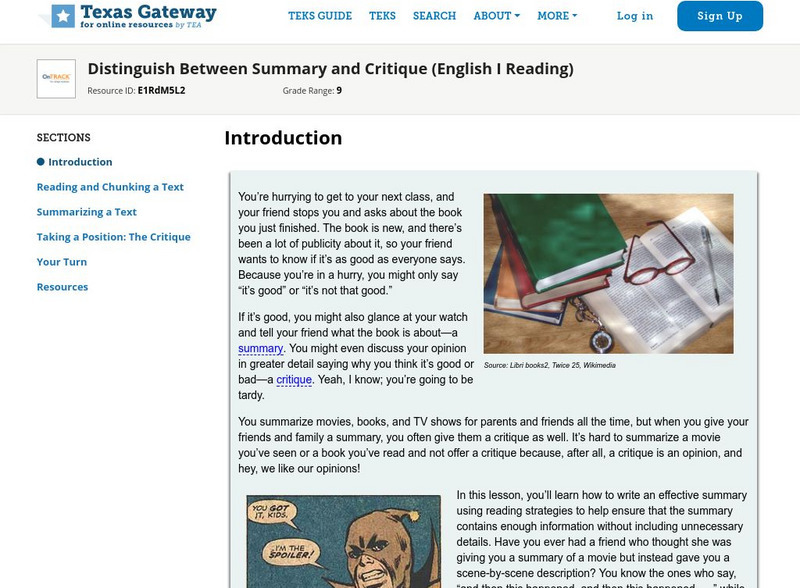
Texas Gateway: Distinguish Between Summary and Critique (English I Reading)
In this lesson, students will learn how to write an effective summary using reading strategies to help ensure that the summary contains enough information without including unnecessary details or personal opinions. You will also learn...
Better Lesson
Better Lesson: Awe Inspiring, Extraordinary, Erudite Kids
Using complex language, including rich descriptors, is necessary for mastery of the CCSS Standards. This lesson is a great lesson in using adjectives to enrich speaking and writing. Included are a video demonstration and printable...
Better Lesson
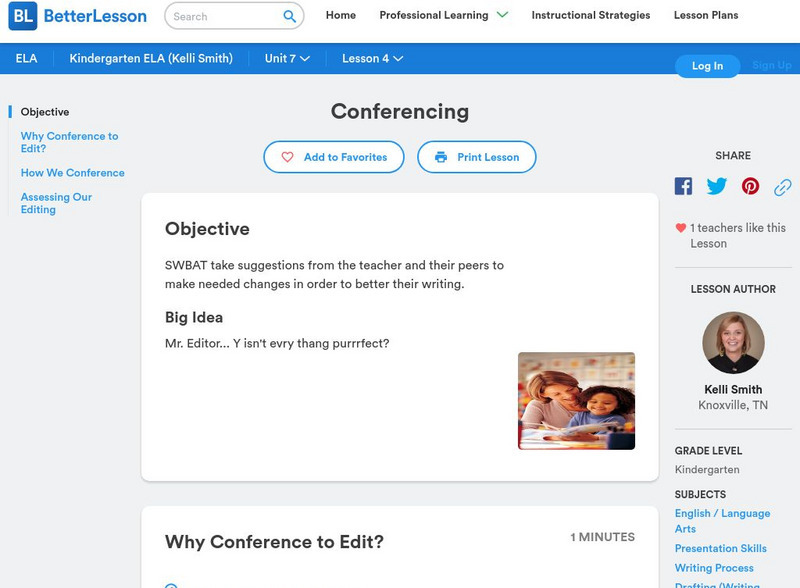
Better Lesson: Conferencing
Editing is a step that can often be overlooked in Kindergarten; however, it is crucial that our students understand how and why to go back and fix their writing! In this lesson, students will take suggestions from the teacher and their...
Utah Education Network
Uen: 1st Grade Act: 22: Retelling the Tiny Seed
This lesson engages students in story retelling to Eric Carle's book, The Tiny Seed. Students will participate in interactive storytelling as they write sentences and illustrate pictures about seed travel.
Better Lesson
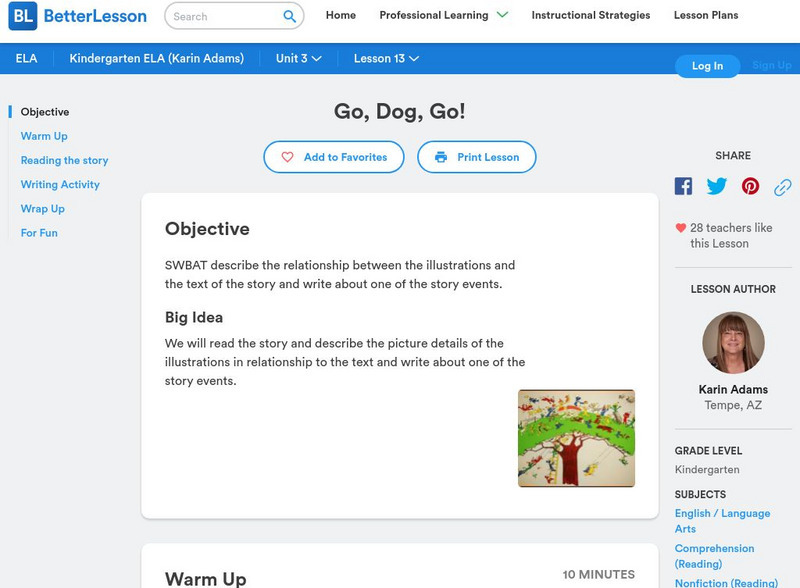
Better Lesson: Go, Dog, Go!
Students will read the story and describe the picture details of the illustrations in relation to the text and write about one of the story events. "Go, Dog, Go!" contains illustrations that are very elaborate and crazy while the text is...
Curated OER
Writing and Literacy in Chinese, Korean and Japanese
This site describes a book that goes into detail about education in China, Korea and Japan. It does show samples that provide interesting information on the schools in Japan.

ReadWriteThink
Read Write Think: Searching Informational Texts
Online lesson allows elementary students to use prior knowledge, make predictions, and perform research on the Internet. Labeled "The Frog Beyond the Fairy Tale Character," lesson challenges students to examine print and online texts...
ReadWriteThink
Read Write Think: Weather: A Journey in Nonfiction
Questions about weather clear up when students use what they learned from their books to create a presentation to share with the rest of the class.
ReadWriteThink
Read Write Think: Listen, Look, and Learn: An Information Gathering Process
This lesson models an information-gathering process for primary learners as they listen to and look at resources, seeking information pertinent to the questions on an information wheel. Guiding the listening, looking, and learning...
PBS
Pbs Learning Media: Cloud
A round up of wild horses proves too strenuous for a young colt in this video segment from Nature. Watch a video about this and follow up with discussion and writing prompts. [7:06]
Other
Nsw Dept. Of Ed.: "One World" [Pdf]
Reading unit plan about endangered animals from the New South Wales, Australia, Department of Education and Training entitled "One World" (Forty-four page PDF file). It contains ten days worth of teaching suggestions that use a variety...
University of Toronto (Canada)
University of Toronto: Standard Documentation Formats
Documenting Internet resources is becoming standardized. You'll find some of the basics here, plus links to more detailed guidelines now included in respected academic style guides. L.9-10.3a Standard Format, W.11-12.6 Technology,...
W. W. Norton
W.w. Norton & Company: Elements of the Essay: Evidence
An explanation of how to incorporate evidence into an essay in order to provide support for the thesis.
Read Works
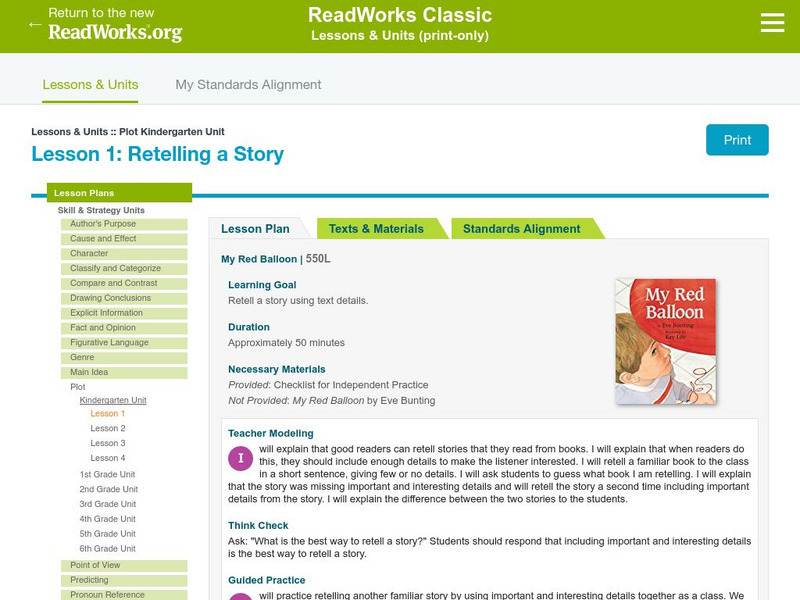
Read Works: Plot Kindergarten Unit: Retelling a Story
[Free Registration/Login Required] Teach retelling a story using plot elements through explanation, guided practice, and independent practice as students develop the skill. The text, My Red Balloon by Eve Bunting, must be provided by the...
Other
Ncrel: Reading Strategies: Before, During, and After [Pdf]
This page provides a detailed chart to aid students' understanding of texts. It goes through the steps of pre-reading, during reading, and after reading, outlining what students should be thinking about as they interact with a text. This...
Read Works
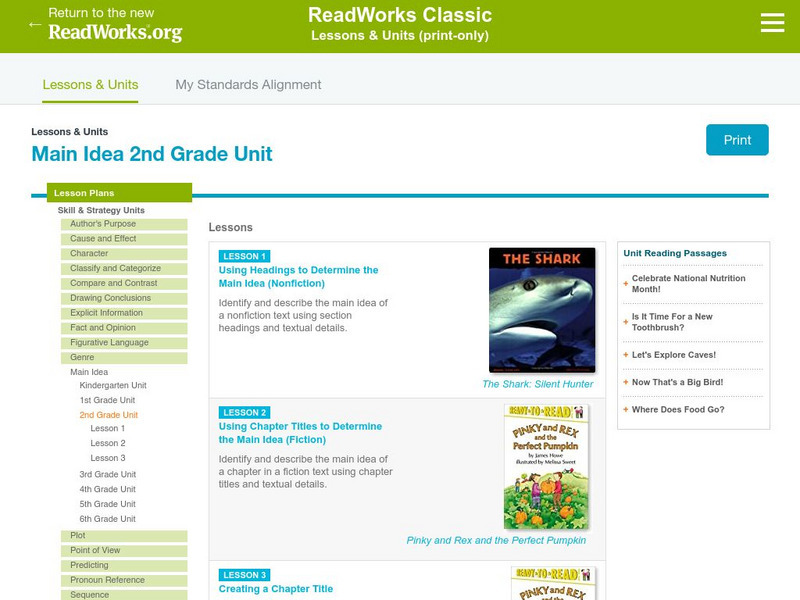
Read Works: Grade 2: Three Lesson Unit: Main Idea
[Free Registration/Login Required] A series of three lesson plans designed to teach young scholars to identify main ideas through headings and chapter titles, and then to write appropriate titles of their own. Lessons are based on the...
Better Lesson
Better Lesson: W.3.3.b: Use Dialogue and Descriptions of Actions
Links to 2 lessons and activities that build student skills in standard W.3.3.b: Write Narratives to develop real or imagined experiences or events using effective technique, descriptive details, and clear event sequences.
![Scholastic Teaching Resources: Nonfiction Notepads [Pdf] Graphic](https://content.lessonplanet.com/knovation/original/360626-4d78344ceeaa140aeef2ac8672d73b35.jpg?1661510814 "Scholastic Teaching Resources: Nonfiction Notepads [Pdf] Graphic")
Scholastic
Scholastic Teaching Resources: Nonfiction Notepads [Pdf]
From Just-Right Reading Response Activity Sheets for Young Learners, this graphic organizer can be used when students read informational texts. As responses to nonfiction, students will write the following on each notepad response:...