Hi, what do you want to do?





Smithsonian Institution
National Museum of Natural History: American Mammals: Townsend's Chipmunk
Clear-cut logging, which destroys habitat for some animals, offers good living conditions for Townsend's chipmunks. They find denning sites, cover, and food among the fallen, decaying logs and sprouting evergreens. Learn more about the...
Smithsonian Institution
National Museum of Natural History: American Mammals: West Indian Manatee
West Indian manatees are big, slow-moving, gentle vegetarians. They live in warm, shallow water in coastal rivers, estuaries, and lagoons. Learn more about the Trichechus manatus, more commonly known as a West Indian Manatee, in this...
Smithsonian Institution
National Museum of Natural History: American Mammals: Swift Fox
Swift foxes are primarily nocturnal, but can sometimes be seen sunning themselves near the entrance to a den. They live on prairie grasslands just east of the Rocky Mountains. Learn more about the Vulpes velox, more commonly known as a...
Smithsonian Institution
National Museum of Natural History: American Mammals: Northern Red Backed Vole
The Northern Red-backed Vole lives in dry tundra and northern boreal forests (taiga). Two distinct coat coloration patterns exist within the species, one darkly colored, and a paler version. Learn more about the Clethrionomys rutilus,...
Smithsonian Institution
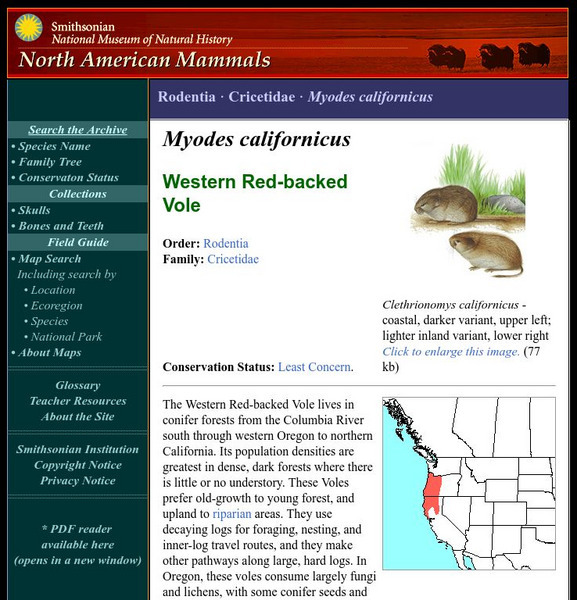
National Museum of Natural History: American Mammals: Western Red Backed Vole
The Western Red-backed Vole lives in conifer forests from the Columbia River south through western Oregon to northern California. Its population densities are greatest in dense, dark forests where there is little or no understory. Learn...
Smithsonian Institution
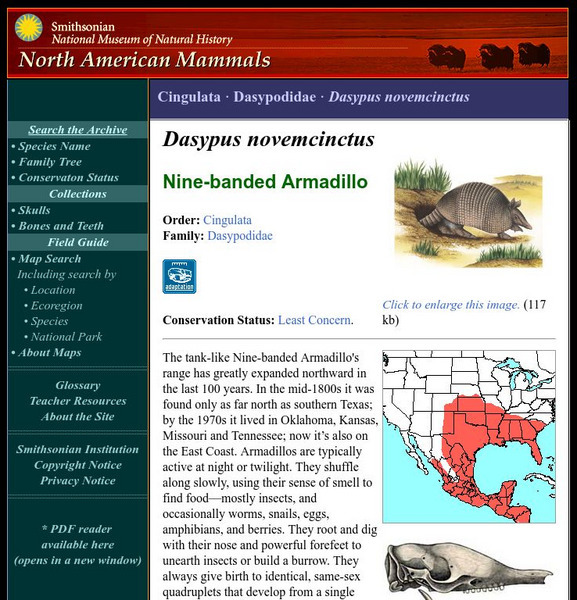
National Museum of Natural History: American Mammals: Nine Banded Armadillo
The tank-like Nine-banded Armadillo's range has greatly expanded northward in the last 100 years. In the mid-1800s it was found only as far north as southern Texas; by the 1970s it lived in Oklahoma, Kansas, Missouri, and Tennessee; now...
Smithsonian Institution
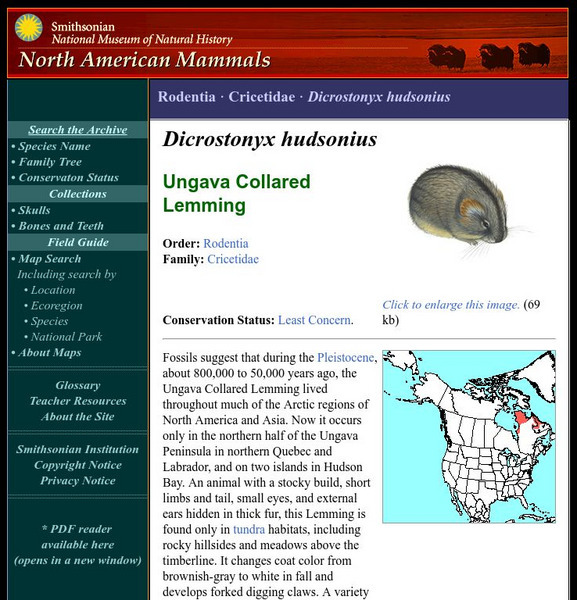
National Museum of Natural History: American Mammals: Ungava Collared Lemming
Fossils suggest that during the Pleistocene, about 800,000 to 50,000 years ago, the Ungava Collared Lemming lived throughout much of the Arctic regions of North America and Asia. Now it occurs only in the northern half of the Ungava...
Smithsonian Institution
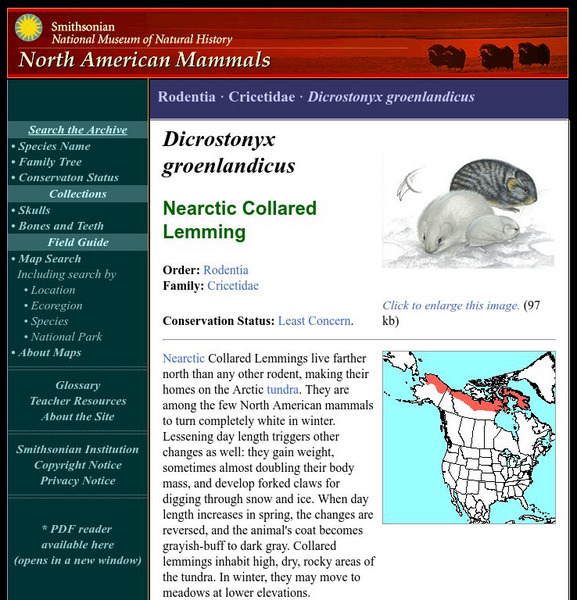
National Museum of Natural History: American Mammals: Northern Collared Lemming
Northern Collared Lemmings live farther north than any other rodent, making their homes on the Arctic tundra. They are among the few North American mammals to turn completely white in winter. Learn more about the Dicrostonyx...
Smithsonian Institution
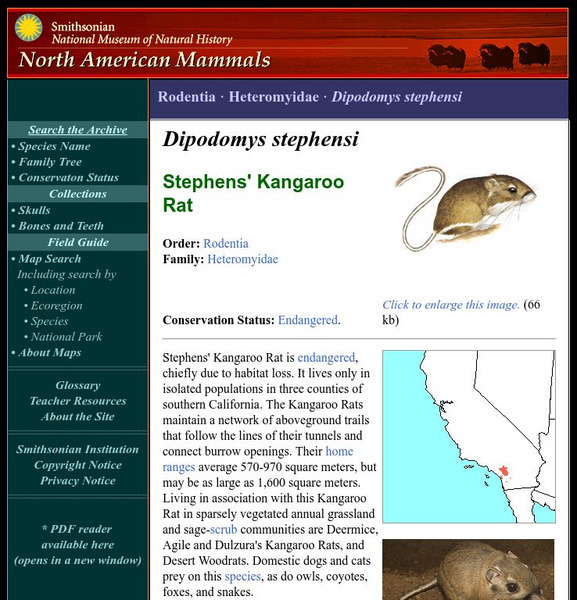
National Museum of Natural History: American Mammals: Stephen's Kangaroo Rat
Stephen's Kangaroo Rat is endangered, chiefly due to habitat loss. It lives only in isolated populations in three counties of southern California. Learn more about the Dipodomys stephensi, more commonly known as a Stephen's Kangaroo Rat,...
Smithsonian Institution
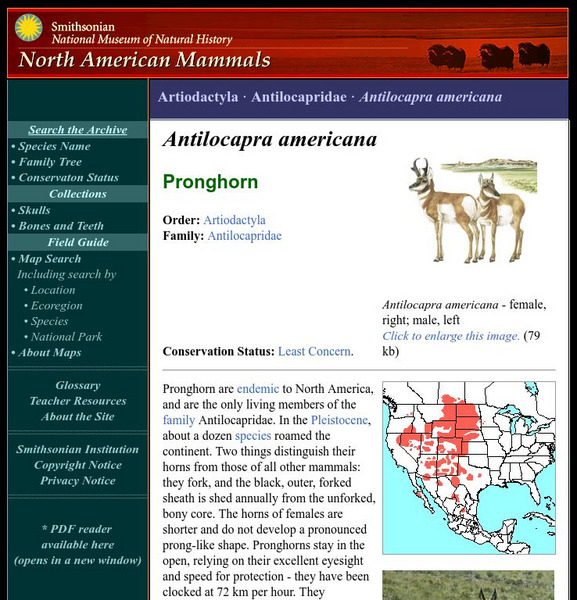
National Museum of Natural History: American Mammals: Pronghorn
Pronghorn are endemic to North America and are the only living members of the family Antilocapridae. In the Pleistocene, about a dozen species roamed the continent. Learn more about the Antilocapra americana, more commonly known as a...
Smithsonian Institution
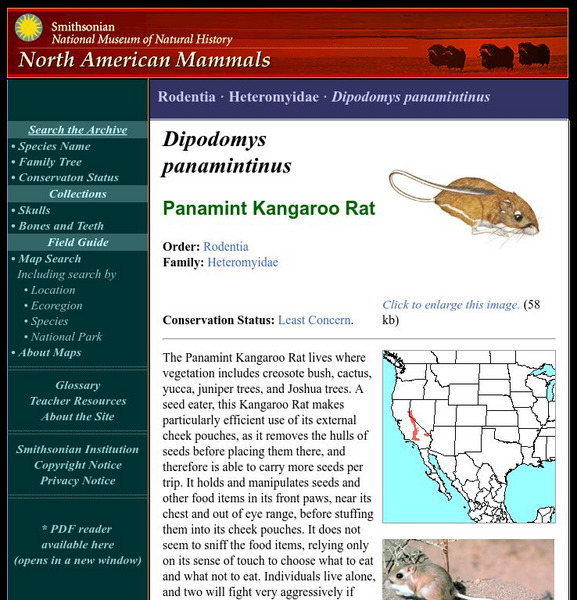
National Museum of Natural History: American Mammals: Panamint Kangaroo Rat
The Panamint Kangaroo Rat lives where vegetation includes creosote bush, cactus, yucca, juniper trees, and Joshua trees. A seed eater, this Kangaroo Rat makes particularly efficient use of its external cheek pouches, as it removes the...
Smithsonian Institution
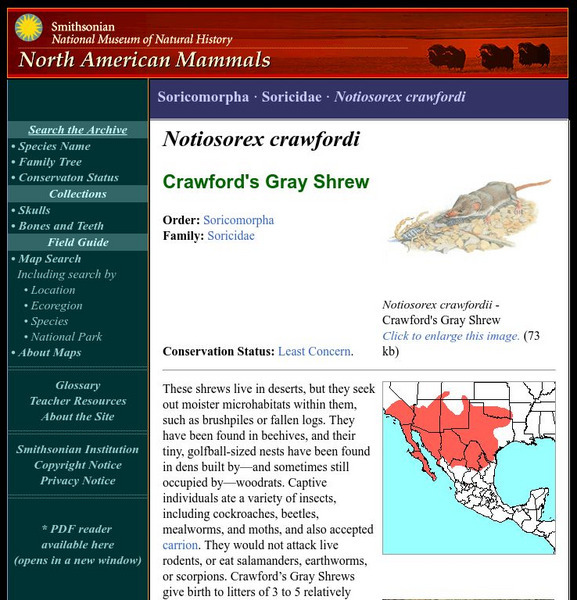
National Museum of Natural History: American Mammals: Crawford's Gray Shrew
These shrews live in deserts, but they seek out moister microhabitats within them, such as brush piles or fallen logs. They have been found in beehives, and their tiny, golfball-sized nests have been found in dens built by and sometimes...
Smithsonian Institution
National Museum of Natural History: American Mammals: Harbor Seal
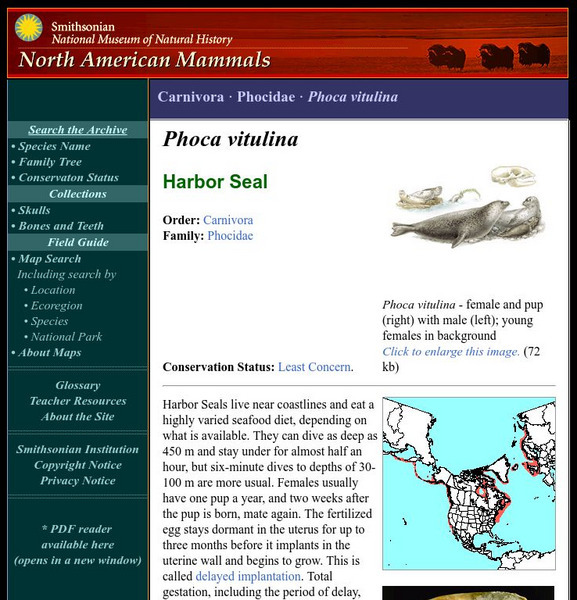
Harbor Seals live near coastlines and eat a highly varied seafood diet, depending on what is available. They can dive as deep as 450 m and stay under for almost half an hour, but six-minute dives to depths of 30-100 m are more usual....
Smithsonian Institution
National Museum of Natural History: American Mammals: Coyote
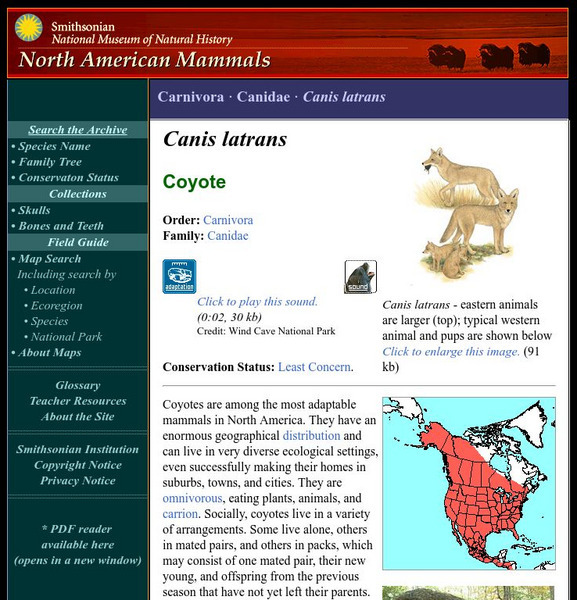
Coyotes are among the most adaptable mammals in North America. They have an enormous geographical distribution and can live in very diverse ecological settings, even successfully making their homes in suburbs, towns, and cities. Learn...
Smithsonian Institution
National Museum of Natural History: American Mammals: Gray Wolf
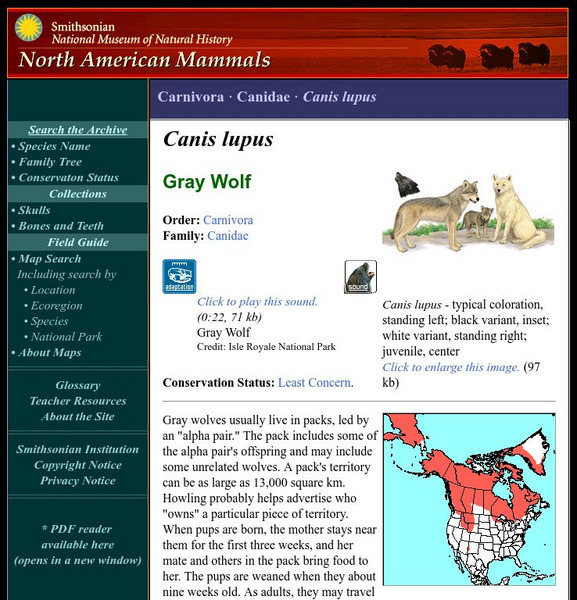
Gray wolves usually live in packs, led by an "alpha pair." The pack includes some of the alpha pair's offspring and may include some unrelated wolves. Learn more about the Canis lupus, more commonly known as a Gray Wolf, in this...
Smithsonian Institution
National Museum of Natural History: American Mammals: Fog Shrew
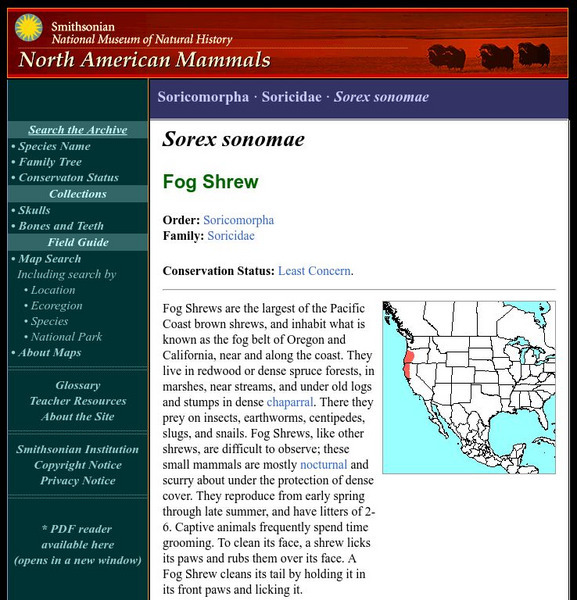
Fog Shrews are the largest of the Pacific Coast brown shrews, and inhabit what is known as the fog belt of Oregon and California, near and along the coast. They live in redwood or dense spruce forests, in marshes, near streams, and under...
Smithsonian Institution
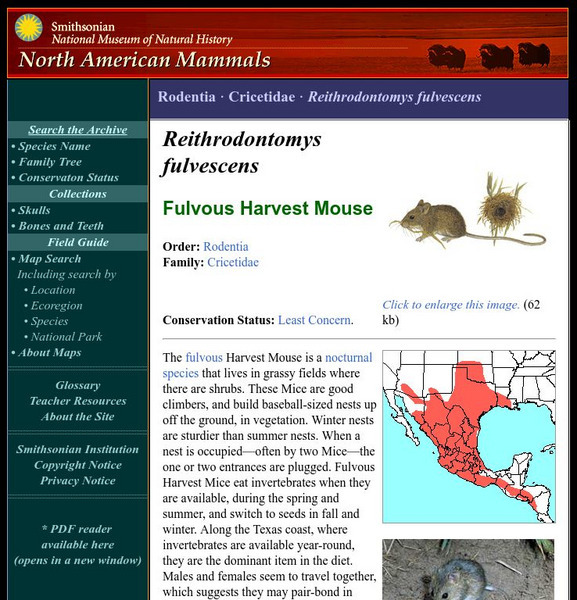
National Museum of Natural History: American Mammals: Fulvous Harvest Mouse
The fulvous Harvest Mouse is a nocturnal species that lives in grassy fields where there are shrubs. These Mice are good climbers, and build baseball-sized nests up off the ground, in vegetation. Learn more about the Reithrodontomys...
Smithsonian Institution
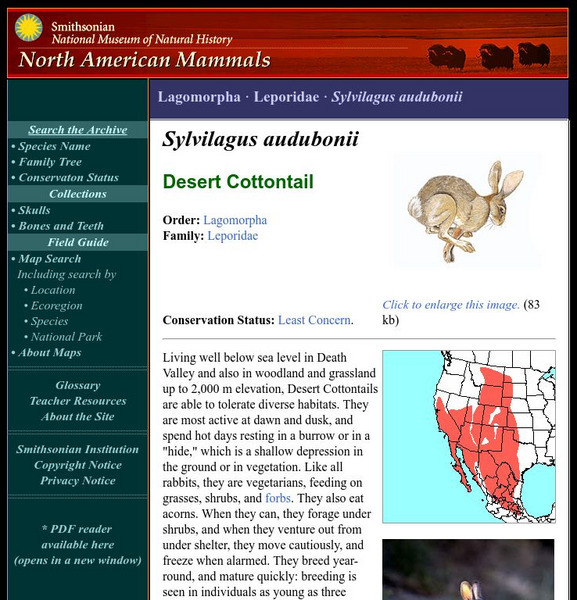
National Museum of Natural History: American Mammals: Desert Cottontail
Living well below sea level in Death Valley and also in woodland and grassland up to 2,000 m elevation, Desert Cottontails are able to tolerate diverse habitats. They are most active at dawn and dusk and spend hot days resting in a...
Smithsonian Institution
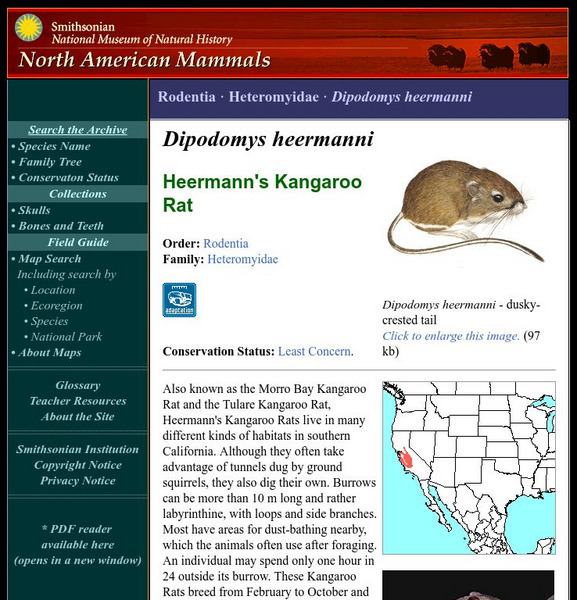
National Museum of Natural History: American Mammals: Heermann's Kangaroo Rat
Also known as the Morro Bay Kangaroo Rat and the Tulare Kangaroo Rat, Heermann's Kangaroo Rats live in many different kinds of habitats in southern California. Although they often take advantage of tunnels dug by ground squirrels, they...
Smithsonian Institution
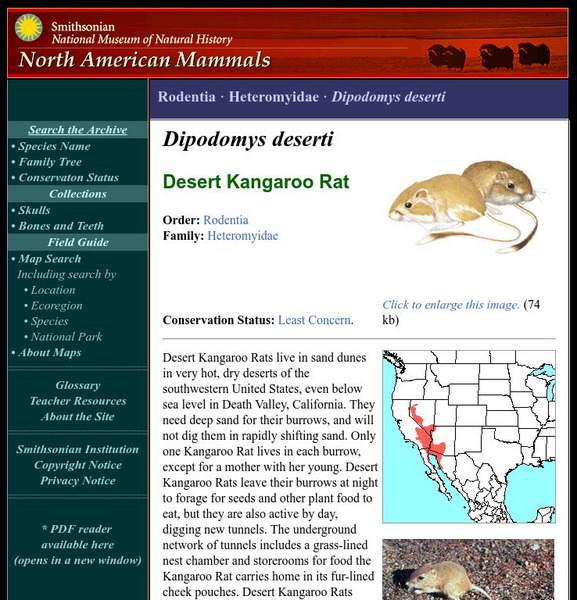
National Museum of Natural History: American Mammals: Desert Kangaroo Rat
Desert Kangaroo Rats live in sand dunes in very hot, dry deserts of the southwestern United States, even below sea level in Death Valley, California. They need deep sand for their burrows, and will not dig them in rapidly shifting sand....
Smithsonian Institution
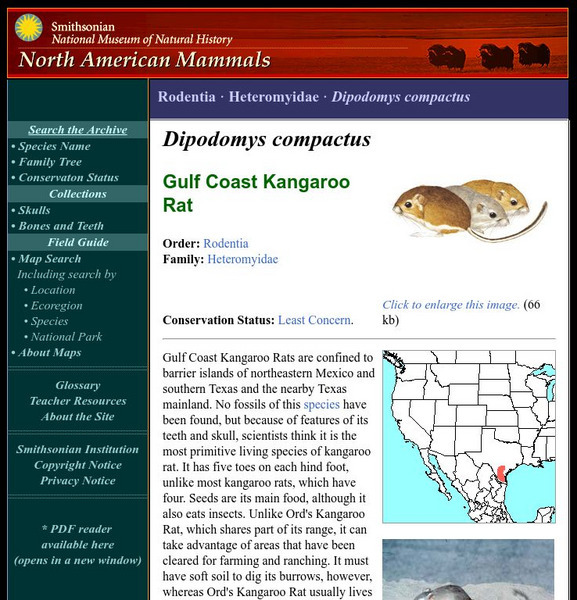
National Museum of Natural History: American Mammals: Gulf Coast Kangaroo Rat
Gulf Coast Kangaroo Rats are confined to barrier islands of northeastern Mexico and southern Texas and the nearby Texas mainland. No fossils of this species have been found, but because of features of its teeth and skull, scientists...
Smithsonian Institution
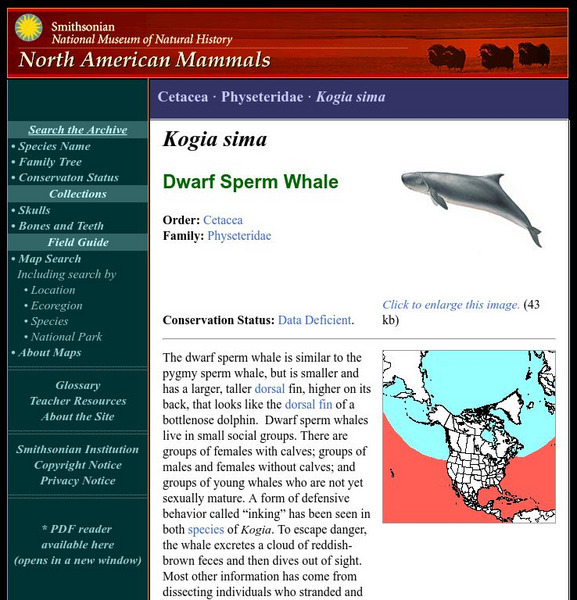
National Museum of Natural History: American Mammals: Dwarf Sperm Whale
The dwarf sperm whale is similar to the pygmy sperm whale, but is smaller and has a larger, taller dorsal fin, higher on its back, that looks like the dorsal fin of a bottlenose dolphin. Dwarf sperm whales live in small social groups....
Smithsonian Institution
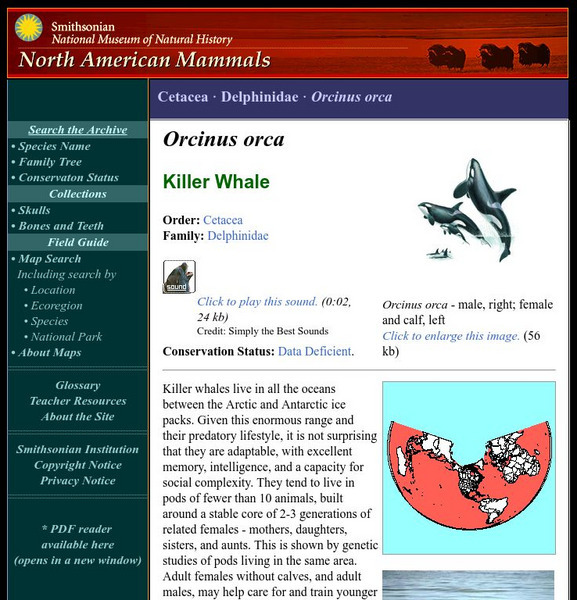
National Museum of Natural History: American Mammals: Killer Whale
Killer whales live in all the oceans between the Arctic and Antarctic ice packs. Given this enormous range and their predatory lifestyle, it is not surprising that they are adaptable, with an excellent memory, intelligence, and a...
Smithsonian Institution
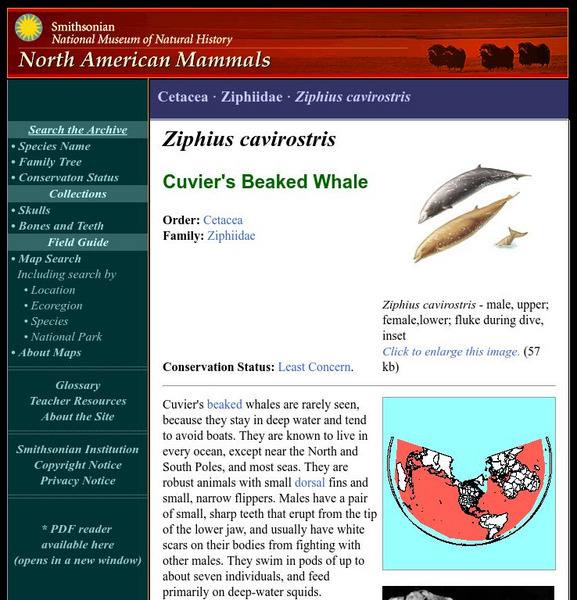
National Museum of Natural History: American Mammals: Cuvier's Beaked Whale
Cuvier's beaked whales are rarely seen because they stay in deep water and tend to avoid boats. They are known to live in every ocean, except near the North and South Poles, and most seas. Learn more about the Ziphius cavirostris, more...
Other popular searches
- Create a Living Museum
- Creating a Living Museum
- Historical Living Museum
- Social Studies Living Museum
- Historic Living Museum
- World History Living Museum
- Living Museum Us History