Hi, what do you want to do?





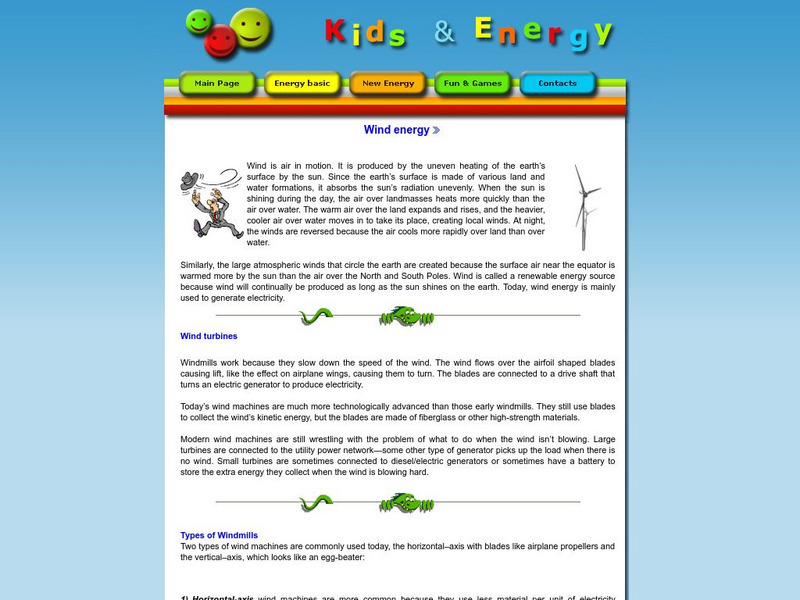
Energy for Sustainable Development
Kinds and Energy: Wind Energy
Wind is air in motion. It is produced by the uneven heating of the earth's surface by the sun. Since the earth's surface is made of various land and water formations, it absorbs the sun's radiation unevenly. When the sun is shining...
Ducksters
Ducksters: Earth Science for Kids: Weather: Wind
Kids learn about wind including how it is formed, how it is measured, local and global winds including prevailing, westerlies, trade, and polar easterlies.

American Museum of Natural History
American Museum of Natural History: Make Your Own Weather Station
Students can plan and carry out investigations of local weather patterns by building their own weather stations to collect observations of various weather conditions: rainfall, wind direction, and air pressure.
NOAA
Noaa: Weather Systems and Patterns
Imagine our weather if Earth were completely motionless, had a flat dry landscape and an un-tilted axis. This, of course, is not the case; if it were, the weather would be much different. The local weather that impacts our daily lives...
Other
Rutgers Marine & Coastal Sciences: Cool Classroom
Students and teachers can explore the work of marine scientists and observe the ocean from their computers. Learn about Rutgers Coastal Ocean Observation Laboratory, discover why oceanography is important, and see what life is like in...
Other
Triple Peak Lodging, Big Piney, Wyoming
Discover local history of the Green River Valley and Wyoming Range by scrolling through this site. Butch Cassidy, Chief Washakie, and others famous to the area are featured.
TeachEngineering
Teach Engineering: Rolling Blackouts & Environmental Impact
The goal is for the students to understand the environmental design considerations required when generating electricity. The electric power that we use every day at home and work is generated by a variety of power plants. Power plants...

Alabama Learning Exchange
Alex: Compass Skills Scavenger Hunt
During this lesson students take a reading with a compass and use the compass to reach multiple checkpoints. Students also demonstrate their knowledge by locating specific coordinates that spell out a phrase.