Hi, what do you want to do?






Curated OER
Anatomy of a Bone - Coloring
Clarify and color code the anatomy of a bone with this resource. This worksheet lists 7 parts of a bone along with a definition for each part. Learners read through this information and color in each part of the bone a listed color. They...

American Museum of Natural History
Anatomy Adventure
Sometimes science is puzzling. Using an online animation, individuals manipulate skeletal bones of an ancient species to recreate its skeleton. Learners complete the skeletal puzzle and learn about the process of paleontology in person...

Curated OER
Invertebrate Diversity
Comparative anatomy prevails in the lesson exploring diversity among invertebrates. Biologists examine physical characteristics of an earthworm from phylum annelida and a meal worm from phylum insecta. They also inspect a cricket and a...

Curated OER
Learning the Bones and Muscles of the Head and Face
Students learn about the human body. In this science lesson plan, students discover the bones of the head and face as they explore their own cranium.

Curated OER
Dinosaur Skeletons
Students investigate the anatomy of a dinosaur, describe its skeleton, and arrange pretend bones using toothpicks, popsicle sticks, tongue depressors, and a variety of wooden beads.

Curated OER
Your Amazing Body
Students are introduced to the anatomy of the human body. Using the different systems of the body, they look at how different artists made a picture out of paper. Individually, they make a cut out of various internal organs or bones. ...

Curated OER
Insects
Second graders brainstorm and identify several types of common insects. They play bug bingo, building bugs and an insect tree, observing real insects in the classroom and examining some of the things insects make.

Curated OER
Mathematics In You
Pupils construct ratios using the hand as data. They use examples of cortical and trabecular bone found in the long bones to measure circumference, diameter, length, and weight of long bones. They perform computations using growth chart...

Curated OER
Whose Skeleton is in Your Closet?
Students analyze and measure parts of a model skeleton to determine sex, race, height and age. They produce a lab report from their inquiries.

Curated OER
The Envelope Please
Students examine and research the importance and functions of the skeletal system in vertebrates. They construct a 10-foot geodesic dome to illustrate the importance of architectural frameworks and create a clay animation movie.

Curated OER
Science: Birds in Flight
Students identify and examine adaptations in birds that enable them to fly. They conduct Internet research to relate these adaptations to the physics of flight. Students observe birds in flight and describe their behavior and flight...

Biology Junction
Birds
Birds adapted to almost every climate on the planet, from the Arctic to the rain forests. A presentation focused on birds covers their similarities and differences. It starts with their evolution from reptiles, their many physical...

American Museum of Natural History
Dress up a T. Rex
Scholars play with an image's color and brightness to predict how tyrannosaurus rex's skin, feathers, and eyes would have appeared. Information and real-world pictures shed light on what evidence guides our assumption of how a...

Curated OER
Dinosaur Detectives
Learners write a report about a paleontologist. In this paleontology lesson, students research and write a report about a noted paleontologist. They discuss the importance of technology to paleontologists and how paleontologist excavate...

Curated OER
Human Body Quiz
In this human body worksheet, students complete short answer questions about the organs in the body and their functions. Students complete 20 questions.

OpenStax
Open Stax: Bone Structure
In this site we examine bone structure. Examine bone cells, markings, tissues and various types of bones.
OpenStax
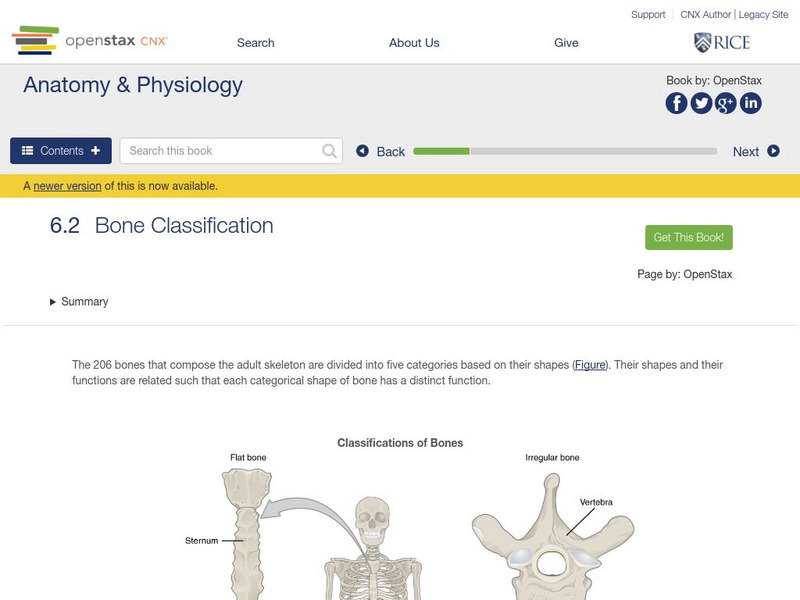
Open Stax: Bone Classification
This site helps you understand how the 206 bones that compose the adult skeleton are divided into five categories based on their shapes.