Hi, what do you want to do?





MadSci Network
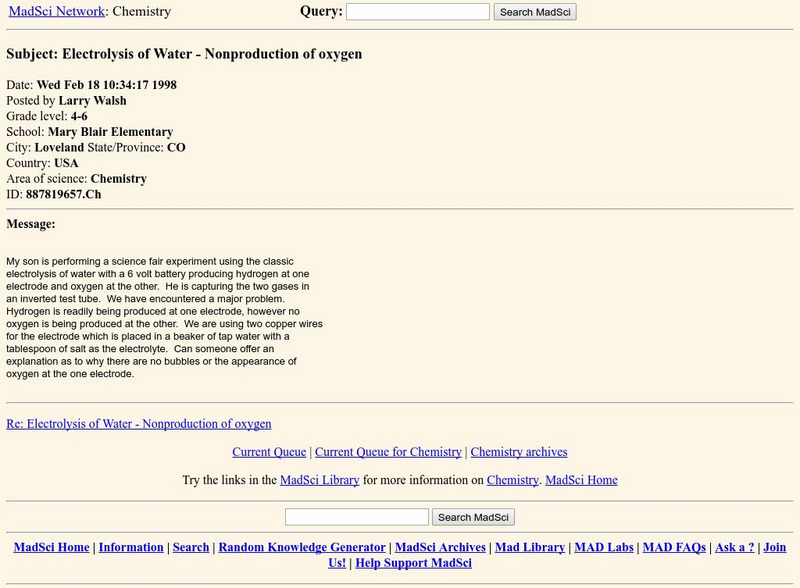
Mad Scientist Network: Nonproduction of Oxygen
From the Mad Scientist Network, this page (and its accompanying answer page) use a question and answer format to help explain the results of an electrolysis of water experiment. Helpful tips for performing such an experiment are given.

Curated OER
Web Gallery of Art: The Cure of Folly (Extraction of the Stone of Madness)
An image of "The Cure of Folly (Extraction of the Stone of Madness)", created by Hieronymus Bosch from 1475-80 (Oil on panel, 48 x 35 cm).
Curated OER
Web Gallery of Art: Portrait of Joan the Mad
An image of "Portrait of Joan the Mad", created by Juan De Flandes from 1496-1500 (Oil on wood, 36 x 26 cm).
Curated OER
Web Gallery of Art: Hairy Harry, Mad Peter and Tiny Amon
An image of "Hairy Harry, Mad Peter and Tiny Amon", created by Agostino Carracci from 1598-1600 (Oil on canvas, 101 x 133 cm).
Curated OER
Web Gallery of Art: Dulle Griet (Mad Meg)
An image of "Dulle Griet (Mad Meg)", created by David the Younger Teniers during the 1640's (Oil on oak panel, 48 x 69 cm).
Curated OER
Web Gallery of Art: Dulle Griet (Mad Meg)
An image of "Dulle Griet (Mad Meg)", created by Pieter the Elder Bruegel, c. 1562 (Oil on wood, 117,4 x 162 cm).
Curated OER
Web Gallery of Art: A Mad Woman
An image of "A Mad Woman", created by Eugene Delacroix, c. 1822 (Oil on canvas, 41 x 33 cm).
MadSci Network
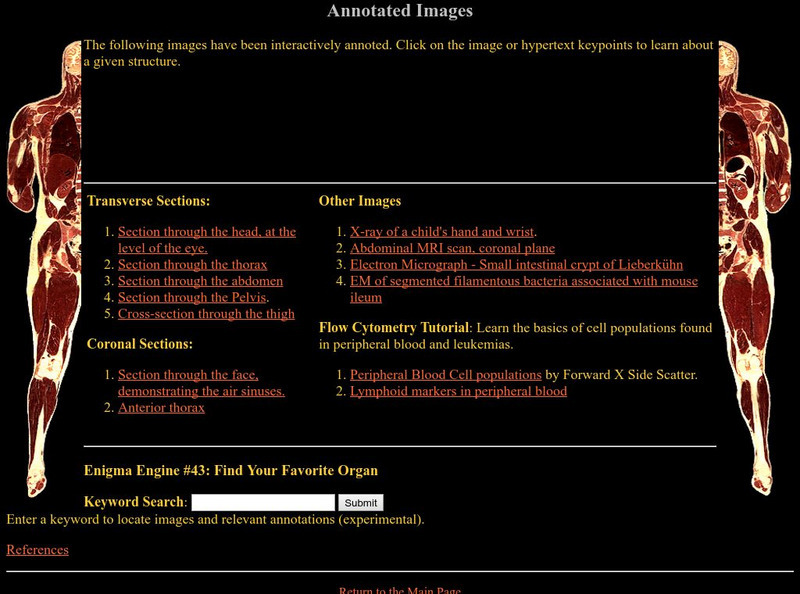
Mad Sci Network: Visible Human: Annotated References
A collection of transverse and coronal views of the internal anatomy of the human body. The webpage also has a keyword search for specific organs.
MadSci Network
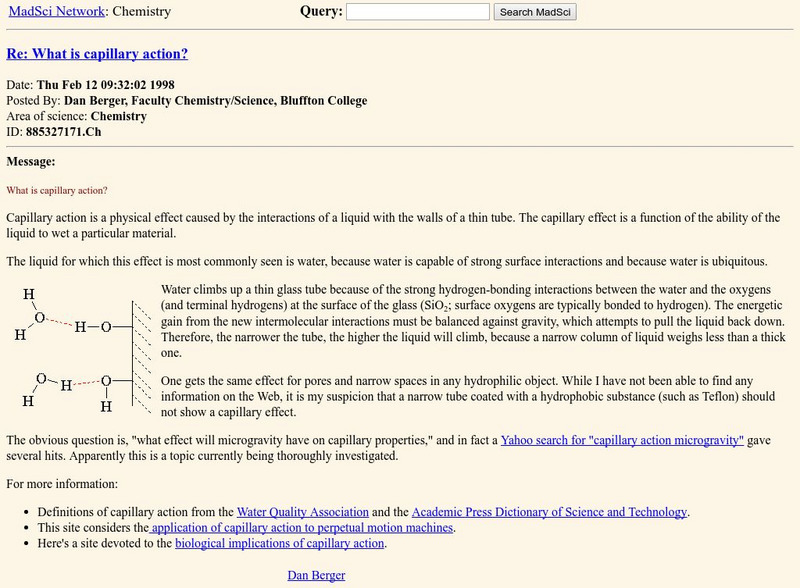
The Mad Scientist Network: Chemistry/cappillary Action
Capillary action is described. Examples are illustrated. Links to related topics.

MadSci Network
Mad Scientist Network: How Can a Gyroscope Defy Gravity
Explanation of the seemingly gravity-defying feats of a gyroscope. Focuses on the reason behind its operation. Includes illustrations.

Quia
Quia: Homonym Madness
This Quia Pop-Up game is a proofreading exercise in which students see a part of a friendly letter and are asked to select the correct form and punctuation for it using the drop-down menu.
NASA
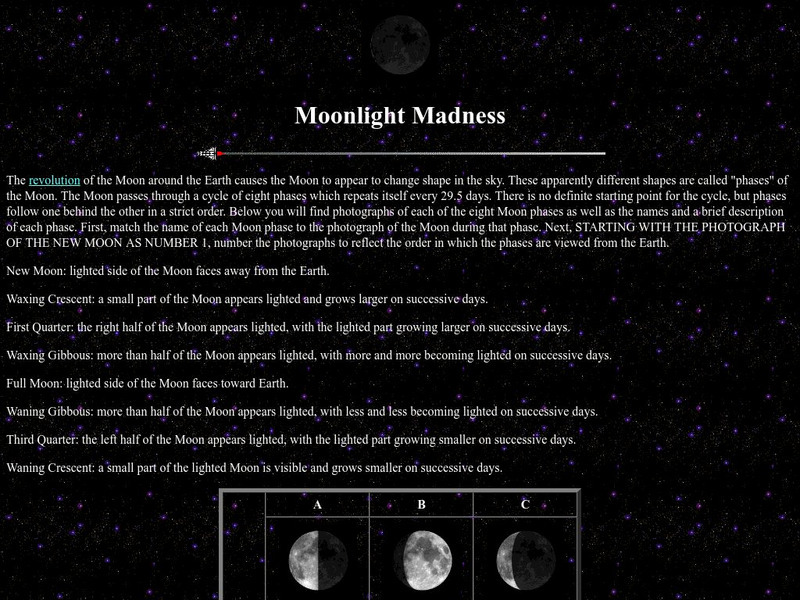
Nasa Star Child: Moonlight Madness
The revolution of the Moon around the Earth causes the Moon to appear to change shape in the sky. These apparently different shapes are called "phases" of the Moon. The Moon passes through a cycle of eight phases which repeats itself...

Alabama Learning Exchange
Alex: Movie Madness
This language arts projects motivates students through being a movie-based project. This instructional activity will have a duration of five days. The students will view a movie of their choice and analyze the movie to complete a chart...
MadSci Network
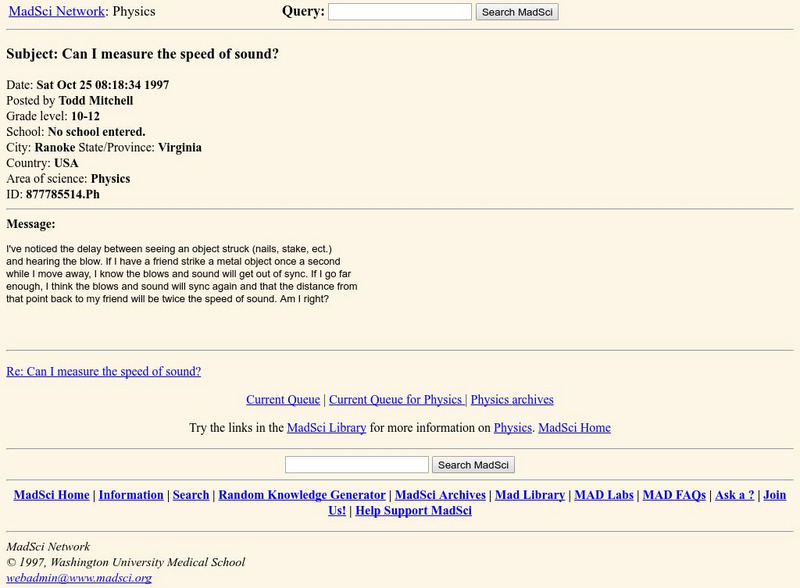
Mad Sci Network: Measuring the Speed of Sound
Can you measure the speed of sound? Find out for yourself using this site's question and answer format.
Universal Teacher
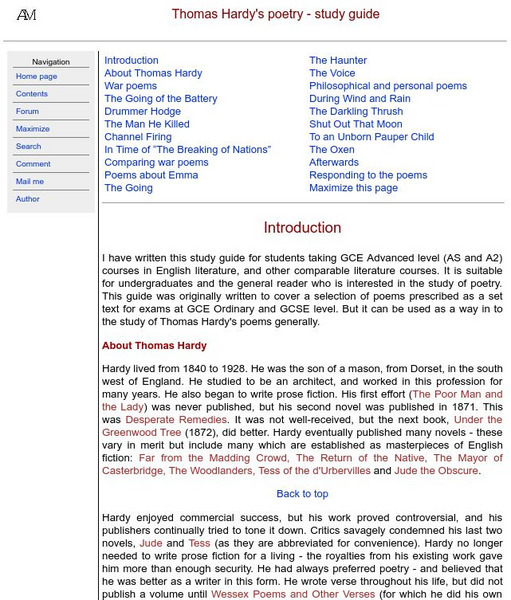
Moore's Teacher Resources: Thomas Hardy's Poetry
This study guide for advanced students explores the poetry of the English novelist Thomas Hardy (Far from the Madding Crowd, Tess of the d'Urbervilles, Jude the Obscure).
PBS
Pbs Learning Media: Daniel Tiger's Neighborhood: Spin and Sing
It's so much fun to sing along with Daniel Tiger! In this online experience, spin a wheel of eight songs to sing along with Daniel and reinforce concepts such as counting to four when mad and being a helper at home.
MadSci Network
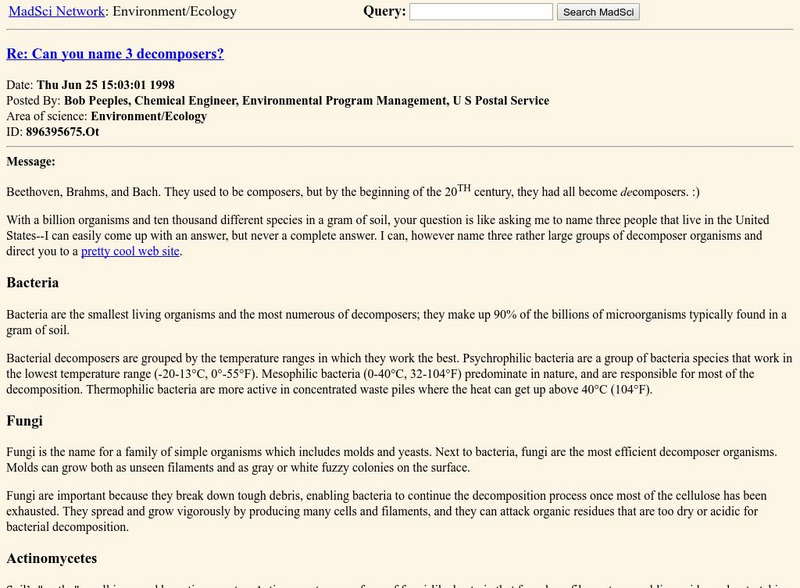
Mad Sci Network: Three Decomposers
The MadSci Network answers the posted question by describing three large groups of decomposers: bacteria, fungi and actinomycetes.
MadSci Network
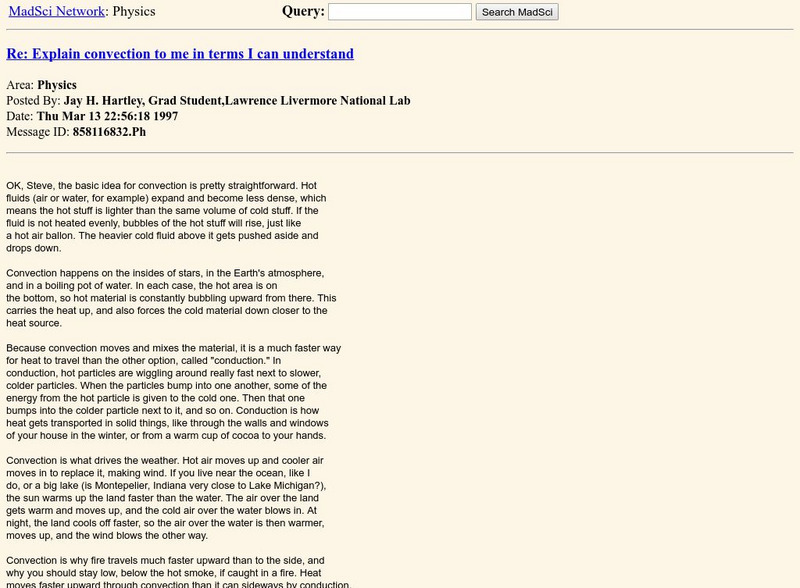
The Mad Scientist Network: Physics
A page from the question and answer section of this useful site. The page responds to the user question: "Explain convection to me in terms I can understand." An excellent discussion of the method of convection.
MadSci Network
The Mad Scientist Network: Chemistry
Using a question and answer format, this page addresses the question: "What effect may crystallization have on the optical properties of a material?" Crystalline and amorphous solids are compared and contrasted; their properties are...
MadSci Network
The Mad Scientist Network: Chemistry
The question: "What would the triple point of water truly look like?" is discussed and explained. The phases of matter are described.
MadSci Network
The Mad Scientist Network: Chemistry
The question "What is process called when gases go back to solids?" is discussed in detail. A comparison of the processes of sublimation, deposition and condensation is made.
MadSci Network
The Mad Scientist Network/is 0 K Absolute Zero?
Using a question and answer format, this page explains what is meant by the term "absolute zero." The basis for the Kelvin temperature scale is described. And the relationship between heat or energy and temperature is discussed.
MadSci Network
Mad Scientist Network: Building a Wimshurst Machine
Using a question and answer format, this page is a response to a question on how to build and use a Wimshurst machine. Directions and suggestions for building such a device are given. The principle of electrostatic induction which...

MadSci Network
The Mad Scientist Network: About Nuclear Fusion
Using a question and answer format, this page introduces and explains the idea of nuclear fusion. The hydrogen bomb and its operation is discussed. Other applications of nuclear fusion are described. Short but clear.