Hi, what do you want to do?





Science Education Resource Center at Carleton College
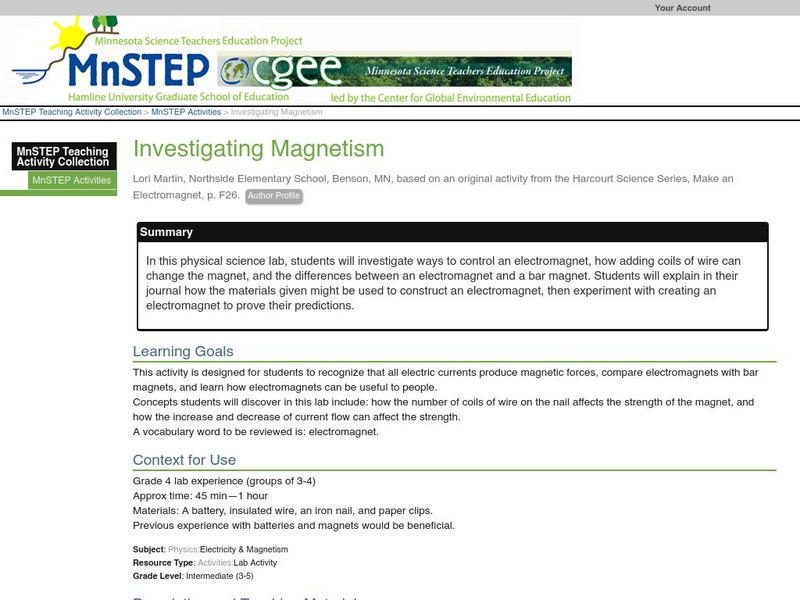
Serc: Investigating Magnetism
In this physical science lab, students will investigate ways to control an electromagnet, how adding coils of wire can change the magnet, and the differences between an electromagnet and a bar magnet. Students will explain in their...
University of Oregon
Magnet Lab: University of Oregon Virtual Laboratory
The collection of interactive physics applets offered by the University of Oregon is an excellent resource for students. The applets are grouped in broad subject areas including astrophysics, energy and environment, mechanics and...
PBS
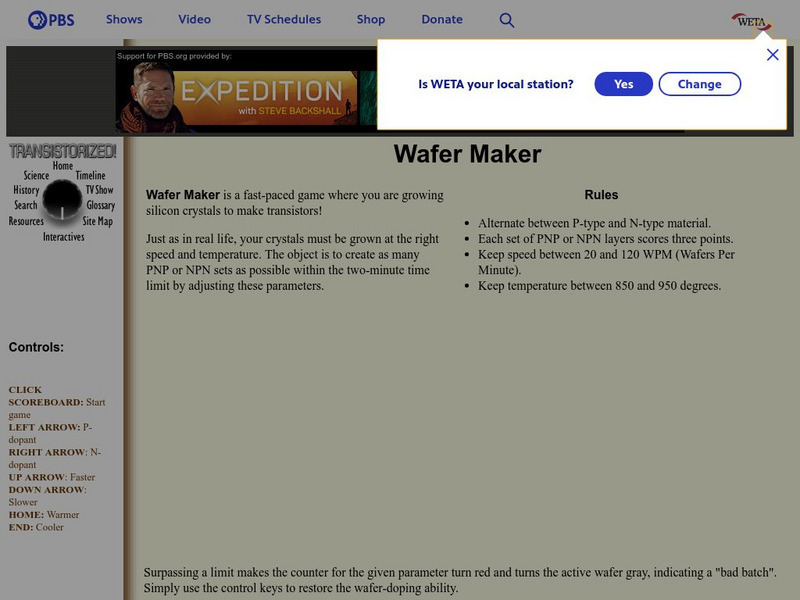
Magnet Lab: Wafer Maker
Included on a PBS site about transistors, Wafer Maker is an interactive Java applet designed as an educational game. Using the arrow keys as controls, players can attempt to grow layers of crystals at the proper speed and temperature and...
National High Magnetic Field Laboratory
Magnet Academy: Maglev Trains
Prof. Eric Hellstrom of the lab's Applied Superconductivity Center uses a toy train to demonstrate magnetic levitation, the Meissner Effect and magnetic flux trapping. [6:30]
National High Magnetic Field Laboratory
Magnet Academy: Edward Purcell
Edward Mills Purcell was an American physicist who received half of the 1952 Nobel Prize for Physics for his development of a new method of ascertaining the magnetic properties of atomic nuclei. Known as nuclear magnetic resonance...
National High Magnetic Field Laboratory
Magnet Academy: Magnetic Shunt
Magnetic shunts are often used to adjust the amount of flux in the magnetic circuits found in most electrical motors. (Java tutorial)
National High Magnetic Field Laboratory
Magnet Academy: Timeline of Electricity and Magnetism: 600 Bc 1599
Find out how humans discovered the magnetic lodestone as well as the attracting properties of amber. Advanced societies, in particular the Chinese and the Europeans, exploited the properties of magnets in compasses, a tool that makes...
National High Magnetic Field Laboratory
Magnet Academy: Deionization
The magnets here at the lab can generate massive amounts of heat. To cool them off, we need massive amounts of water. But first, we have to take the ions out.
National High Magnetic Field Laboratory
Magnet Academy: Timeline of Electricity and Magnetism: 1775 1799
Scientists take important steps toward a fuller understanding of electricity, as well as some fruitful missteps, including an elaborate but incorrect theory on animal magnetism that sets the stage for a groundbreaking invention.
National High Magnetic Field Laboratory
Magnet Academy: Magnetic Core Memory 1949
At the dawn of the computer age, magnetic core memory helped make data storage possible, and showed surprising staying power in a field where components are constantly being replaced by new and improved products.
National High Magnetic Field Laboratory
Magnet Academy: Timeline of Electricity and Magnetism: 1830 1839
The first telegraphs are constructed and Michael Faraday produces much of his brilliant and enduring research into electricity and magnetism, inventing the first primitive transformer and generator.
National High Magnetic Field Laboratory
Magnet Academy: Timeline of Electricity and Magnetism: 1800 1819
Alessandro Volta invents the first primitive battery, discovering that electricity can be generated through chemical processes; scientists quickly seize on the new tool to invent electric lighting. Meanwhile, a profound insight into the...
National High Magnetic Field Laboratory
Magnet Academy: Timeline of Electricity and Magnetism: 1700 1749
Aided by tools such as static electricity machines and Leyden jars, scientists continue their experiments into the fundamentals of magnetism and electricity.
National High Magnetic Field Laboratory
Magnet Academy: Timeline of Electricity and Magnetism: 1600 1699
The Scientific Revolution takes hold, facilitating the groundbreaking work of luminaries such as William Gilbert, who took the first truly scientific approach to the study of magnetism and electricity and wrote extensively of his findings.
National High Magnetic Field Laboratory
Magnet Academy: Magnetic Core Memory
Magnetic core memory was developed in the late 1940s and 1950s, and remained the primary way in which early computers read, wrote and stored data until RAM came along in the 1970s. (Java tutorial)
National High Magnetic Field Laboratory
Magnet Academy: Hans Christian Orsted
A discovery by Hans Christian Orsted forever changed the way scientists think about electricity and magnetism. While preparing to perform an experiment during a lecture at the University of Copenhagen, he found that the magnetized needle...
National High Magnetic Field Laboratory
Magnet Academy: Isidor Isaac Rabi
Isidor Isaac Rabi won the Nobel Prize in Physics in 1944 for his development of a technique for measuring the magnetic characteristics of atomic nuclei. Rabi's technique was based on the resonance principle first described by Irish...
National High Magnetic Field Laboratory
Magnet Academy: Induced Current
A current can be induced in a conducting loop if it is exposed to a changing magnetic field. (Java tutorial)
National High Magnetic Field Laboratory
Magnet Academy: Maglev Trains 1984
The railroad industry began in the frontier days, magnetic levitation has moved it squarely into the space age.
National High Magnetic Field Laboratory
Magnet Academy: Anders Celsius
Anders Celsius is most familiar as the inventor of the temperature scale that bears his name. The Swedish astronomer, however, also is notable as the first person to make a connection between the radiant atmospheric phenomenon known as...
National High Magnetic Field Laboratory
Magnet Academy: Lodestone 600 Bc
The history of electricity and magnetism starts with this special mineral possessing amazing, and still mysterious, properties.
National High Magnetic Field Laboratory
Magnet Academy: Oersted Satellite, 1999
Named in honor of Danish physicist Hans Christian Oersted, Denmark's first satellite has been observing and mapping the magnetic field of the Earth.

National High Magnetic Field Laboratory
Magnet Academy: Schweigger Multiplier 1820
Spurred by Hans Christian Orsted's discovery of a relationship between electricity and magnetism, German chemist Julian Schweigger immediately began tinkering and soon came up with a very early galvanometer known as the Schweigger...
National High Magnetic Field Laboratory
Magnet Academy: Peter Debye
Peter Debye carried out pioneering studies of molecular dipole moments, formulated theories of magnetic cooling and of electrolytic dissociation, and developed an X-ray diffraction technique for use with powdered, rather than...