Hi, what do you want to do?





Thomas Jefferson National Accelerator Facility
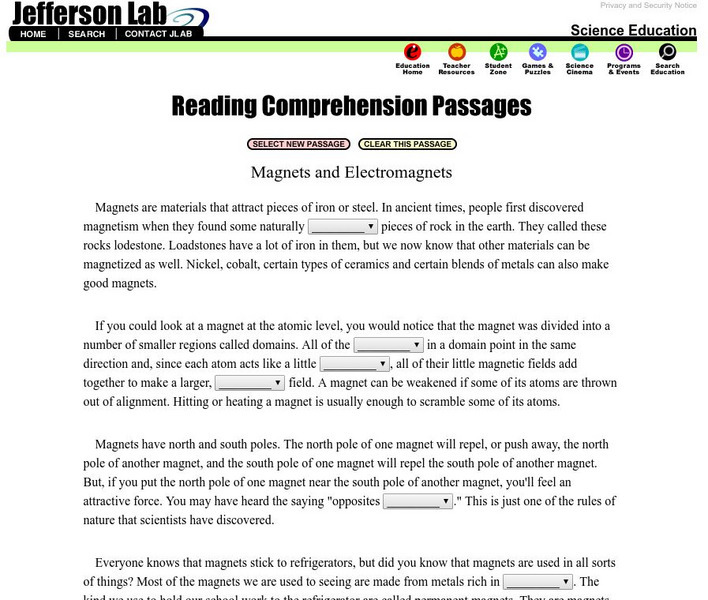
Jefferson Lab: Reading Passages: Magnets and Electromagnets
Read and fill in the blanks of this passage explaining atomic history. Each blank has a dropdown menu with choices. When you finish, click CHECK MY ANSWERS. If you pick a wrong answer, the right answer will be displayed along with your...

Khan Academy
Khan Academy: Experiment: What's the Shape of a Magnetic Field?
See drawing from Hans Christian Orsted's lab notebook showing an experiment in which an electric charge passing through a wire seemed to create a magnetic field!
Other
Solar and Astrophysics Lab: Trace Analysis Guide
This site provides a detailed overview of the TRACE (Transition Region and Coronal Explorer) satellite mission, data received, details about the instrumentation, and how to interpret the data.
National High Magnetic Field Laboratory
Magnet Academy: Arc Lamp 1876
Fire lighted the night for many centuries. Then came Sir Humphry Davy and the birth of the arc lamp, an invention built upon in the years that followed by many.
National High Magnetic Field Laboratory
Magnet Academy: Duchenne Machine 1850
French physician Guillaume Benjamin Amand Duchenne invented a device that electrically stimulates muscles. The apparatus gave him new insight into neuromuscular disorders, earned him the epitaph of "father of electrotherapeutics," and...
National High Magnetic Field Laboratory
Magnet Academy: Davenport Motor 1834
Odd though it seems today, when Thomas Davenport was selling one of the first electric motors way back in the 1830s, nobody was buying.
National High Magnetic Field Laboratory
Magnet Academy: Cyclotron 1931
A cyclotron is a machine that allows scientists to shoot particle beams at other particle beams. The result of doing this is a spectacular smash up - but that's not why scientists do it.
National High Magnetic Field Laboratory
Magnet Academy: Coaxial Cable 1929
As more and more American households acquired telephones, the pressure was on to create a better cable to accommodate the increasing demand. Engineers Lloyd Espenschied and Herman Affel answered the call.
National High Magnetic Field Laboratory
Magnet Academy: Audion 1906
Two years after Englishman John Ambrose Fleming invented a two-electrode vacuum tube, American inventor Lee De Forest one-upped him by developing a tube with three electrodes.
National High Magnetic Field Laboratory
Magnet Academy: Gauss Weber Telegraph 1833
Several years before the telegraph created by American inventor Samuel Morse revolutionized communications, two German scientists built their own functional telegraph.
National High Magnetic Field Laboratory
Magnet Academy: Faraday Motor 1821
Few inventions have shaped technology as much as the electric motor, but the very first version - the Faraday motor - didn't look anything like the modern motor.
National High Magnetic Field Laboratory
Magnet Academy: Gramme Dynamo 1871
Zenobe Theophile Gramme (1826 - 1901) invented the first industrial generator, or dynamo. A deceptively simple-looking machine, it consisted of 30 coils wrapped around a spinning ring of iron.
National High Magnetic Field Laboratory
Magnet Academy: Bell Telephone 1876
Acoustics, variable resistance and allegations of foul play contribute to the exciting story of the invention of the telephone.
National High Magnetic Field Laboratory
Magnet Academy: Electrostatic Repulsion in Van De Graaff Bubbles
A fun look at how Van de Graaff generators illustrate electrostatic forces. (Java tutorial)
National High Magnetic Field Laboratory
Magnet Academy: Heat Resistance
Heating a metal conductor makes it more difficult for electricity to flow through it. See why in this tutorial. (Java tutorial)
National High Magnetic Field Laboratory
Magnet Academy: Mass Spectra
The mass spectrum of a material, deduced using a machine called a mass spectrometer, reveals how many isotopes of a given element are to be found in the material. See here what these spectra look like and how they are useful. (Java...
National High Magnetic Field Laboratory
Magnet Academy: Bubble Chamber 1952
To understand a bubble chamber, picture the long, white streak an airplane leaves in its wake. That's water vapor produced by condensation from the plane's hot exhaust. Until the water particles evaporate, you can follow the streak to...
National High Magnetic Field Laboratory
Magnet Academy: Mag Lab: Image Furnace
Scientists use image furnaces to grow crystals at very high temperatures. A built-in camera allows them to observe in action a delicate process that is equal parts art and science.
Math Science Nucleus
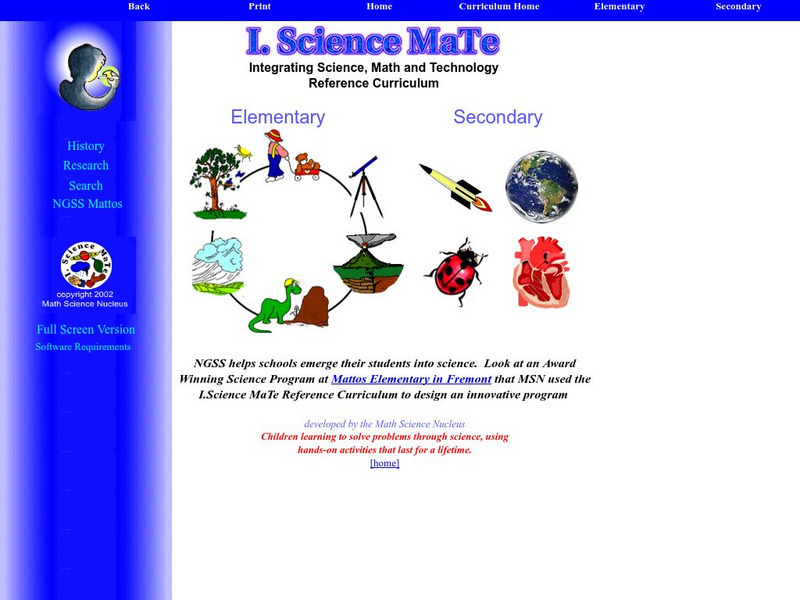
I. Science Ma Te: Integrating Science, Math and Technology
This site offers a wealth of online textbook-related materials that encourage the discovery of science in the world around us. Enter the site to access material on specific topics. Each section contains reading material (complete with...

Smithsonian Institution
Lemelson Center: Spark!lab: Build a Speaker
Learn how to build your very own speaker with items usually found around the house. Follow step-by-step instructions and discover how to use your speaker to listen to the radio.
Science and Mathematics Initiative for Learning Enhancement (SMILE)
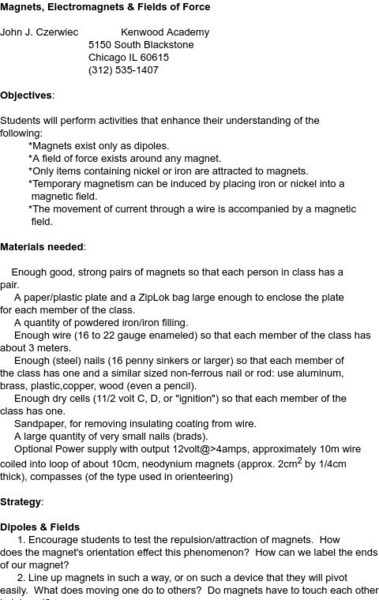
Smile: Magnets, Electromagnets & Fields of Force
A teacher lesson plan which includes several student activities on magnetism, force fields, and magnetic induction. May provide an idea for a student project or lab investigation.
Science and Mathematics Initiative for Learning Enhancement (SMILE)
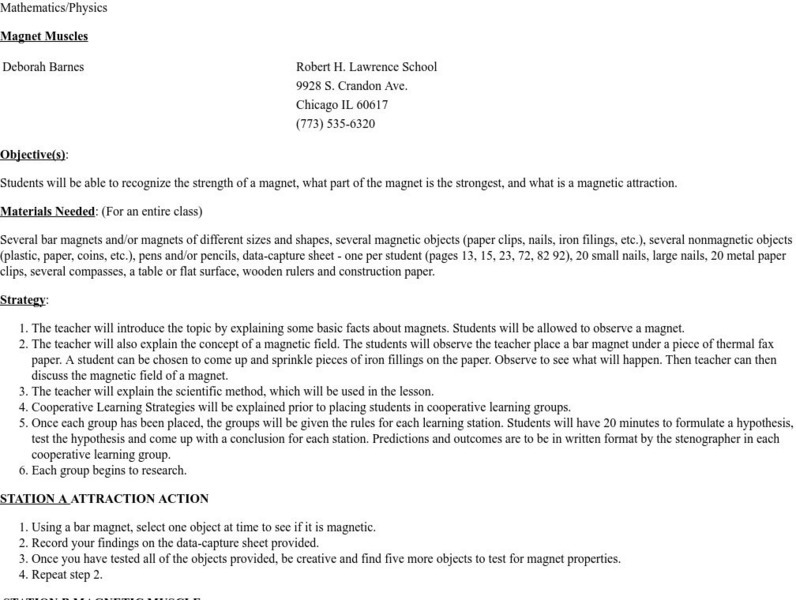
Smile: Magnet Muscles (Lesson Plan)
A teacher lesson plan which includes a station lab; students navigate through four stations with separate activities on magnetic principles. Easily adaptable as a student project.
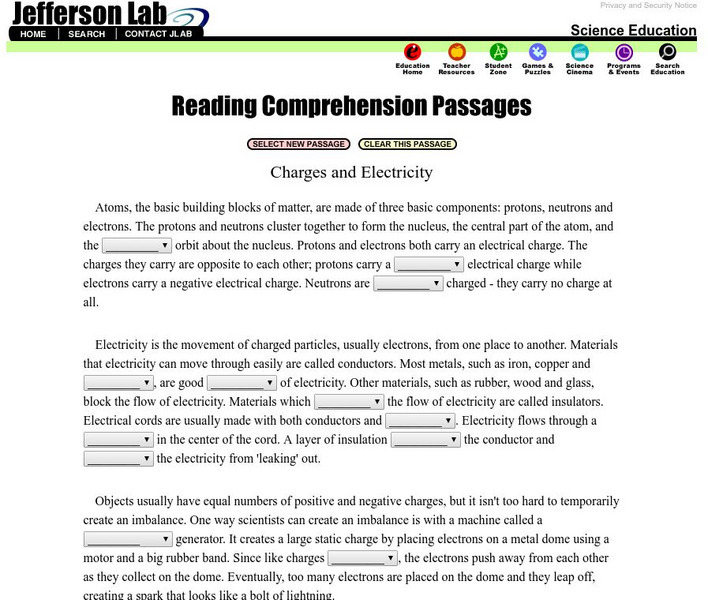
Thomas Jefferson National Accelerator Facility
Jefferson Lab: Reading Passages: Charges and Electricity
Read and fill in the blanks of this passage explaining charges and electricity. Each blank has a dropdown menu with choices. When you finish, click CHECK MY ANSWERS. If you pick a wrong answer, the right answer will be displayed along...
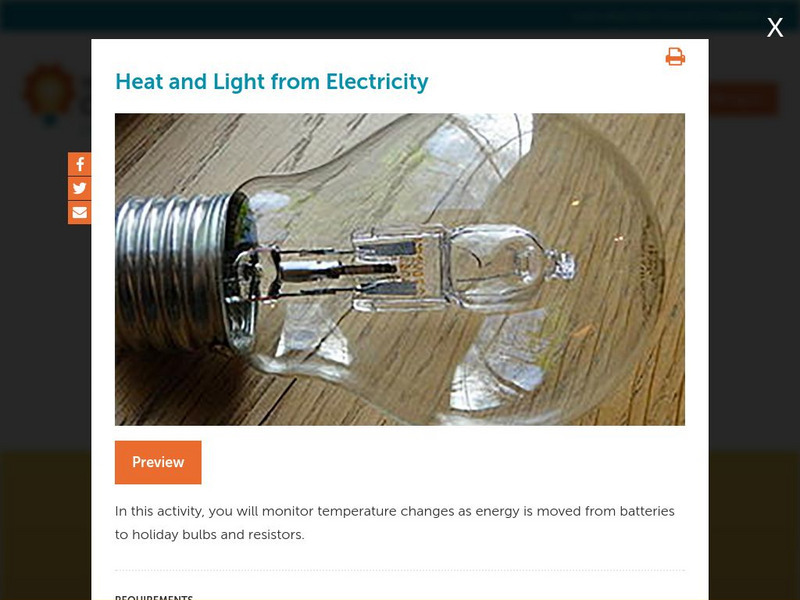
Concord Consortium
Concord Consortium: Stem Resources: Heat and Light From Electricity
Understand the energy transformations that happens when you light a bulb with a battery. Activity requires students to build a simple circuit and take temperature and time measurements. Lab includes procedure with questions that can be...