Hi, what do you want to do?






National High Magnetic Field Laboratory
Magnet Academy: Magnetic Domains
In ferromagnetic materials, smaller groups of atoms band together into areas called domains, in which all the electrons have the same magnetic orientation. That's why you can magnetize them. See how it works in this Java tutorial.

National High Magnetic Field Laboratory
Magnet Academy: Carl Friedrich Gauss
Although he is best known as one of the greatest mathematicians of all time, Carl Friedrich Gauss was also a pioneer in the study of magnetism and electricity. To facilitate an extensive survey of terrestrial magnetism, he invented an...

National High Magnetic Field Laboratory
Magnet Academy: Magnetic Field Around a Wire, Ii
A handful of iron filings helps visualize the invisible magnetic field that circulates around a wire with a current running through it. (Java tutorial)

National High Magnetic Field Laboratory
Magnet Academy: Magnetic Field Around a Wire, I
Whenever current travels through a conductor, a magnetic field is generated. (Java tutorial)

National High Magnetic Field Laboratory
Magnet Academy: Zeeman Effect 1896
Most of us have seen the rainbow-hued breakdown of the composition of light. Light is of course a form of energy. A magnetic field changes the behavior of light- a phenomenon known as the Zeeman effect.

National High Magnetic Field Laboratory
Magnet Academy: Wilhelm Weber
Find out more about German physicist Wilhelm Weber, who developed and enhanced a variety of devices for sensitively detecting and measuring magnetic fields and electrical currents.

National High Magnetic Field Laboratory
Magnet Academy: Compasses in Magnetic Fields
Experiment with the compass in this tutorial to see how it responds to magnetic fields.

National High Magnetic Field Laboratory
Magnet Academy: Diamagnetism and Paramagnetism
Think iron, nickel and other "ferromagnetic" substances are the only ones with magnetic properties? In fact, everything reacts to magnetic fields in some way.

National High Magnetic Field Laboratory
Magnet Academy: Hall Effect
When a magnetic field is applied perpendicular to the flow of current, the field causes resistance in the current. This is the Lorentz force at work, and can be observed well in the Hall effect. (Java tutorial)

National High Magnetic Field Laboratory
Magnet Academy: Lorentz Force
Learn about the Lorentz force with the help of this tutorial, in which a wire fashioned into a pendulum moves inside a magnetic field. (Java tutorial)

National High Magnetic Field Laboratory
Magnet Academy: Barkhausen Effect
The Barkhausen effect makes the concept of magnetic domains audible (if not exactly music to the ear).

National High Magnetic Field Laboratory
Magnet Academy: William Thomson, Lord Kelvin
William Thomson, known as Lord Kelvin, was one of the most eminent scientists of the nineteenth century and is best known today for inventing the international system of absolute temperature that bears his name. He made contributions to...

National High Magnetic Field Laboratory
Magnet Academy: Oersted's Compass
Recreate the discovery by Hans Christian Oersted about the relationship between electricity and magnetism in this very simple experiment.

Florida State University
Florida State University: Magnet Lab: Magnetic Thin Films
This gallery takes readers from the 1880s and the pioneering work of German physicist August Kundt, up to recent advances in technology, including interlayer exchange coupling (IEC) and giant magnetoresistance (GMR).
Florida State University
Florida State University: Magnet Lab: Metallic Superlattices
A look at superlattices (alternating layers of thin films deposited in an orderly manner), methods for forming them, and their applications.
Florida State University
Florida State University: Magnet Lab: Lanthanum Aluminate
An explanation of this unique ceramic, including why it is of such great interest to scientists. Researchers use lanthanum aluminate to grow thin films of superconducting materials (including buckyballs) and hope it can one day be used...
Florida State University
Florida State University: Magnet Lab: Faraday Cage
A faraday cage is an important tool for some scientists at the MagLab. But they don't work with it: they work inside it.
Florida State University
Florida State University: Magnet Lab: Dilution Refrigerators
Dilution fridges owe their cooling power to the incredible element helium. This animation illustrates how dil fridges exploit the element's properties to make things very, very cold.
Florida State University
Florida State University: Magnet Lab: Atmospheric Pressure Photoionization (Appi)
In the APPI technique, UV light photons are used to ionize sample molecules.
Florida State University
Florida State University: Magnet Lab: What Is a Bus Room?
The MagLab's bus tunnel has an aluminum track, but it doesn't carry passengers: it carries electricity, up to 56 megawatts of it.
Florida State University
Florida State University: Magnet Lab: Timeline of Electricity and Magnetism: 1750 1774
With his famous kite experiment and other forays into science, Benjamin Franklin advances knowledge of electricity, inspiring his English friend Joseph Priestley to do the same.
Florida State University
Florida State University: Magnet Lab: Organic Superconductors
Organic superconductors, though still new to science, are lighter and more potentially versatile than inorganic superconductors and may have important applications in the future.
University of Colorado
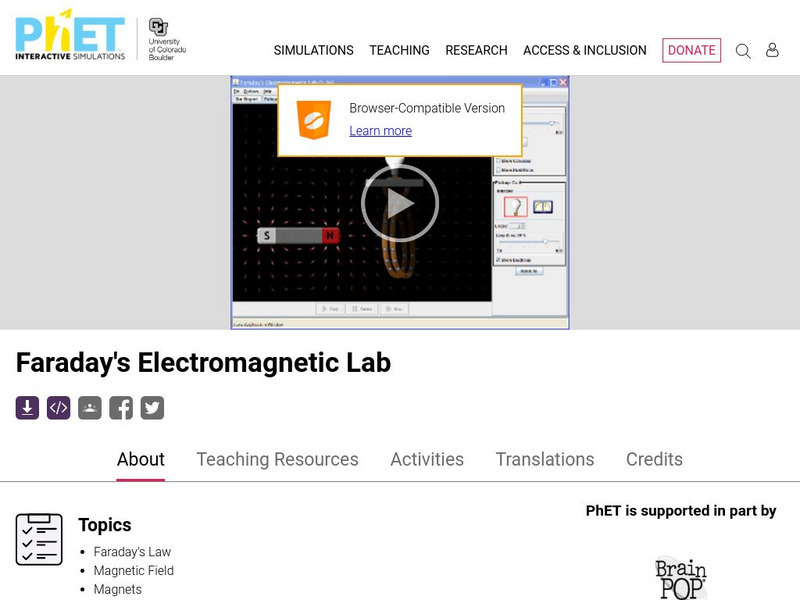
University of Colorado: Ph Et Interactive Simulations: Faraday's Electromagnetic Lab
This interactive lab in electromagnetics effectively illustrates how Faraday's law works.
Science Education Resource Center at Carleton College
Serc: Investigating With Magnets: Attraction and Repelling
In this fun lab activity, students will learn about the attraction and repulsion of magnets. Students will discover that like poles repel while unlike poles attract.