Hi, what do you want to do?





Science and Mathematics Initiative for Learning Enhancement (SMILE)
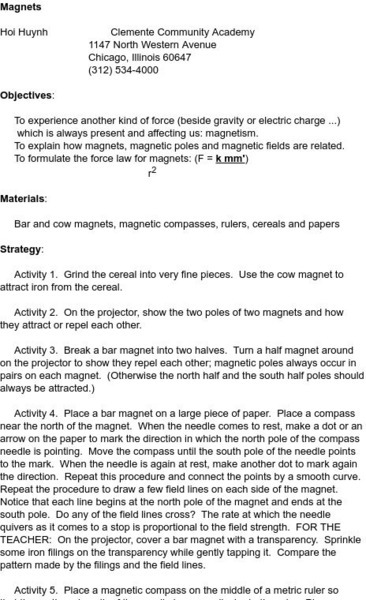
Smile: Magnets (Lesson Plan)
A teacher lesson plan which includes six hands-on activities regarding magnets. Students will be able to experience magnetism; explain how magnets, magnetic poles and magnetic fields are related; and formulate the force law for magnets.
Science and Mathematics Initiative for Learning Enhancement (SMILE)
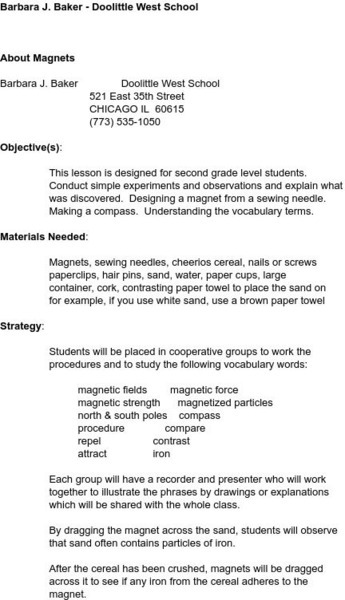
Smile: About Magnets (Lesson Plan)
This site provides a lesson plan which includes a hands-on activity about magnetism and magnetic fields. Parts of the plan would be easily adaptable as a student project (for any grade level).

Other
Stanford University: Probing What You Can't See
Students will investigate magnetic forces and poles using a refrigerator magnet.
University of New South Wales (Australia)
University of New South Wales: Einstein Light
Einstein Light highlights the Theory of Special Relativity and related topics. Learn how Galileo, Maxwell, and Einstein contributed to our knowledge of relativity, electricity, magnetism, and time by watching fun, interactive modules.
Science and Mathematics Initiative for Learning Enhancement (SMILE)
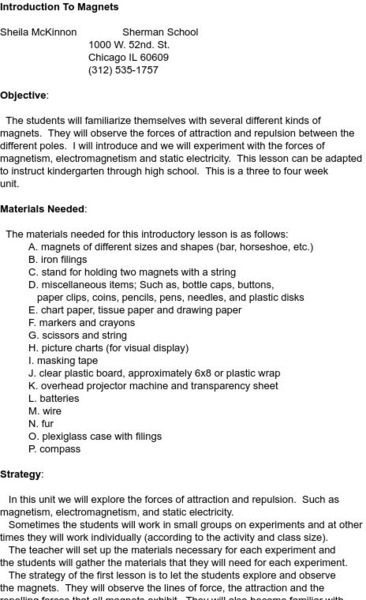
Smile: Introduction to Magnets (Classroom Unit)
A teacher unit which includes several hands-on activities about types of magnets, magnetism, and electrostatics. An activity designed to suit all grade levels. Many parts of the activity would be easily adaptable as a student project.
Other
Space Weather Center: Our Protective Shield
The Earth's magnetosphere helps shield us from cosmic and solar radiation. This segment offers a great explanation of this abstract concept along with numerous images and diagrams. An interactive game is provided as well.
NOAA
Noaa: Make Your Own Compass [Pdf]
Build a compass to help you figure out which direction is north or south.
Curated OER
Science Kids: Science Images: Aurora Borealis, Northern Lights
The aurora borealis (also known as the northern lights) is a spectacular light display that can be seen at night in regions near the North Pole (auroras can also be seen near the South Pole). Auroras occur because of charged particles...