Hi, what do you want to do?






Massachusetts Institute of Technology
Mit: Open Course Ware: Courses: Physics: Electricity and Magnetism
College-level physics course highlighting electromagnetism. This course also includes a wide variety of other physics topics including lightning, electrocardiograms, metal detectors, and atom smashers, to name a few. Course includes a...
Georgia Department of Education
Ga Virtual Learning: Magnetism and Electromagnetism
In this interactive learning module, students learn about the basic properties of magnetism. Practice problems are provided for ongoing assessment.
University of Guelph
Magnet Lab: Dc Circuits
This site describes and demonstrates a number of important concepts related to direct current circuits. Information on many of the featured topics, such as the use of Ohm's law and Kirchhoff's laws. Examples of featured topics include...
Massachusetts Institute of Technology
Mit: Open Course Ware: Electricity and Magnetism
The Massachusetts Institute of Technology offers a free and open educational resource for educators, students and self-learners. The university's physics OpenCourseWare includes a large section on electricity and magnetism. Numerous...
Georgia Department of Education
Ga Virtual Learning: Physical Science: Electricity and Magnetism
Students learn about static electricity using terms such as friction, induction, and conduction. They also explain and illustrate the difference between alternating and direct current, and understand the relationship among voltage,...
Other
Magnet Lab: The Basics of Nmr
The site is very easy to read and provides a thorough demystification of Nuclear Magnetic Resonance. Written by Dr. Joseph P. Hornak, a professor of Chemistry and Imaging Science at the Rochester Institute of Technology, the site breaks...
The Wonder of Science
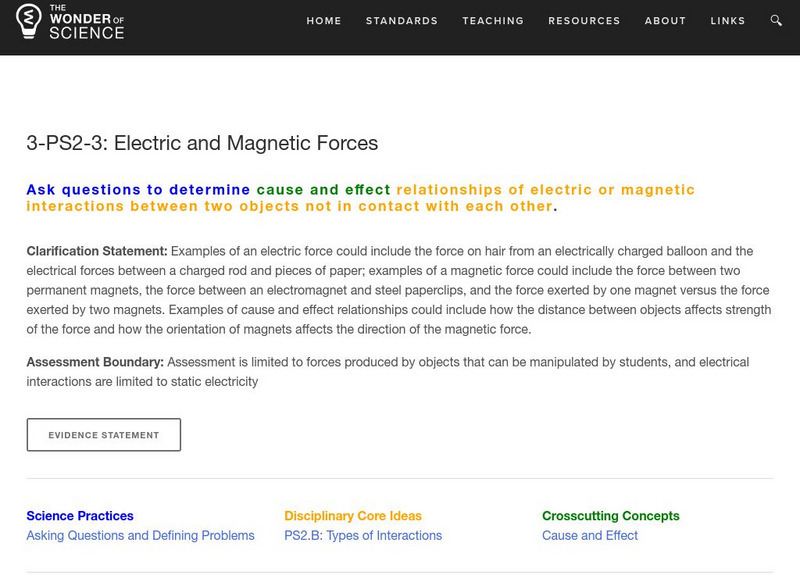
The Wonder of Science: 3 Ps2 3: Electric and Magnetic Forces
Learn about cause and effect relationships of electric or magnetic interactions between two objects not in contact with each other.
Other
Magnet Lab: Physics Lessons by Science Joy Wagon
These physics lessons and tutorials are designed to be a resource for learning introductory level, algebra-based physics. Organization is by topic, but a search option is available for quickly finding specific information. Although most...
TeachEngineering
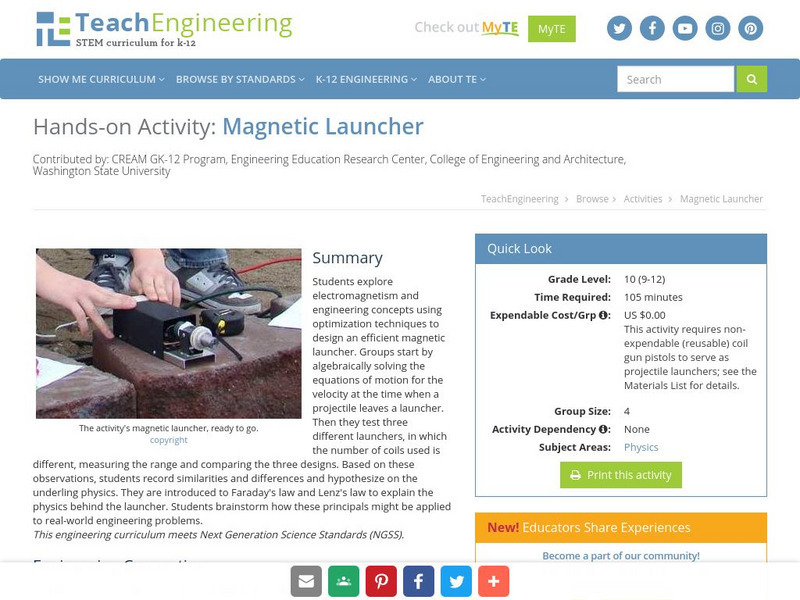
Teach Engineering: Magnetic Launcher
Students explore electromagnetism and engineering concepts using optimization techniques to design an efficient magnetic launcher. Groups start by algebraically solving the equations of motion for the velocity at the time when a...
Technovation
Curiosity Machine: Challenges: Build a Magnetic Nanoparticle Coating
Interested in nanoparticles? Use this challenge to design a coating for a magnet that will pick up different surfaces. Challenge includes tips, a lesson plan, and a place for students to document their engineering design process.
TeachEngineering
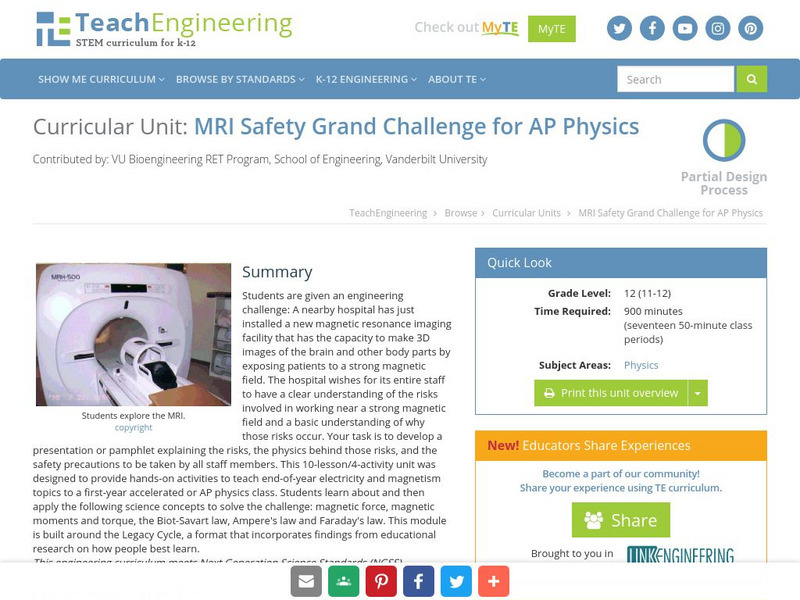
Teach Engineering: Mri Safety Grand Challenge
This module was written for a first year accelerated or AP physics class. It is intended to provide hands on activities to teach end of the year electricity and magnetism topics including the magnetic force, magnetic moments and torque,...
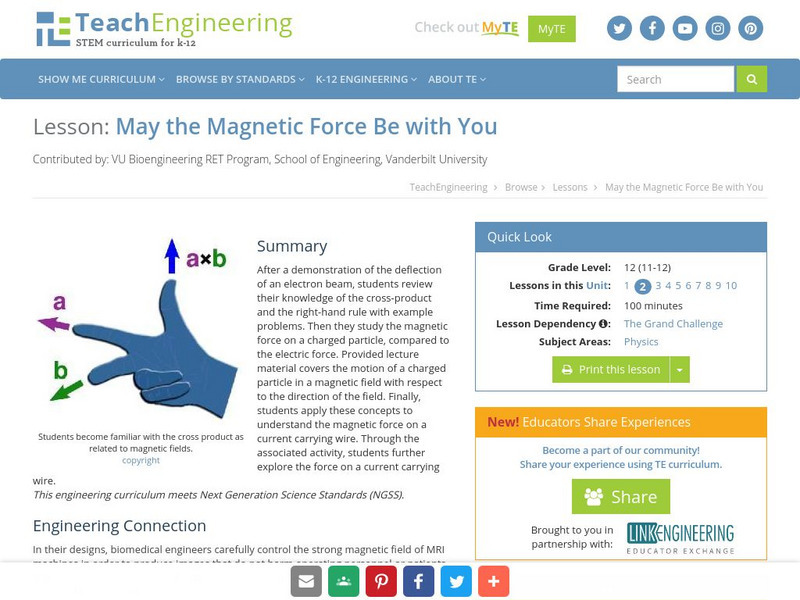
TeachEngineering
Teach Engineering: May the Magnetic Force Be With You
This lesson plan begins with a demonstration of the deflection of an electron beam. Students then review their knowledge of the cross product and the right hand rule with sample problems. After which, students study the magnetic force on...

Smithsonian Institution
Smithsonian: This Magnetic Map Shows Earth as You've Never Seen It Before
This article discusses a map generated by the European Space Agency's Swarm mission that depicts Earth's magnetic field using satellites to measure magnetism. The map reveals magnetic stripes and magnetic anomalies. The article includes...
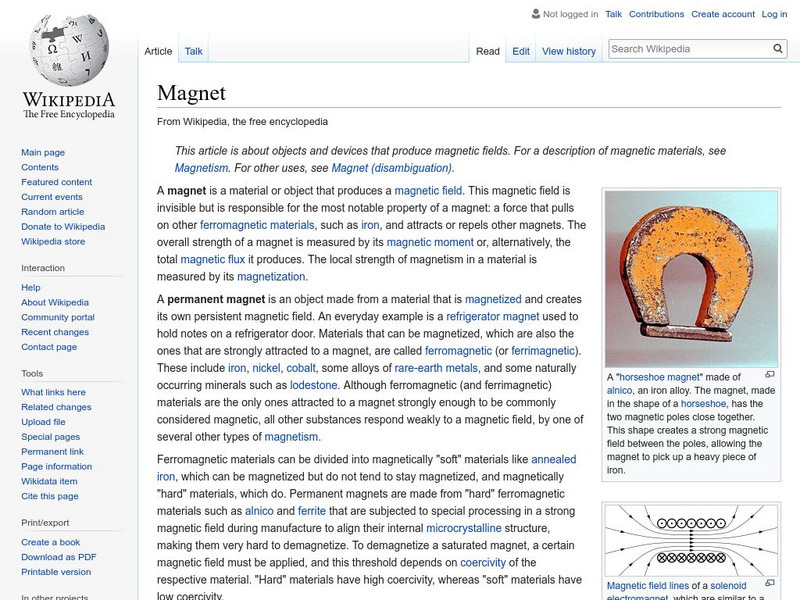
Wikimedia
Wikipedia: Magnet
Wikipedia.com provides an excellent introductory site on magnets. Including basic information describing different types of magnets and their characteristics.
National High Magnetic Field Laboratory
Magnet Academy: Edward Purcell
Edward Mills Purcell was an American physicist who received half of the 1952 Nobel Prize for Physics for his development of a new method of ascertaining the magnetic properties of atomic nuclei. Known as nuclear magnetic resonance...
National High Magnetic Field Laboratory
Magnet Academy: Magnetic Shunt
Magnetic shunts are often used to adjust the amount of flux in the magnetic circuits found in most electrical motors. (Java tutorial)
National High Magnetic Field Laboratory
Magnet Academy: Timeline of Electricity and Magnetism: 600 Bc 1599
Find out how humans discovered the magnetic lodestone as well as the attracting properties of amber. Advanced societies, in particular the Chinese and the Europeans, exploited the properties of magnets in compasses, a tool that makes...
Read Works
Read Works: Magnetism Magnets: Types and Uses
[Free Registration/Login Required] An informational text about magnets and their uses. A question sheet is available to help students build skills in reading comprehension.
National High Magnetic Field Laboratory
Magnet Academy: Timeline of Electricity and Magnetism: 1775 1799
Scientists take important steps toward a fuller understanding of electricity, as well as some fruitful missteps, including an elaborate but incorrect theory on animal magnetism that sets the stage for a groundbreaking invention.
National High Magnetic Field Laboratory
Magnet Academy: Magnetic Core Memory 1949
At the dawn of the computer age, magnetic core memory helped make data storage possible, and showed surprising staying power in a field where components are constantly being replaced by new and improved products.
National High Magnetic Field Laboratory
Magnet Academy: Timeline of Electricity and Magnetism: 1830 1839
The first telegraphs are constructed and Michael Faraday produces much of his brilliant and enduring research into electricity and magnetism, inventing the first primitive transformer and generator.
National High Magnetic Field Laboratory
Magnet Academy: Timeline of Electricity and Magnetism: 1800 1819
Alessandro Volta invents the first primitive battery, discovering that electricity can be generated through chemical processes; scientists quickly seize on the new tool to invent electric lighting. Meanwhile, a profound insight into the...
National High Magnetic Field Laboratory
Magnet Academy: Timeline of Electricity and Magnetism: 1700 1749
Aided by tools such as static electricity machines and Leyden jars, scientists continue their experiments into the fundamentals of magnetism and electricity.
National High Magnetic Field Laboratory
Magnet Academy: Timeline of Electricity and Magnetism: 1600 1699
The Scientific Revolution takes hold, facilitating the groundbreaking work of luminaries such as William Gilbert, who took the first truly scientific approach to the study of magnetism and electricity and wrote extensively of his findings.
Other popular searches
- Electricity and Magnetism
- Magnetism Worksheets
- Magnets and Magnetism
- Gravity and Magnetism
- Electricity Magnetism
- Magnetism and Poles
- Induced Magnetism
- Science, Magnetism
- Bill Nye Magnetism
- Science Magnetism
- Magnetism Lesson Plans
- Energy and Magnetism