Hi, what do you want to do?






Alabama Learning Exchange
Alex: How Do Magnets Work?
During this lesson students will examine magnets and determine that they have two poles (north and south). They will observe which poles attract and which poles repel.
TeachEngineering
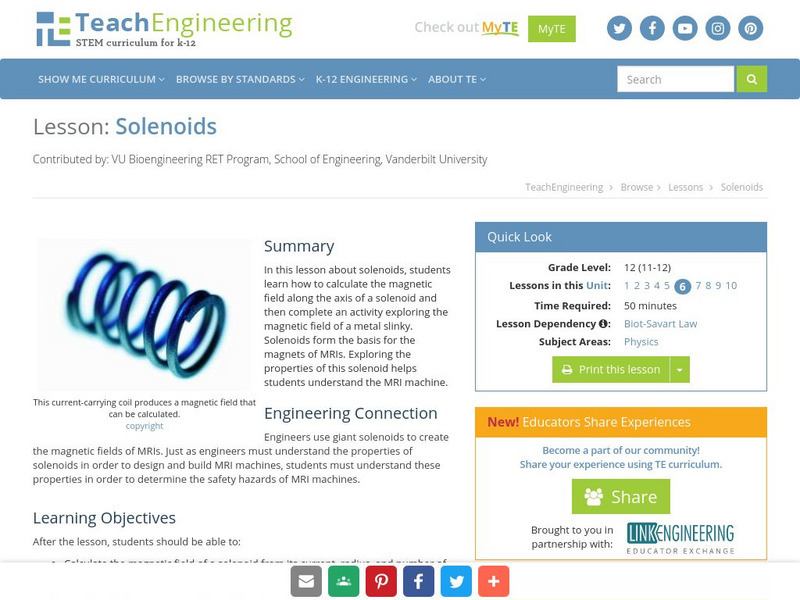
Teach Engineering: Solenoids
This lesson discusses solenoids. Young scholars learn how to calculate the magnetic field along the axis of a solenoid and complete an activity exploring the magnetic field of a metal slinky. Solenoids form the basis for the magnet of an...
Other
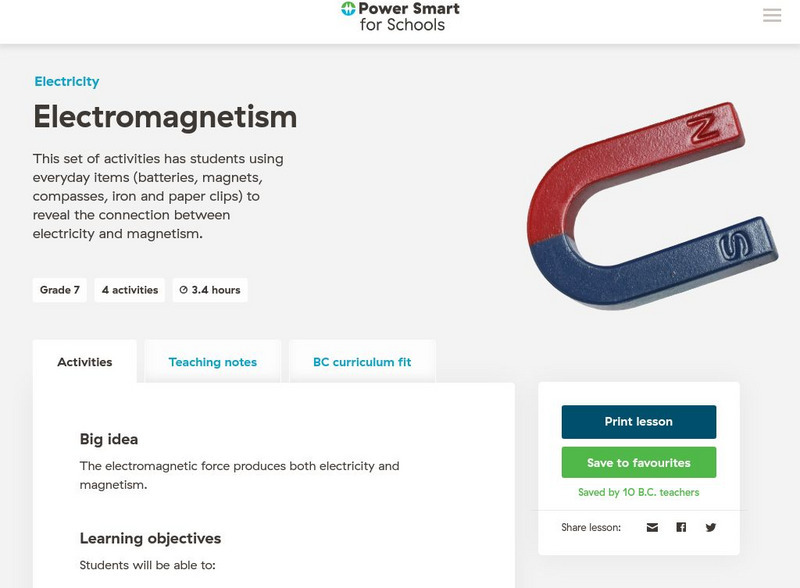
Bc Hydro: Power Smart for Schools: Electromagnetism
This set of activities has students using everyday items (batteries, magnets, compasses, iron and paper clips) to reveal the connection between electricity and magnetism. Ideally, students will already have experience building simple...
TeachEngineering
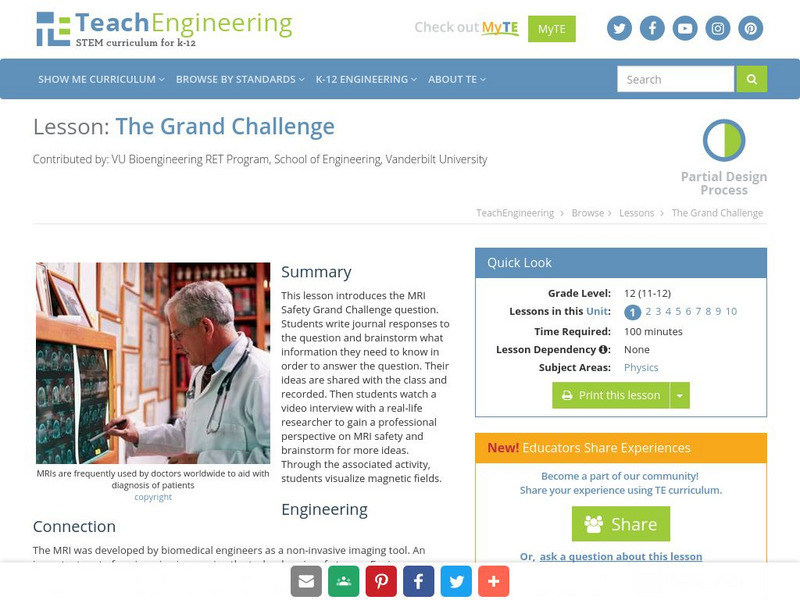
Teach Engineering: The Grand Challenge
This lesson plan introduces the MRI Safety Grand Challenge question. Students are asked to write journal responses to the question and brainstorm what information they will need to answer the question. The ideas are shared with the class...
TeachEngineering
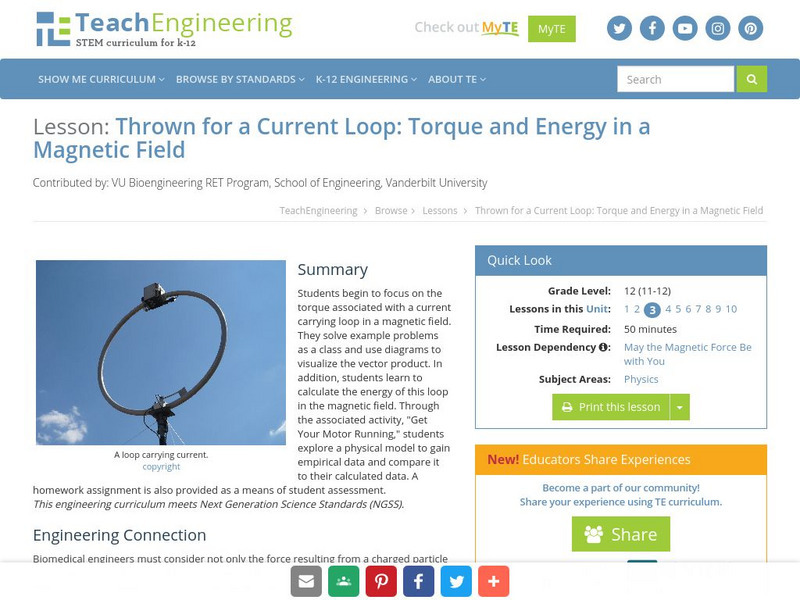
Teach Engineering: Thrown for a Loop
In this lesson, young scholars begin to focus on the torque associated with a current carrying loop in a magnetic field. Students are prompted with example problems and use diagrams to visualize the vector product. In addition, young...
TeachEngineering
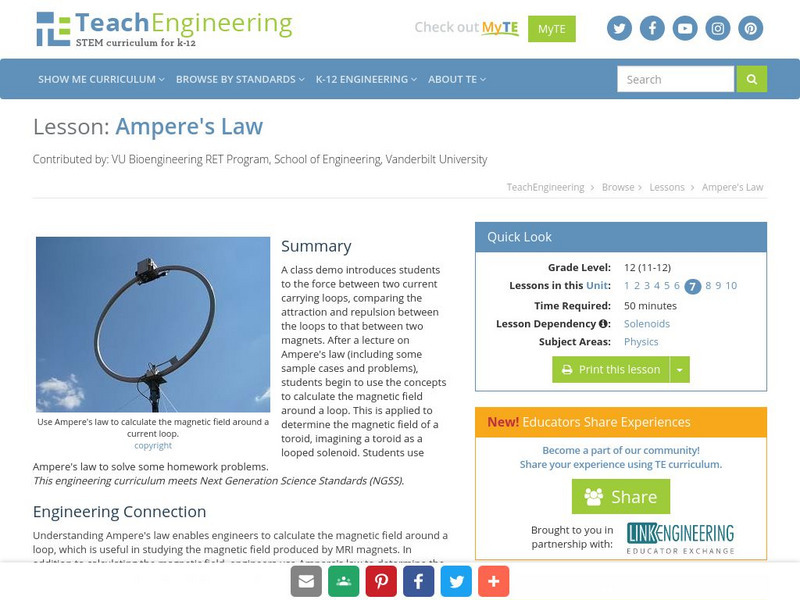
Teach Engineering: Ampere's Law
The lesson plan begins with a demonstration introducing students to the force between two current carrying loops, comparing the attraction and repulsion between the loops to that between two magnets. After formal lecture on Ampere's law,...
TeachEngineering
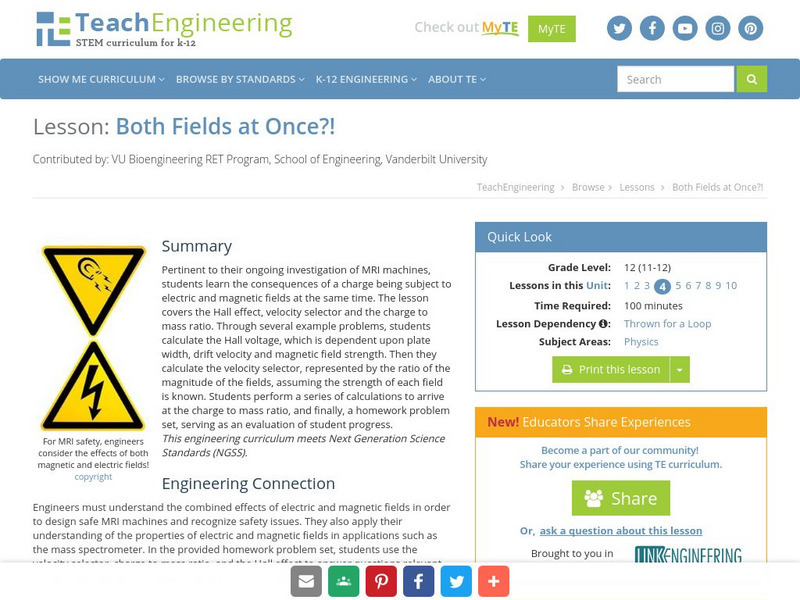
Teach Engineering: Both Fields at Once?!
This lesson discusses the result of a charge being subject to both electric and magnetic fields at the same time. It covers the Hall effect, velocity selector, and the charge to mass ratio. Given several sample problems, students learn...
TeachEngineering
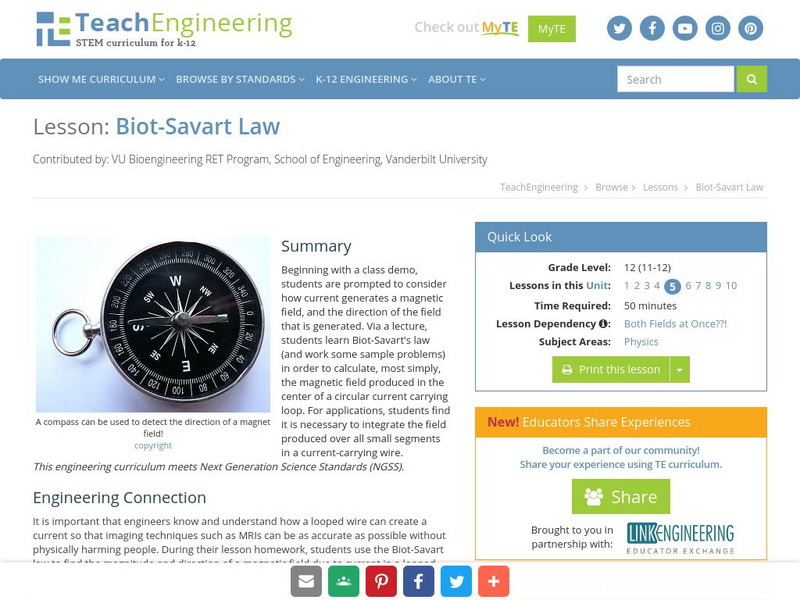
Teach Engineering: Biot Savart Law
This lesson begins with a demonstration prompting students to consider how current generates a magnetic field and the direction of the field that is generated. Through formal lecture, students learn Biot-Savart's law in order to...
Science and Mathematics Initiative for Learning Enhancement (SMILE)
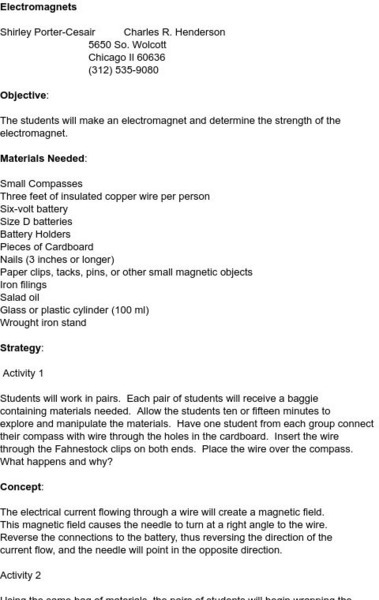
Smile: Electromagnets
This lesson plan contains several activities designed to help the student understand the magnetic effects of an electrical current.

Alabama Learning Exchange
Alex: May the Force Be With You!
The goal of this lesson is to provide students with hands on experiences, while learning about magnets. This lesson engages students in experiments which explore magnet use. An emphasis is placed on open-ended questions which encourage...
![Hes Energy Net: Energy Use and Delivery: Lesson Plan 3.3: Electromagnets [Pdf] Lesson Plan](https://static.lp.lexp.cloud/images/attachment_defaults/resource/large/FPO-knovation.png "Hes Energy Net: Energy Use and Delivery: Lesson Plan 3.3: Electromagnets [Pdf] Lesson Plan")
Other
Hes Energy Net: Energy Use and Delivery: Lesson Plan 3.3: Electromagnets [Pdf]
In this lesson, students learn how to identify and explain an electromagnet, describe the relationship between electricity and magnetism, and compare an electromagnet to a bar magnet.
Discovery Education
Discovery Education: Science of Everyday Life: Interaction at a Distance [Pdf]
An experiment where students investigate the strength of magnets. This site includes a lesson plan with both teacher and student information for completing the experiment.
Science Education Resource Center at Carleton College
Serc: Magnets and Electricity: Creating Magnetism With Electricity
Students will work in small groups to design at least one complete circuit using multiple materials. They will record their observations of how they created an electrical circuit using diagrams and notes in their journals. Using a...
TeachEngineering
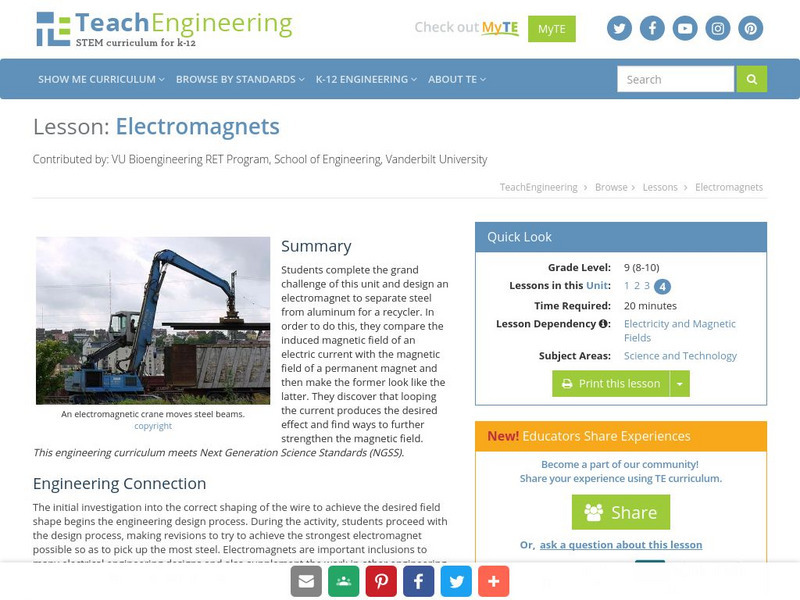
Teach Engineering: Electromagnets
In this activity, the students will complete the grand challenge and design an electromagnet to separate steel from aluminum for the recycler. In order to do this, students compare the induced magnetic field of an electric current with...

University of Florida
Florida Museum of Natural History: Physical Science
This guide focuses on four physical science topics that fascinate children and scientists alike. They are motion, magnets, sound, and light. With your guidance and support, these topics provide children with many opportunities to explore...
TeachEngineering
Teach Engineering: Changing Fields
This lesson begins with an activity in which students induce EMF in a coil of wire using magnetic fields. Then, demonstrations on Eddy currents show how a magnetic field can slow magnets just as Eddy currents are used to slow large...
University Corporation for Atmospheric Research
Ucar: The Sun Earth Connection: Exploring the Dynamic Nature of the Sun
The unit contains lessons and a presentation that allow learners to explore the Sun through images and investigate how magnetism from the Sun interacts with the Earth's magnetic field during space weather events.
TeachEngineering
Teach Engineering: Riding the Radio Waves
In this lesson students learn how AM radios work through basic concepts about waves and magnetic fields. Waves are first introduced by establishing the difference between transverse and longitudinal waves, as well as identifying the...
OpenSciEd
Open Sci Ed: 8.3 Forces at a Distance
This unit allows students to investigate the cause of a speaker's vibration in addition to the effect.
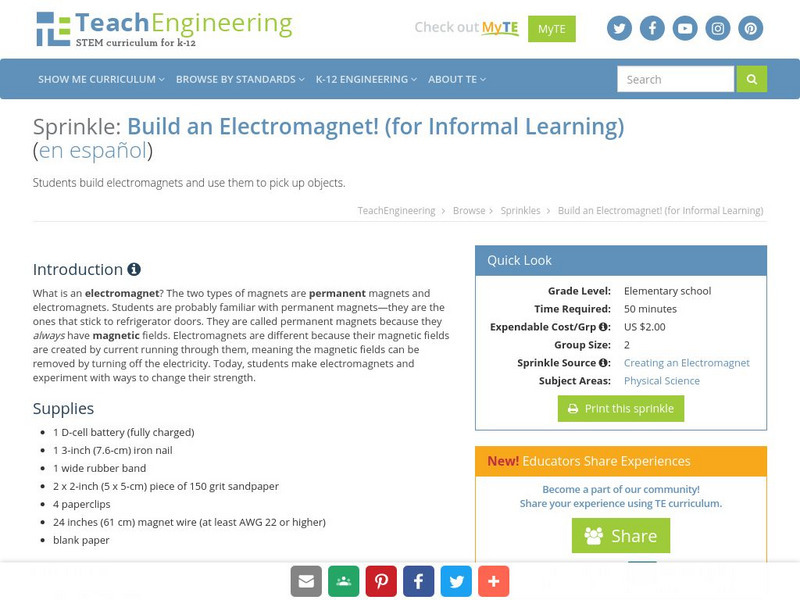
TeachEngineering
Teach Engineering: Build an Electromagnet!
Students build electromagnets and experiment with ways to change their strength.

Science Education Resource Center at Carleton College
Serc: Electromagnetic Induction Demonstration
Students learn the relationship between the electric and magnetic fields. Specifically, they verify that a magnetic field is created in a current carrying coil of wire and a changing magnetic field can induce a current in another coil of...
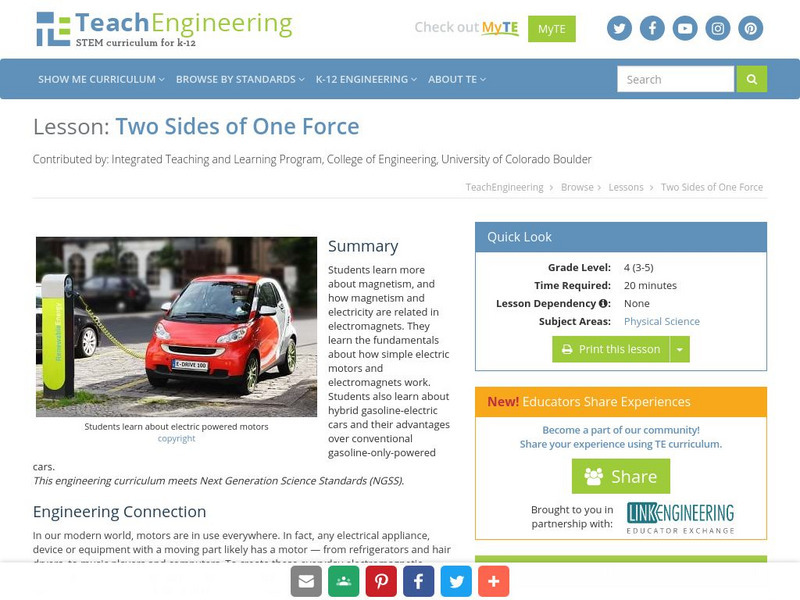
TeachEngineering
Teach Engineering: Two Sides of One Force
Students learn more about magnetism, and how magnetism and electricity are related in electromagnets. They learn the fundamentals about how simple electric motors and electromagnets work. Students also learn about hybrid...
Climate Literacy
Clean: Going for a Spin Making a Model Steam Turbine
Young scholars explore how various energy sources can be used to cause a turbine to rotate and then generate electricity with a magnet.
American Geosciences Institute
American Geosciences Institute: Earth Science Week: Make Your Own Compass
Students create their own magnetic compass.
Other popular searches
- Electricity and Magnetism
- Magnetism Worksheets
- Magnets and Magnetism
- Gravity and Magnetism
- Electricity Magnetism
- Magnetism and Poles
- Induced Magnetism
- Science, Magnetism
- Bill Nye Magnetism
- Science Magnetism
- Magnetism Lesson Plans
- Energy and Magnetism