Hi, what do you want to do?





University of Oregon
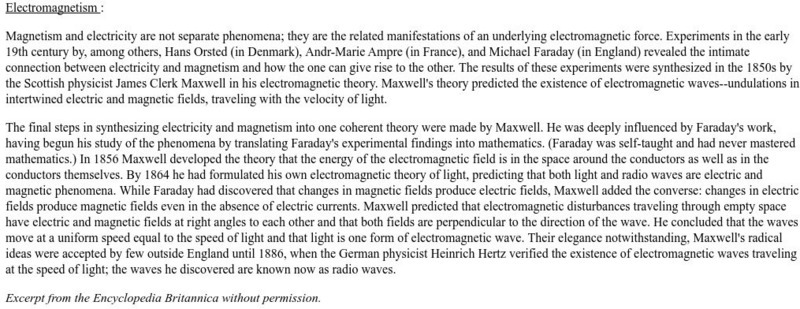
University of Oregon: Electromagnetism
A solid summary from the University of Oregon of the work of James Maxwell Clerk, Michael Faraday, and others in the field of electric and magnetic phenomena. This is a fine essay.
Sophia Learning
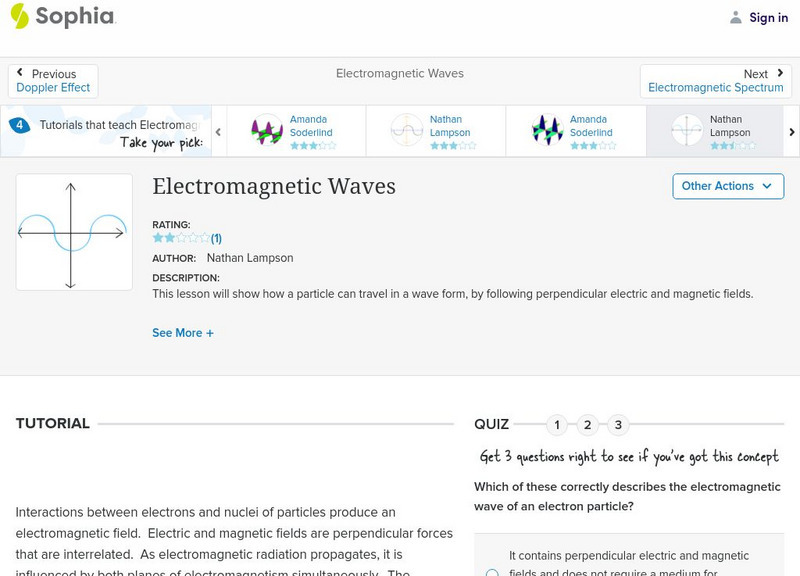
Sophia: Electromagnetic Waves: Lesson 2
This lesson will show how a particle can travel in a wave form, by following perpendicular electric and magnetic fields. It is 2 of 4 in the series titled "Electromagnetic Waves."
Sophia Learning
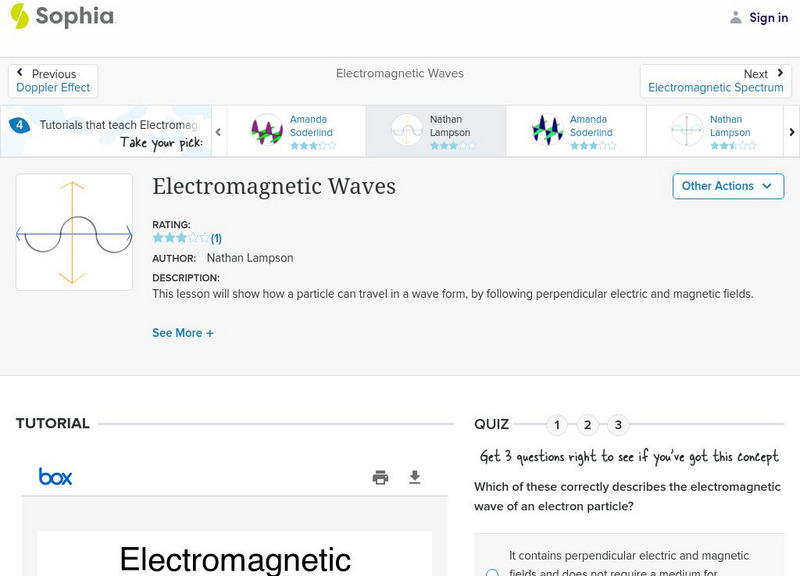
Sophia: Electromagnetic Waves: Lesson 3
This lesson will show how a particle can travel in a wave form, by following perpendicular electric and magnetic fields. It is 3 of 4 in the series titled "Electromagnetic Waves."
Sophia Learning
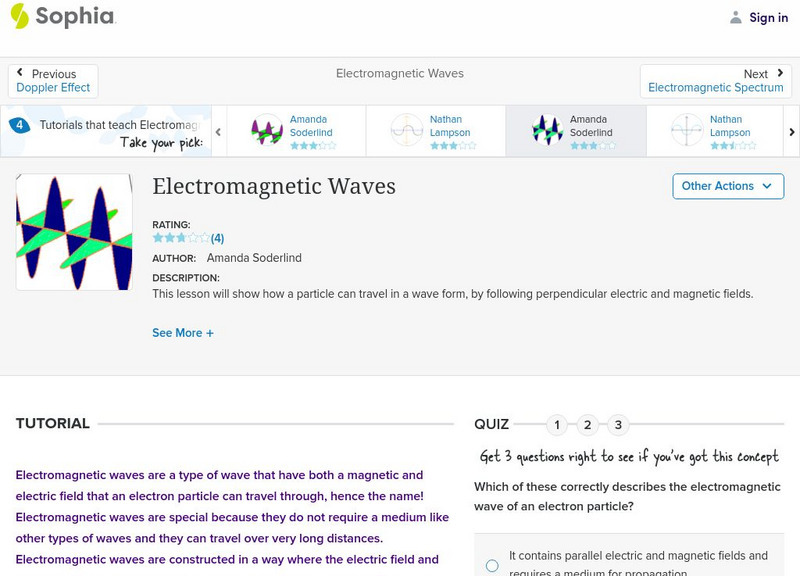
Sophia: Electromagnetic Waves: Lesson 4
This lesson will show how a particle can travel in a wave form, by following perpendicular electric and magnetic fields. It is 4 of 4 in the series titled "Electromagnetic Waves."
Other
Science Toys: Magnetism
This site describes how to make several toys with magnets. It also gives an explanation of how they work and where to get the right kind of magnets.

Canada Science and Technology Museum
Canada Science and Technology Museum: Materials
Does glass have magnetic properties? Test several materials, in this interactive activity, to see if they have the properties to be attracted to a magnet.
TeachEngineering
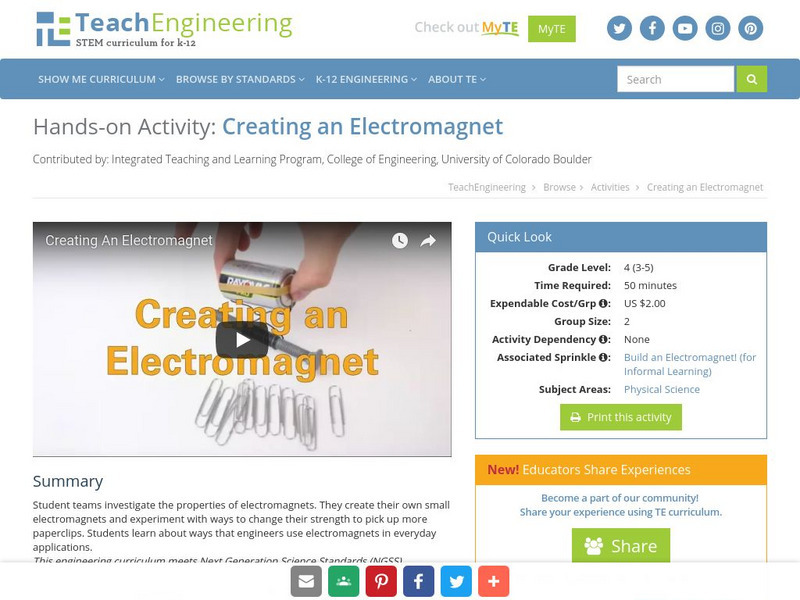
Teach Engineering: Building an Electromagnet
Student teams investigate the properties of electromagnets. They create their own small electromagnet and experiment with ways to change its strength to pick up more paper clips. Students learn about ways that engineers use...

National High Magnetic Field Laboratory
Magnet Academy: Right and Left Hand Rules
No fancy movement in this tutorial, but these rules come in very handy when trying to understand some of what's going on in our other tutorials.
CK-12 Foundation
Ck 12: Electromagnetic Induction
[Free Registration/Login may be required to access all resource tools.] In order to understand electromagnetic induction, students are introduced to magnetic flux, to Faraday's Law of Induction, and to Lenz's Law. Includes a simulation...
Other
Quackwatch: Power Lines and Cancer Nothing to Fear
This site explores the history of power lines and cancer associations, as well as dispelling the myth. The science is explored by citing known facts, studies and experts in the field.
Science Struck
Science Struck: The 13 Types of Energy and Their Applications
Read about all the different kinds of potential and kinetic energy. Includes energy formulas and examples of energy applications.

TED Talks
Ted: Ted Ed: String Theory and the Hidden Structures of the Universe
What is everything made of? Thus far, we can break everything in the universe down to a few very small elementary particles. But they fit into strange patterns that are not understood. Clifford Johnson describes these ideas, along with...
Physics4kids
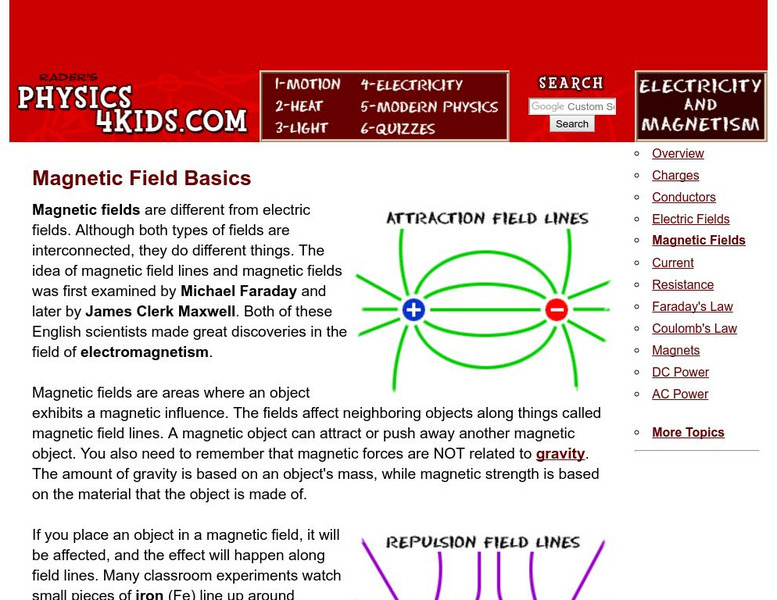
Physics4 Kids: Electricity and Magnetism: Magnetic Fields
Explains magnetic fields, how they differ from electric fields, and attraction and repulsion.
University of Wisconsin
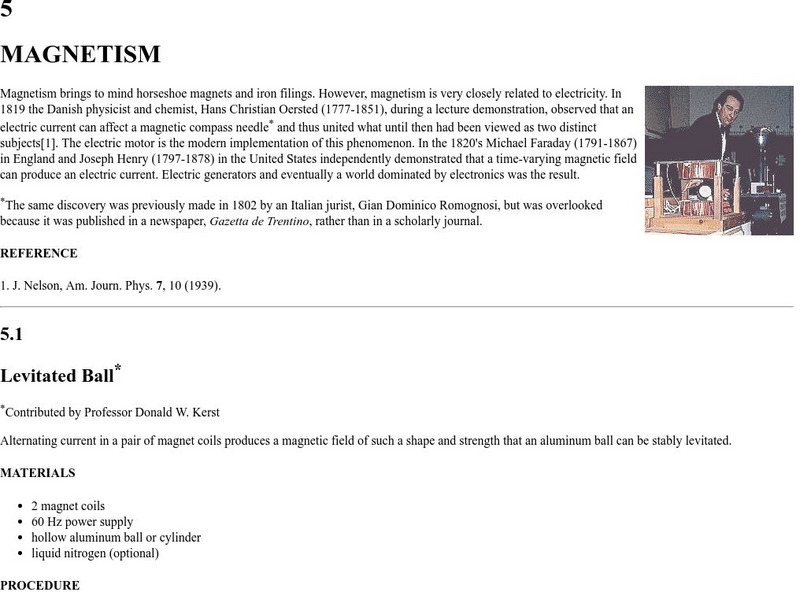
University of Wisconsin: 5 Magnetism
From an online teacher demonstration book. Includes a description and explanation of five demonstrations on a variety of magnetism topics. Interesting and captivating demos.
Cornell University
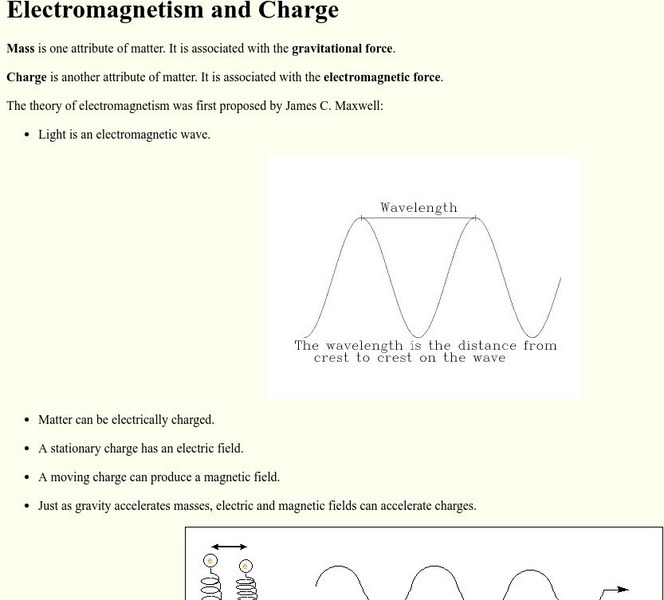
Cornell University: Astronomy: Electromagnetism and Charge
This site from Cornell University provides a very short, very telling comparison of matter and charge. This is a good site to check out on the subject, with a chart diagram to help with further information.
TeachEngineering
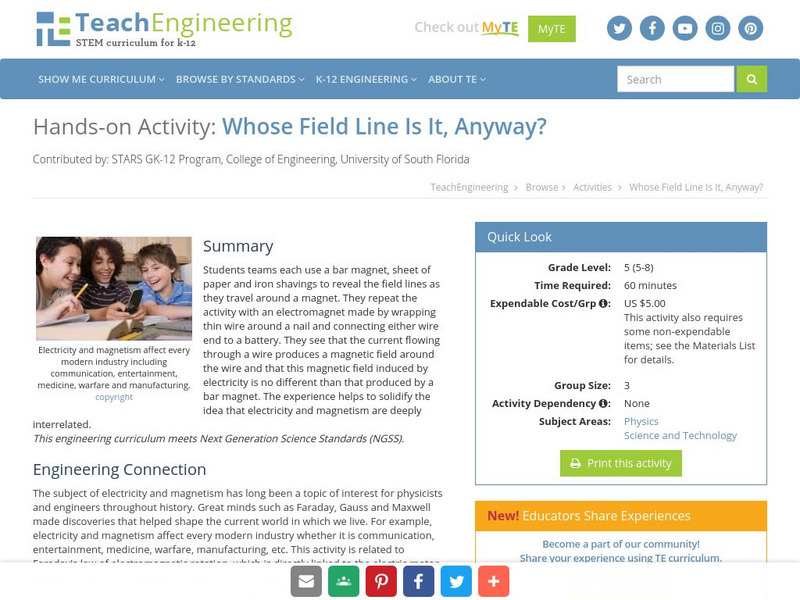
Teach Engineering: Whose Field Line Is It, Anyway?
Students teams each use a bar magnet, sheet of paper and iron shavings to reveal the field lines as they travel around a magnet. They repeat the activity with an electromagnet made by wrapping thin wire around a nail and connecting...
TeachEngineering
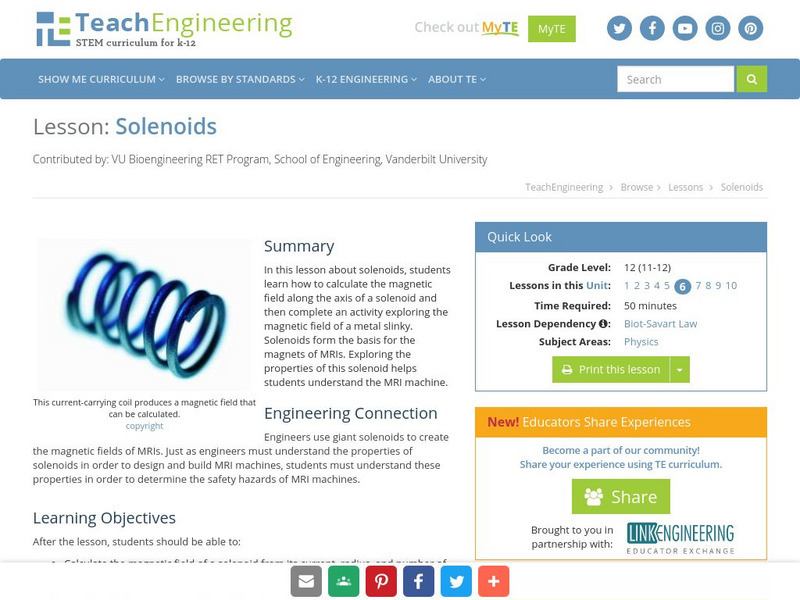
Teach Engineering: Solenoids
This instructional activity discusses solenoids. Students learn how to calculate the magnetic field along the axis of a solenoid and complete an activity exploring the magnetic field of a metal slinky. Solenoids form the basis for the...
TeachEngineering
Teach Engineering: Both Fields at Once?!
This lesson discusses the result of a charge being subject to both electric and magnetic fields at the same time. It covers the Hall effect, velocity selector, and the charge to mass ratio. Given several sample problems, young scholars...
University of Minnesota
University of Minnesota: Ships: Science & Religion of Michael Faraday
Here's a whole different look at Faraday. His religion, Sandemanian, greatly influenced both his life and his science. This article looks deeply at that aspect of his life.
TeachEngineering
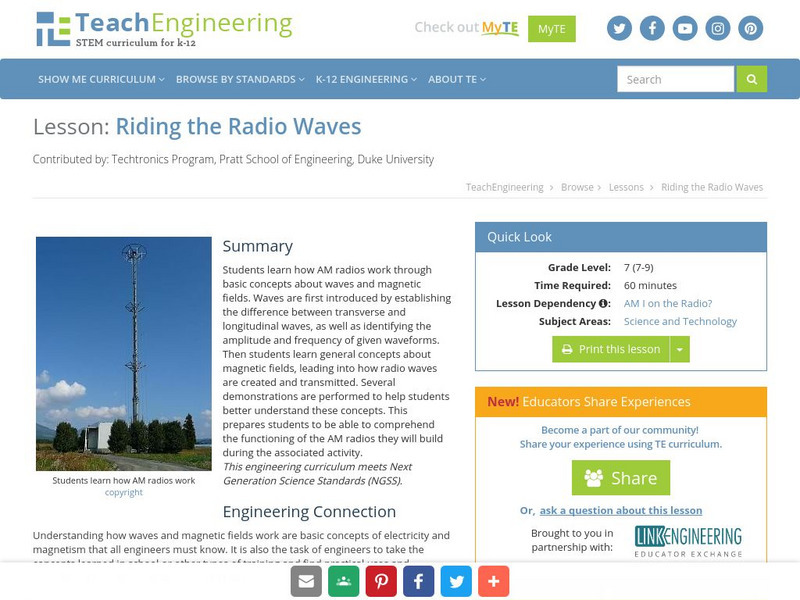
Teach Engineering: Riding the Radio Waves
In this lesson students learn how AM radios work through basic concepts about waves and magnetic fields. Waves are first introduced by establishing the difference between transverse and longitudinal waves, as well as identifying the...
Princeton University
Princeton University: Joseph Henry
A really fine and complete biography, quite lengthy. Some emphasis placed on his time at Princeton. A great deal of detail can be found here. Link here to the Joseph Henry House.
Science and Mathematics Initiative for Learning Enhancement (SMILE)
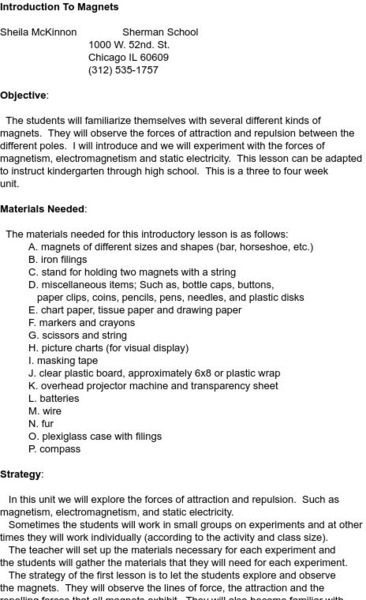
Smile: Introduction to Magnets (Classroom Unit)
A teacher unit which includes several hands-on activities about types of magnets, magnetism, and electrostatics. An activity designed to suit all grade levels. Many parts of the activity would be easily adaptable as a student project.
Discovery Education
Discovery Education: The Em Spectrum: Waves of Energy
Students are introduced to the electromagnetic spectrum through this group research activity. Each group investigates a different wavelength range within the em spectrum and reports back to class. Discussion ideas also included.
TeachEngineering
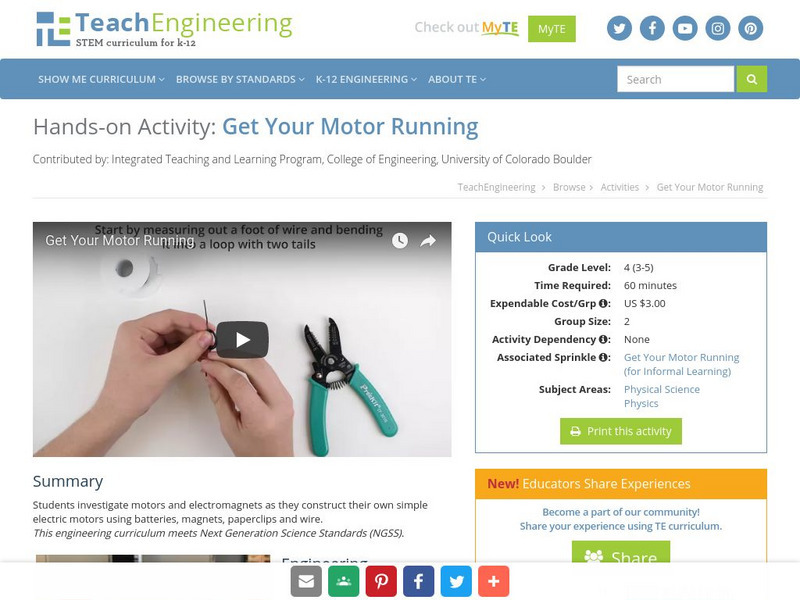
Teach Engineering: Get Your Motor Running
Students investigate motors and electromagnets as they construct their own simple electric motors using batteries, magnets, paper clips and wire.