Hi, what do you want to do?






National High Magnetic Field Laboratory
Magnet Academy: Magnetic Core Memory 1949
At the dawn of the computer age, magnetic core memory helped make data storage possible, and showed surprising staying power in a field where components are constantly being replaced by new and improved products.

National High Magnetic Field Laboratory
Magnet Academy: Julian Schwinger
Theoretical physicist Julian Schwinger used the mathematical process of renormalization to rid the quantum field theory developed by Paul Dirac of serious incongruities with experimental observations that had nearly prompted the...

National High Magnetic Field Laboratory
Magnet Academy: Gerd Binnig
Gerd Binnig co-developed the scanning tunneling microscope (STM) with Heinrich Rohrer. The STM allowed scientists entry into the atomic world in a new way and was a major advance in the field of nanotechnology. For their achievement,...

National High Magnetic Field Laboratory
Magnet Academy: Humphry Davy
Humphry Davy was a pioneer in the field of electrochemistry who used electrolysis to isolate many elements from the compounds in which they occur naturally. Electrolysis is the process by which an electrolyte is altered or decomposed via...

National High Magnetic Field Laboratory
Magnet Academy: Luigi Galvani
Luigi Galvani was a pioneer in the field of electrophysiology, the branch of science concerned with electrical phenomena in the body. His experiments with dissected frogs and electrical charges led him to suggest the existence of a...

National High Magnetic Field Laboratory
Magnet Academy: Eric Cornell
Born in Palo Alto, California, and raised in Cambridge, Massachusetts - homes to Stanford and the Massachusetts Institute of Technology, respectively - you could say Eric Cornell was destined to become a renowned scientist. And while he...

National High Magnetic Field Laboratory
Magnet Academy: Paul Dirac
Paul Adrien Maurice Dirac was an outstanding twentieth century theoretical physicist whose work was fundamental to the development of quantum mechanics and quantum electrodynamics. He was awarded the Nobel Prize for Physics jointly with...
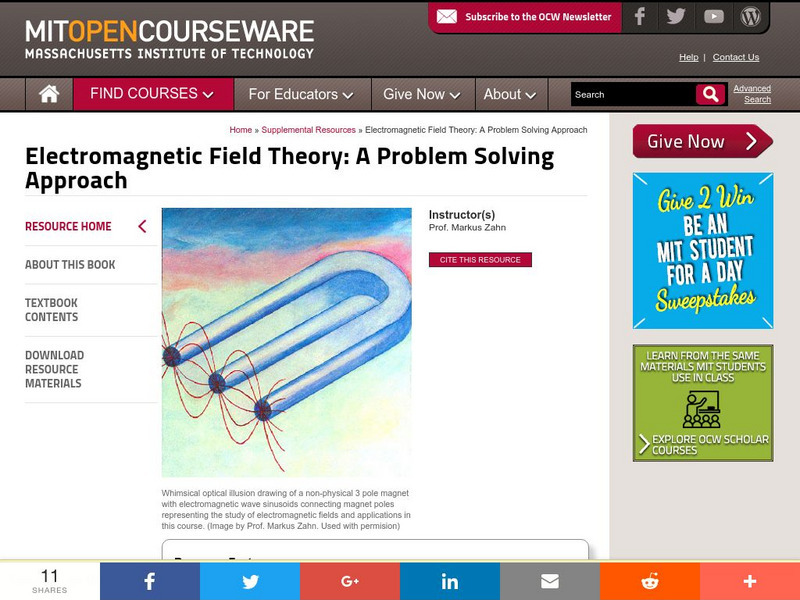
Massachusetts Institute of Technology
Mit: Open Course Ware: Resources: Electromagnetic Field Theory
College-level electrical engineering textbook starting from the Coulomb-Lorentz force law on a point charge. Sample problems that reinforce the content are found at the end of each chapter. Includes downloadable excerpts of the textbook...

Science Struck
Science Struck: The Relationship Between Magnetism and Electricity
Provides a short explanation of the similarities between magnetism and electricity, the properties of their fields, and the effect they each have on a charged particle.
NASA
Nasa: Image Science Center: Ask the Space Scientist Earth
Site from NASA contains a collection of 91 questions pertaining to the Earth's atmosphere, magnetic field, ionosphere, rotation and origin of life.

PBS
Pbs Kids: Design Squad: Build: Inspector Detector
This challenge requires you to design and build a device that can pass above a surface and detect magnetic fields.
Exploratorium
Exploratorium: Curie Temperature
In this experiment, students experience the Curie point--and what happens when a piece of iron gets too hot to attract a magnet.

Alabama Learning Exchange
Alex: May the Force Be With You!
The goal of this lesson is to provide students with hands on experiences, while learning about magnets. This lesson engages students in experiments which explore magnet use. An emphasis is placed on open-ended questions which encourage...

National High Magnetic Field Laboratory
Magnet Academy: Right and Left Hand Rules
No fancy movement in this tutorial, but these rules come in very handy when trying to understand some of what's going on in our other tutorials.
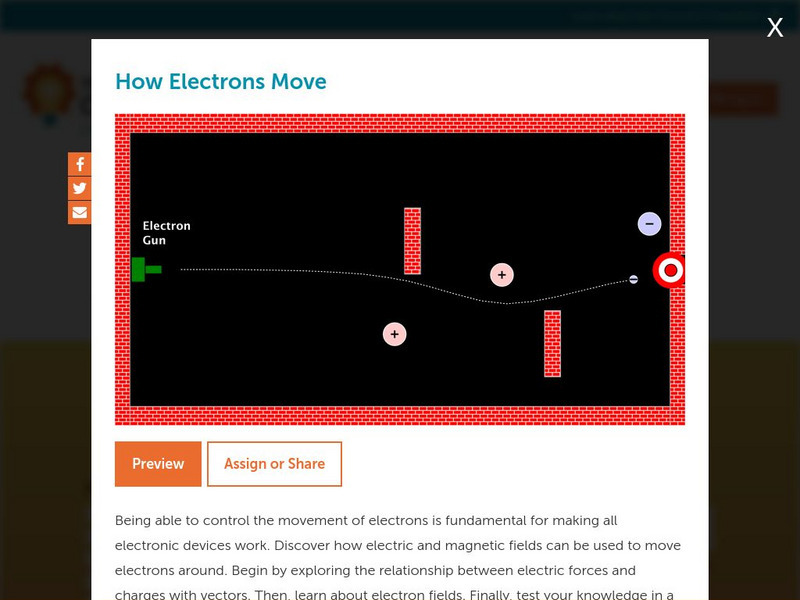
Concord Consortium
Concord Consortium: How Electrons Move
Being able to control the movement of electrons is fundamental for making all electronic devices work. Discover how electric and magnetic fields can be used to move electrons around. Begin by exploring the relationship between electric...
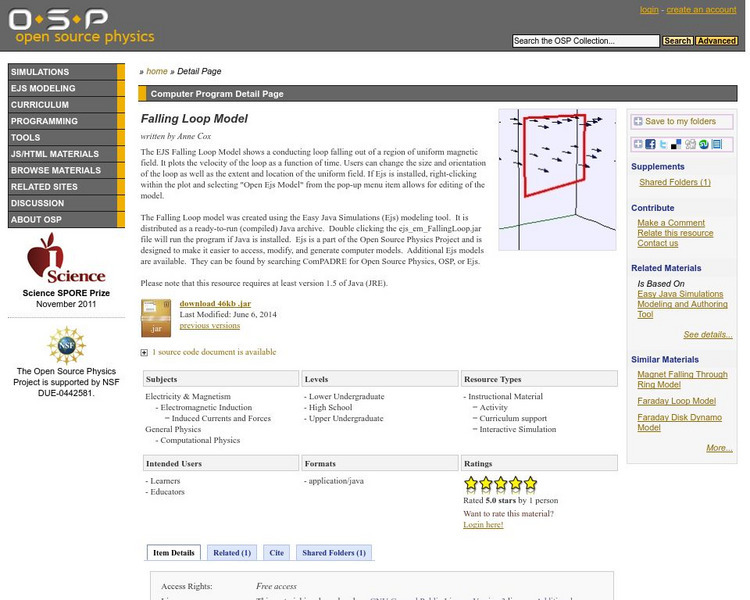
American Association of Physics Teachers
Com Padre Digital Library: Open Source Physics: Falling Loop Model
Change the size and orientation of a conducting loop falling out of a region of uniform magnetic field. Then, the data is plotted on an interactive graph.
Texas Education Agency
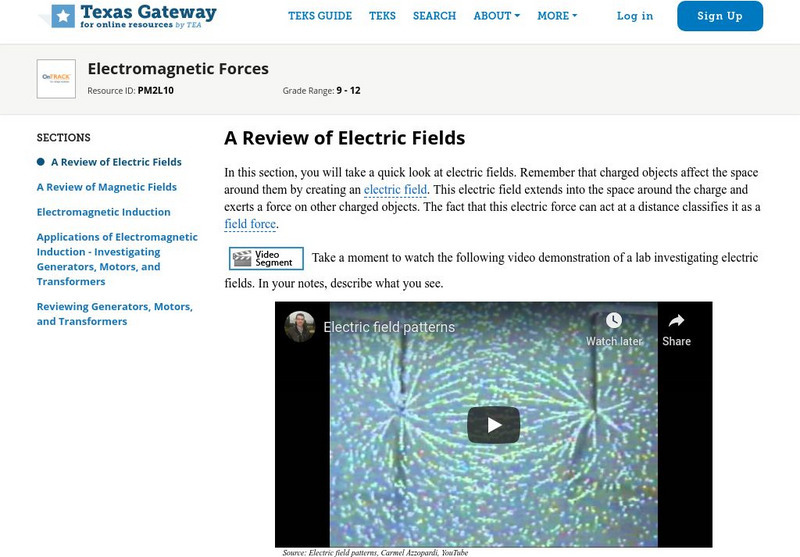
Texas Gateway: Electromagnetic Forces
Given schematic diagrams, illustrations or descriptions, students will identify the relationship of electric and magnetic fields in applications such as generators, motors, and transformers.
CK-12 Foundation
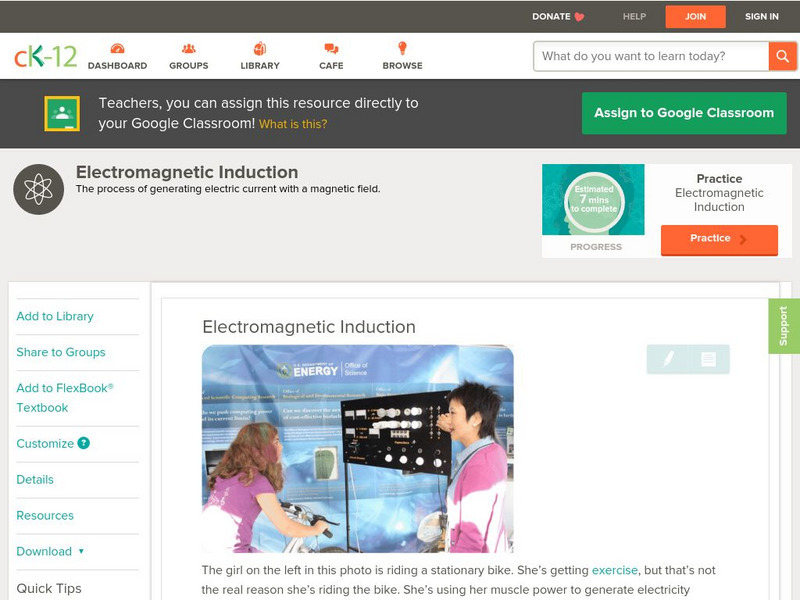
Ck 12: Physical Science: Electromagnetic Induction
[Free Registration/Login may be required to access all resource tools.] Covers what electromagnetic induction is, how it occurs, the current produced from it, and how it is used.
Other
Space Weather Center: Our Protective Shield
The Earth's magnetosphere helps shield us from cosmic and solar radiation. This segment offers a great explanation of this abstract concept along with numerous images and diagrams. An interactive game is provided as well.

PBS
Nova: See a Reversal
The earth's magnetic field is due for a reversal. Find out what causes the magnetic field and view an animated model that shows it reversing.
Wikimedia
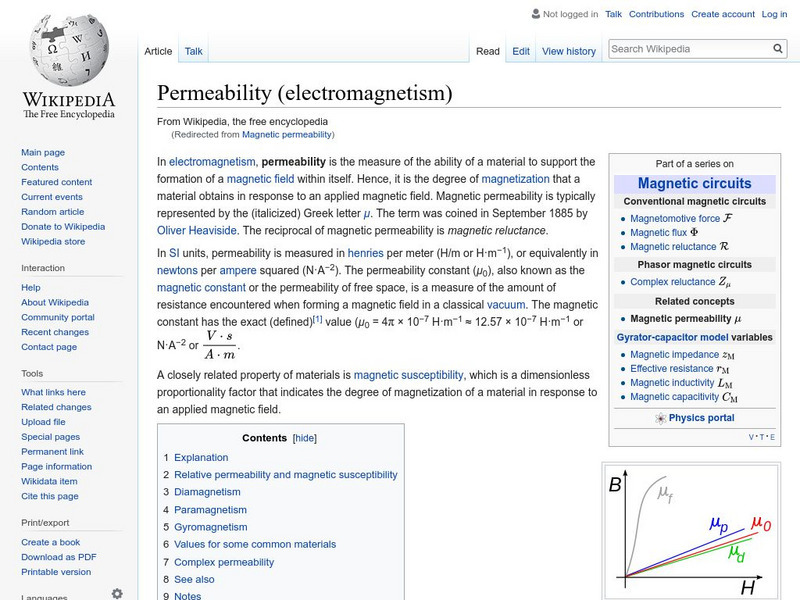
Wikipedia: Permeability
This site from the encyclopedia Wikipedia provides a concise definition of magnetic permeability given in terms of magnetic flux density and magnetic field strength.
Cosmo Learning
Cosmo Learning: Physics Ii: Electricity and Magnetism
A collection of video lectures from a fundamentals of physics course taught at Massachusetts Institute of Technology. The course is the second in the sequence and focuses on electricity and magnetism The videos feature topics on...
Science and Mathematics Initiative for Learning Enhancement (SMILE)
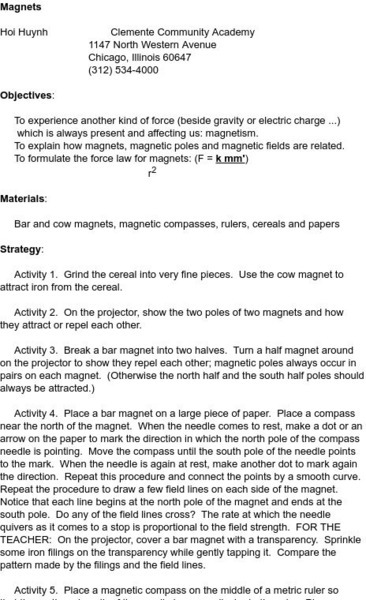
Smile: Magnets (Lesson Plan)
A teacher lesson plan which includes six hands-on activities regarding magnets. Young scholars will be able to experience magnetism; explain how magnets, magnetic poles and magnetic fields are related; and formulate the force law for...
Science and Mathematics Initiative for Learning Enhancement (SMILE)
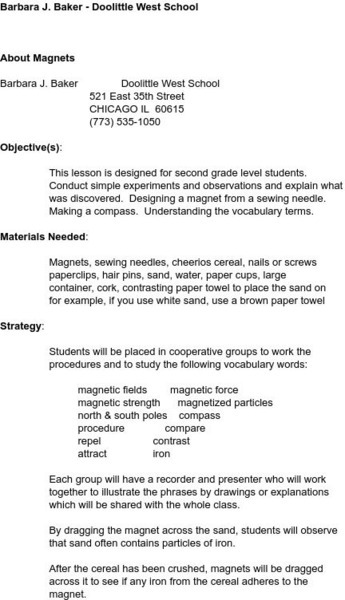
Smile: About Magnets (Lesson Plan)
This site provides a lesson plan which includes a hands-on activity about magnetism and magnetic fields. Parts of the plan would be easily adaptable as a student project (for any grade level).