Hi, what do you want to do?





Exploratorium
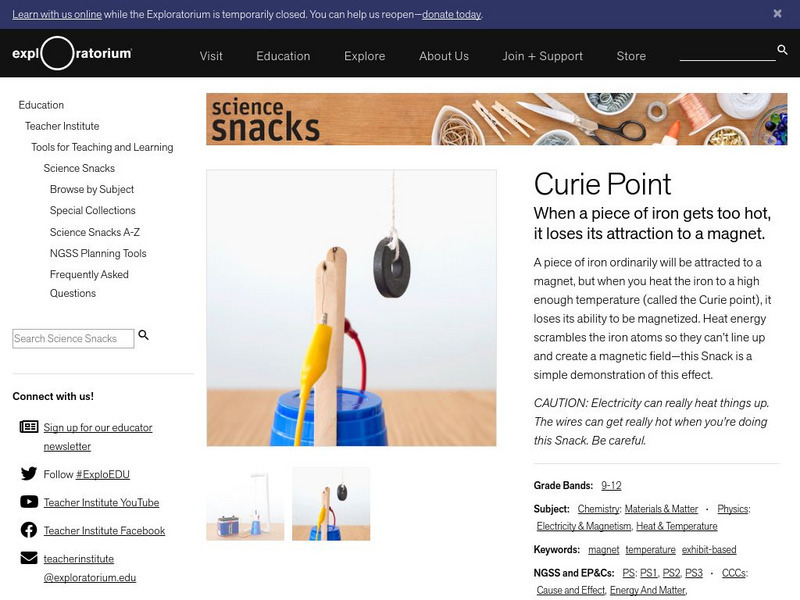
Exploratorium: Science Snacks: Curie Point
Did you know that a piece of iron can lose its magnetism if heated too high? There is a point called the Curie point when iron is heated to a high enough temperature that its iron atoms are scrambled and can't line up to form a magnetic...
Sophia Learning
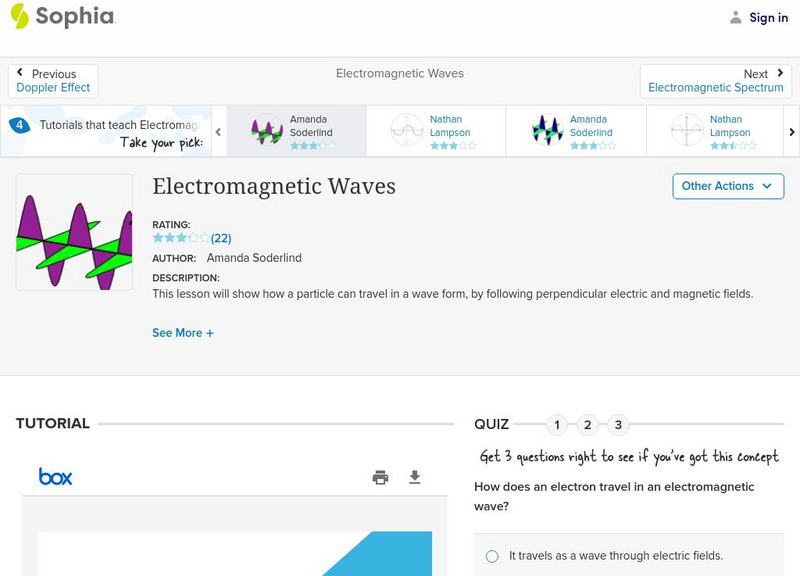
Sophia: Electromagnetic Waves: Lesson 1
This lesson will show how a particle can travel in a wave form, by following perpendicular electric and magnetic fields. It is 1 of 4 in the series titled "Electromagnetic Waves."
NASA
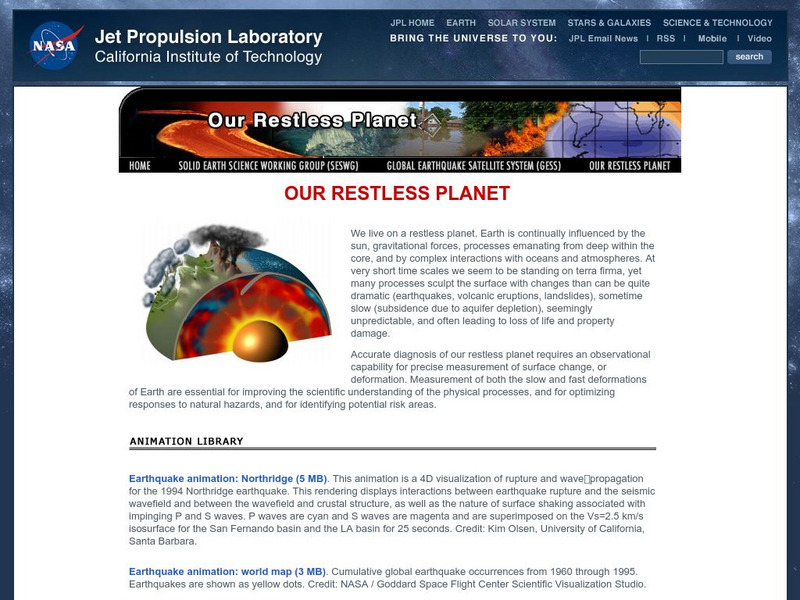
Nasa: Our Restless Planet
This animation library is a great resource for a diverse list of earth science topics including: tsunamis, land subsidence, magnetic fields, volcanoes earthquakes, floods, and sea level changes.
Tech Target
Whatis.com: Permeability
This resource defines magnetic permeability and then describes how it is used to classify materials as diamagnetic, paramagnetic, or ferromagnetic.
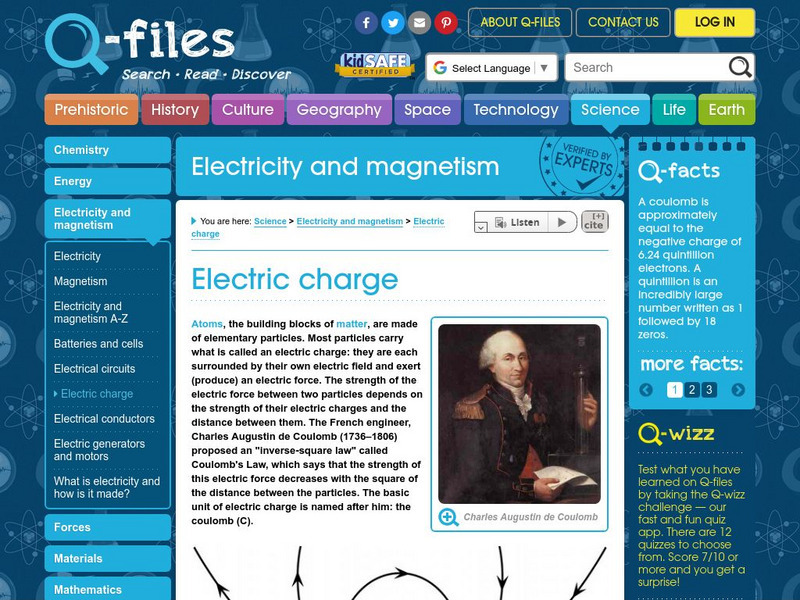
Orpheus Books
Q Files: Electricity and Magnetism: Electric Charge
Learn how electric charges work and about Coulomb's Law, which is used to calculate the strength of an electric force.
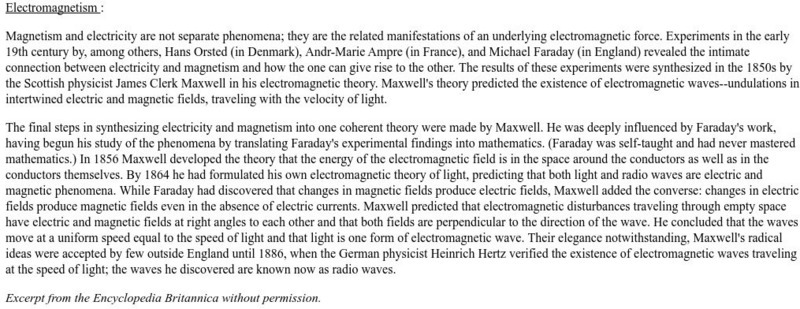
University of Oregon
University of Oregon: Electromagnetism
A solid summary from the University of Oregon of the work of James Maxwell Clerk, Michael Faraday, and others in the field of electric and magnetic phenomena. This is a fine essay.

Smithsonian Institution
Lemelson Center: Spark!lab: Build a Speaker
Learn how to build your very own speaker with items usually found around the house. Follow step-by-step instructions and discover how to use your speaker to listen to the radio.
Walter Fendt
Walter Fendt: Apps Zur Physik
This site, in German, offers numerous apps that illustrate common physics principles. Apps are organized into categories: mechanics, oscillations and waves, electrodynamics, optics, thermodynamics, the theory of relativity, physics of...
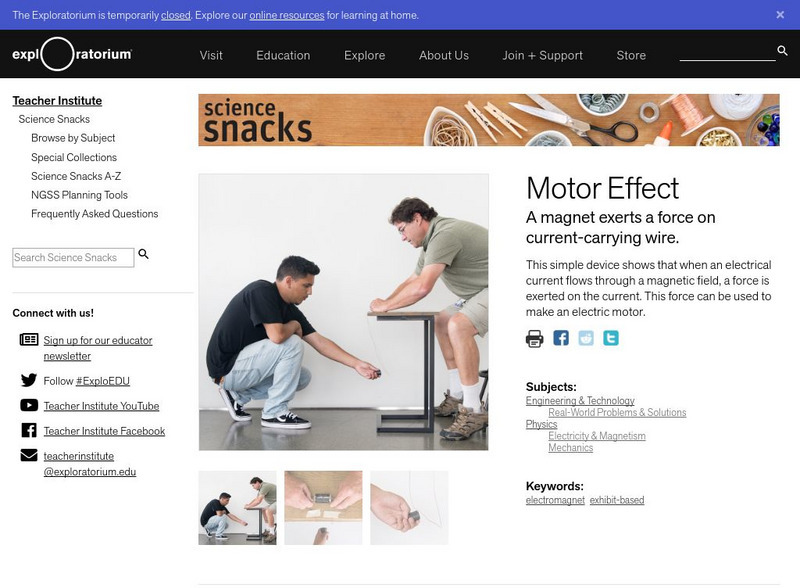
Exploratorium
Exploratorium: Science Snacks: Motor Effect
"A magnet exerts a force on current-carrying wire." This simple device shows how magnets affect wires with current in them, the basis of the electric motor. If you see, feel and understand this, the electric motor becomes very clear.
CK-12 Foundation
Ck 12: Physics Simulation: Galvanometer
[Free Registration/Login Required] Understand how the magnetic field generated by loops of current-carrying wire is used to create measuring devices like voltmeters and ammeters with this interactive simulation. A PDF worksheet and a...
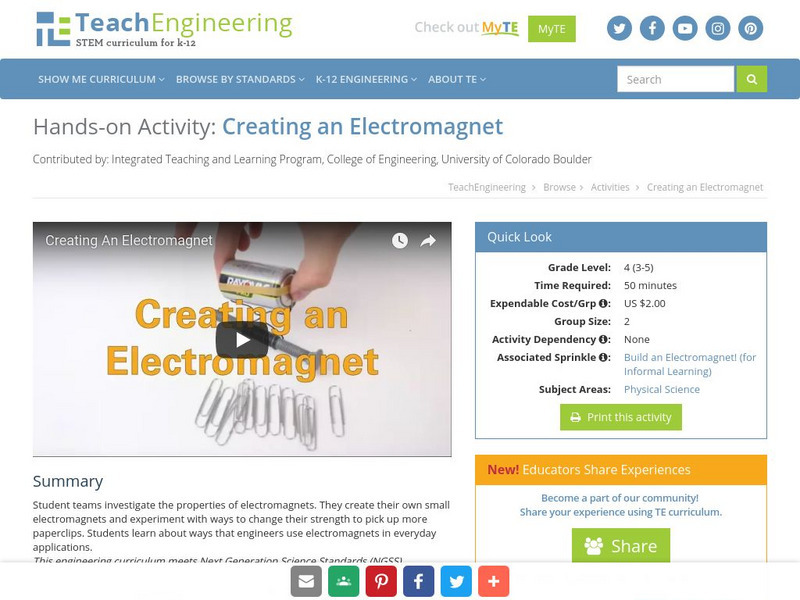
TeachEngineering
Teach Engineering: Building an Electromagnet
Student teams investigate the properties of electromagnets. They create their own small electromagnet and experiment with ways to change its strength to pick up more paper clips. Students learn about ways that engineers use...
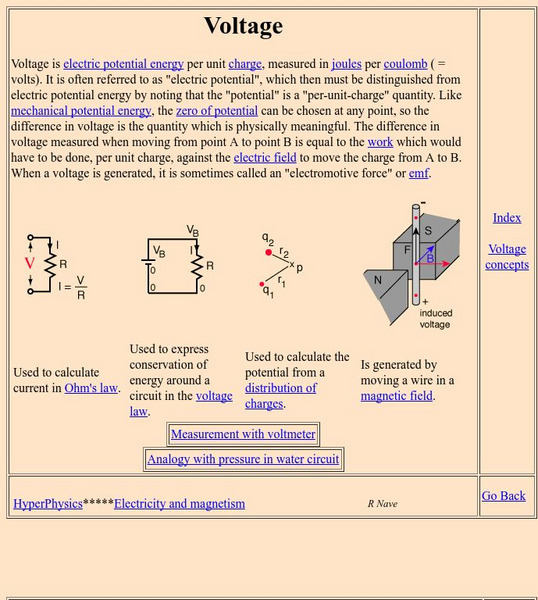
Georgia State University
Georgia State University: Hyper Physics: Voltage
Electrical currents and voltage are defined and illustrated.
Nine Planets
The Nine Planets: Uranus
An excellent report on the planet Uranus. The site includes detailed information about the planet as well as links to information about Uranus moons, unmanned probes sent to explore Uranus, and an extensive set of images of the planet.
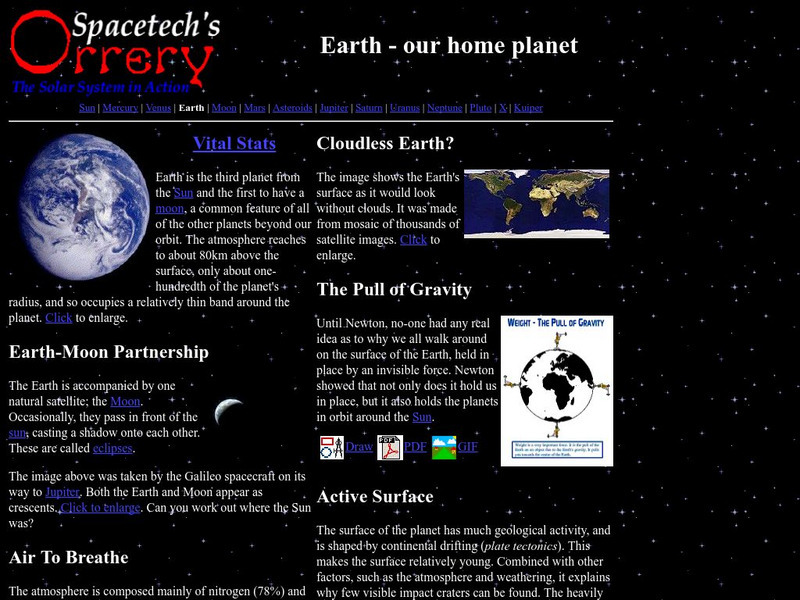
Other
Spacetech's Orrery: Earth Our Home Planet
This site provides a very interesting overview of our home planet, Earth. Content includes a focus on the atmosphere, the pull of gravity, and the active surface.
NASA
Nasa: Imagine the Universe: Pulsars
Resource explores what a pulsar is, as well as what is currently known about this phenomenon. Content includes a focus on x-ray observations of pulsars, and gamma-ray pulsars.
Aetna Intelihealth
Aetna: Inteli Health: Alternative Therapies for Osteoarthritis
Provides readers with a list of the most common complementary and alternative therapies for osteoarthritis. Explains each and discusses any research on the effectiveness.

Learn Engineering
Learn Engineering: How Does an Induction Motor Work?
An article and video about the most commonly used electrical machine called an induction motor. Learn about the parts of the motors that allow the motor to function. [4:43]

TeachEngineering
Teach Engineering: Find Your Own Direction
In this activity, students create their own simple compass using thread, needle and water in a bowl - and learn how it works.
Oswego City School District
Regents Exam Prep Center: Permeability
A good visual introduction to permeability, comparing the magnetic permeabilities of air and iron. This site provides a good conceptual introduction to this topic.
Massachusetts Institute of Technology
Mit: Invention of the Week: Raymond Damadian: Medical Resonance Scanning Machine
Read about the education and career of Raymond V. Damadian, inventor of the magnetic resonance imaging (MRI), and learn how the MRI has impacted the field of medicine.
CK-12 Foundation
Ck 12: Plix: Bar Magnet Magic: Ferromagnetic Material
[Free Registration/Login Required] Explore how magnets affect objects by dragging the bar magnet around and observing how the field lines within each area of the material change.
NASA
Nasa: Imagine the Universe: "Burst Behind the Sun"
Site provides the article, "Burst Behind the Sun Reveals Magnetic Charm of Distant Explosion," that details on a gamma-ray burst that occurred on December 6, 2002. Provides graphics and links to learn more about gamma-ray bursts.
NASA
Nasa: Imagine the Universe: The Sun
Site discusses the regions of the Sun's atmosphere such as the Photosphere, Chromosphere, and Corona. Provides sources for educators as well as additional links for students.

Cosmos 4 kids
Cosmos4 kids.com: Solar System Details
This comprehensive site delves into other aspects of our solar system besides the planets and the sun. Click on the topics on the right like solar winds, the heliosphere, the heliopause, asteroids, comets, and more.