Hi, what do you want to do?






Curated OER
Color Mixing
Students distinguish and recognize the three primary colors used in color printing. In this color mixing lesson, students predict what color will be produced when pigments or color beams are mixed. Students will demonstrate an...

Curated OER
Transportation
Students read about various modes of transportation for people, plants, and animals. In this transportation lesson, students read information about the transportation modes for people plants, and animals using water and land. Students...

Curated OER
Worming Your Way Through the Soil
Students study soil, living and non-living particles in the soil, and learn about composting. In this soil study lesson, students study soil samples and discuss the living and non-living components of the soil. Students classify the...

Curated OER
Capturing Light: The Science of Photography
Students create their own cameras to understand how artists use light to capture an image in a photograph. In this light lesson plan, students use tape, wax paper, rubber bands, and more to create their cameras.

Curated OER
Physics Quiz
For this physics worksheet, students complete short answer questions about physics concepts such as electricity, space, light, and more. Students complete 20 short answer questions.

Curated OER
Microscopes and Telescopes
Students analyze a microscope and study what they do. In this investigative lesson students study how microscopes were first invented, and how ray diagrams are used in conjunction.

Curated OER
Pinhole Viewer
Students make a pinhole viewer to demonstrate how it inverts light passing through it which produces inverted images.

Curated OER
Lenses and Mirrors
Students investigate lenses and mirrors showing how they bend and reflect light waves.

Curated OER
Eye Safety
Tenth graders become aware of the need for eye safety in the classroom through three mini labs.

Curated OER
Fun with Ecology
Students explore their environment. Given a question and a scenario, they conduct a field study of a designated area. In that area, they count and tally the number of insects that are present.

Curated OER
History and Development of the Microscope
In this microscope worksheet, learners review how microscopes work and how early scientists figured out how microscopes could help them with their discoveries. This worksheet has 3 fill in the blank and 7 short answer questions.

Curated OER
Microscopes Online
In this microscopes worksheet, students access a website to complete questions about the early compound microscopes and the scientist involved in the development. This worksheet has 1 graphic organizer, 7 fill in the blank, and 10 short...
Science Buddies
Science Buddies: A Magnifying Discovery
Have you ever looked through a magnifying lens? Why do things look bigger when you look at them through the magnifying lens? Even though the object appears to get larger, it really stays the same size. Each lens has its own unique power...
Exploratorium
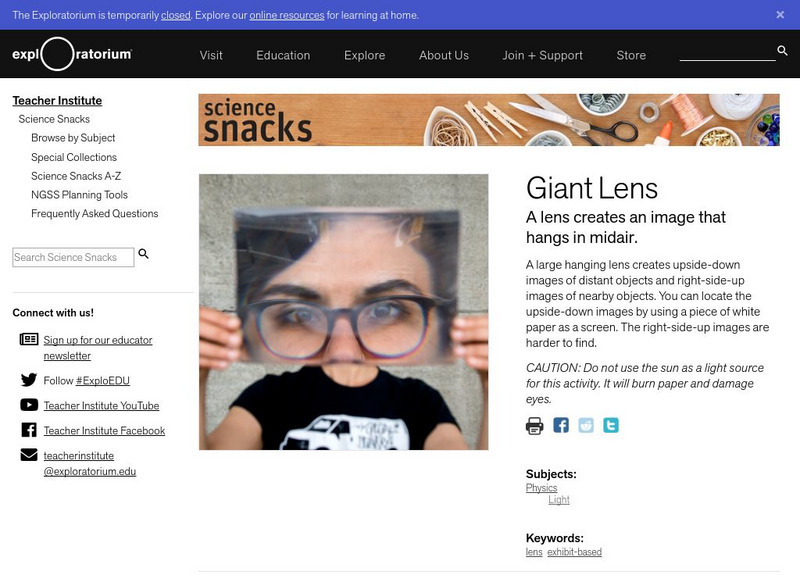
Exploratorium: Science Snacks: Giant Lens
A discussion of how to make a refraction exhibit using a Fresnel lens. Consists of assembly instructions and a "To do and notice" section.
Georgia State University
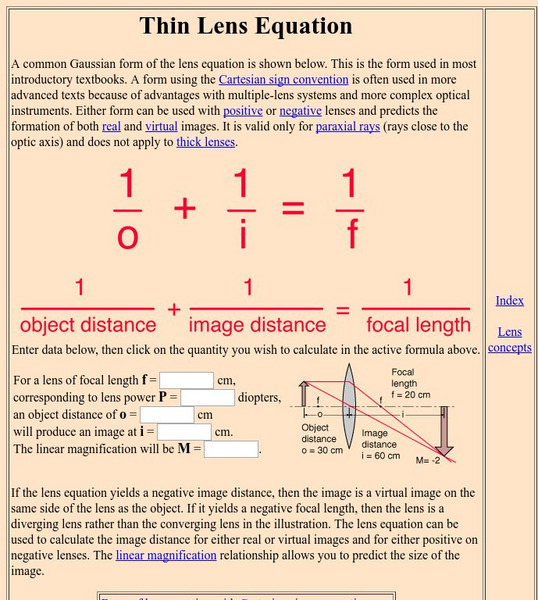
Georgia State University: Hyper Physics: Thin Lens Equation
This is an informative site from Georgia State University. It gives a discussion of the thin lens equation and an illustration of its use in determining the image distance based upon the object distance and the focal length.
Georgia State University
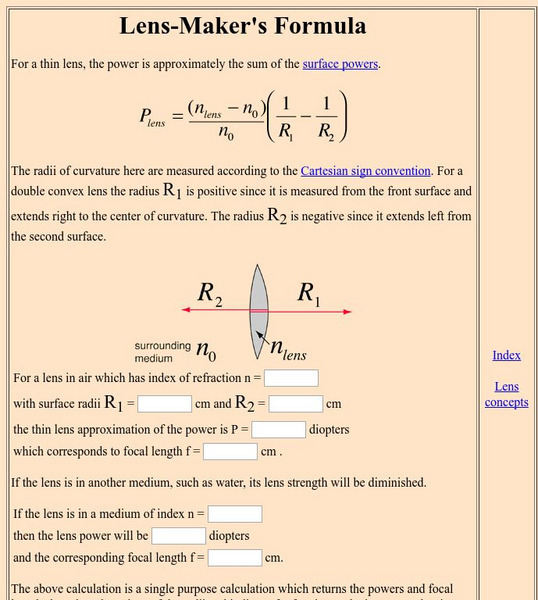
Georgia State University: Hyper Physics: Lens Maker's Formula
A discussion of the lens-maker's formula and its use in determining the effect of lens shape and index of refraction upon the magnifying power of a lens. Includes an interactive problem-solving section.

Khan Academy
Khan Academy: Thin Lens Sign Conventions
Have you ever wondered why some people need glasses and others don't? It's because of the way light is focused by the lens in your eye. This lens, like magnifying glasses, eyeglasses, and contact lenses, is considered a thin lens.
Exploratorium
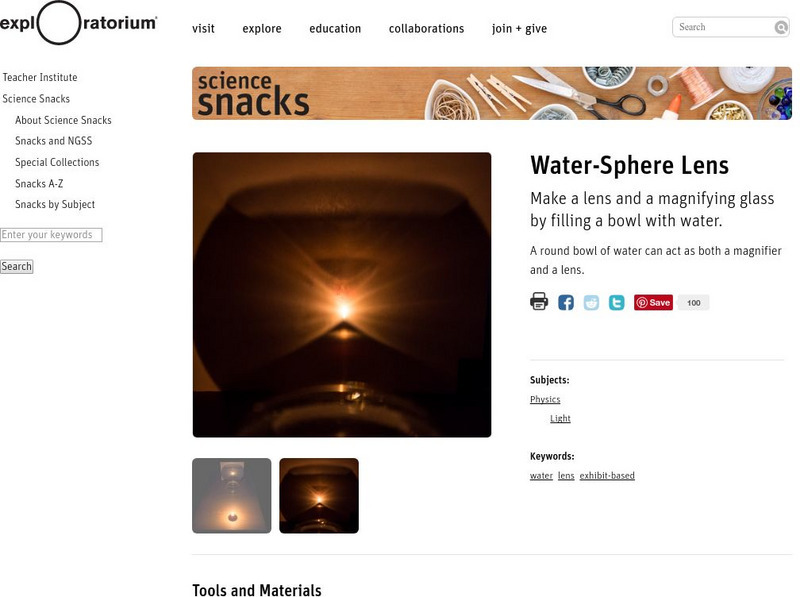
Exploratorium: Science Snacks: Water Sphere Lens
Demonstrate for students how a round bowl of water can act as both a magnifier and a lens.

CK-12 Foundation
Ck 12: Physics Simulation: Magnifying Glass
[Free Registration/Login Required] Learn about the type, size, location, and orientation of the image that forms when a thin lens is used to view an object using this interactive simulation. A PDF worksheet and a video tutorial are also...
Exploratorium
Exploratorium: Water Sphere Lens
A discussion of how to make a magnifying lens exhibit using a water-filled flask and a light bulb. Consists of assembly instructions and a "To do and notice" section. Great for a teacher demonstration or a student project.
Optical Society
Optical Society of America: Optics for Kids: Watch Tv Upside Down
An experiment to invert a television image using a magnifying lens. Accompanied by an explanation of what's happening.
Center of Science and Industry
Cosi Columbus: Two Lenses in One
Investigate the behavior of a water filled vial, and discover why it acts like a magnifier. Includes full list of materials, procedures, and scientific explanation of what causes light rays to change direction.

Science Education Resource Center at Carleton College
Serc: Investigating Oranges How Many Sections Are Inside?
For this biology investigation students will be asked to attempt to determine how many sections exist in an orange without having peeled it. Students will work in small cooperative groups. Each group will be able to use a small...
Globe
The Globe Program: Water Module
Learning activities allow students to learn about tools for making science observations such as a magnifying lens and ruler. Then students describe how macroinvertebrates are adapted to their aquatic environment.