Hi, what do you want to do?






Curated OER
It's Time to Make Time!
Students explore the evolution of time measurement, and explain the relationship of sunrise/sunset to length of daylight. They collect data and calculations to determine length of daylight during a given day.

North Carolina Museum of Natural Sciences
Weather Watch Activity Guide: Groundhog Day
Exactly what do groundhogs know about weather? Not as much as your science students will after completing these lessons and activities that cover everything from the earth's rotation and the creation of shadows, to cloud...

Curated OER
Primary History: Ancient Greeks - Athens
In this world history worksheet, students study the government of Athens, read surviving court cases, and try making a water clock. They read about Atlantis and design a plate showing the festivals of ancient Greece which they paint...

Curated OER
Stargazers and Skywatchers
Students observe the daily motions of the sun and relate them to the functions of a sundial. They determine the locations of sunrises and sunsets and determine how the elevation of the sun effects temperature.

Curated OER
Stargazers and Skywatchers
Students are introduced to the apparent motion of the Sun across the sky and the way it changes in summer and winter.

Space Awareness
What is Time?
Does it ever seem like time is slipping through your fingers? Model the passing of time with an hourglass activity in which individuals determine whether hourglasses are the most efficient way to measure time.

Curated OER
Big Time Lessons
Teaching students about time can provide a way to talk about sundials, different types of clocks, and even time travel.

Curated OER
Clocks and Time
Second graders observe and demonstrate how to tell and write time. They discuss different ways and things that tell time, then listen to a teacher-led lecture about the hands on a clock. Students complete a worksheet along with the...

Curated OER
"Space" Investigations
Sixth graders understand the patterns of change observable on Earth as a result of the movement of the different bodies in the solar system. They identify the physical characteristics of the different components of the solar system.

Curated OER
Stargazers And Skywatchers
Students recognize the daily motion of the Sun across the sky, defining the main directions of east, west, south and north. They see how the first calendars were based on changes in the Sun's noontime elevation, and on locations of...

Curated OER
The Earth Moves Around the Sun
Students demonstrate that the movement of the sun causes shadows which were used as the first indicators of telling time.

Curated OER
Intermediate Critical Reading - Clocks
In these critical reading worksheets, students read the short story about clocks. Students then answer 3 critical reading questions about the passage.

Utah Education Network
Uen: Trb 3:1 Investigation 5 Making a Sundial
Make a sundial and learn how to use it.
Other
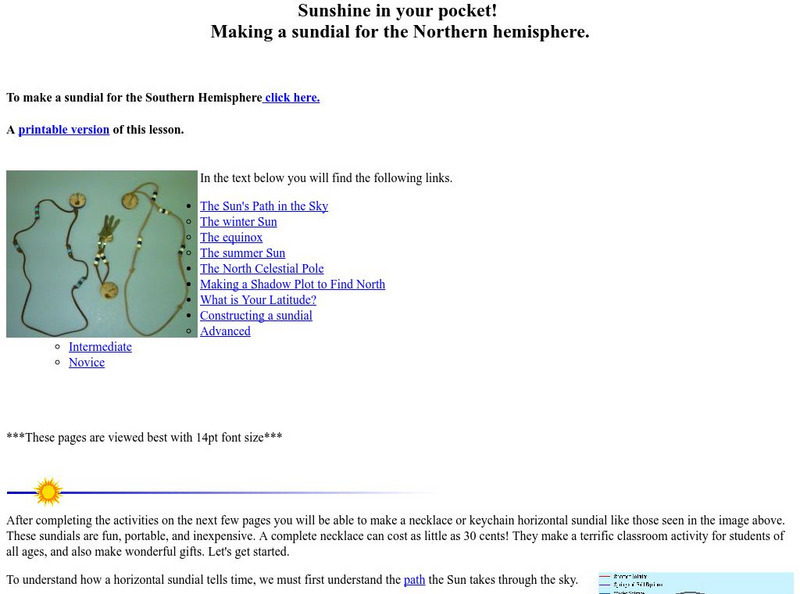
Lockheed Martin: Making a Horizontal Sundial
A website with directions on how to build a sundial for the Northern Hemisphere and information on how a sundial works. Includes three skill levels of construction.
Harvard University
University of Harvard: This Is a Stickup!
Students are taught how to make a sundial. The relationship between angles and the sides of a right triangle are explored. Great lesson plan ideas with plenty of background information. The instructional activity is adapted for grade...
TeachEngineering
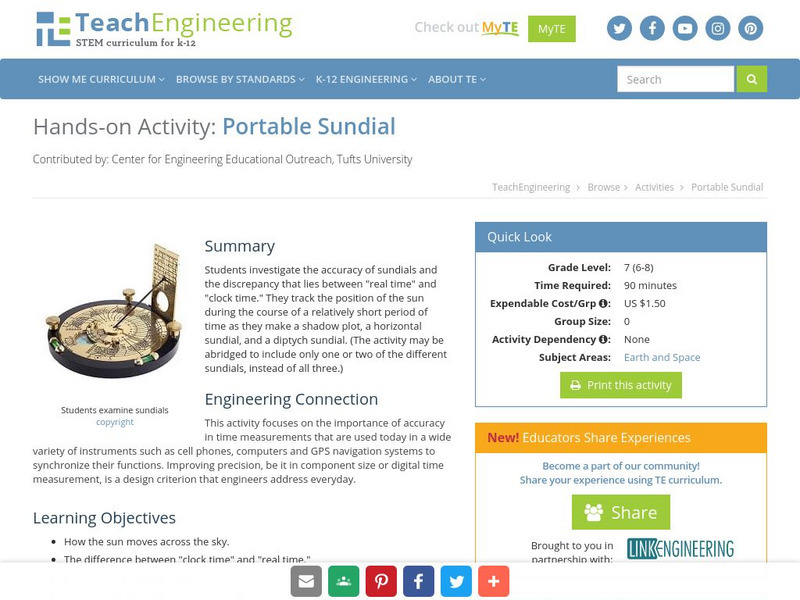
Teach Engineering: Portable Sundial
In this activity students will investigate the accuracy of sundials and the discrepancy that lies between "real time" and "clock time". They will track the position of the sun over the course of a relatively short period of time as they...
Other
Center for Science Education: Eye on the Sky: Observing and Using Shadows
This resource provides all the directions and worksheets necessary to make a sundial and record data with it.
Curated OER
Sundial Image
This resource provides all the directions and worksheets necessary to make a sundial and record data with it.
Exploratorium
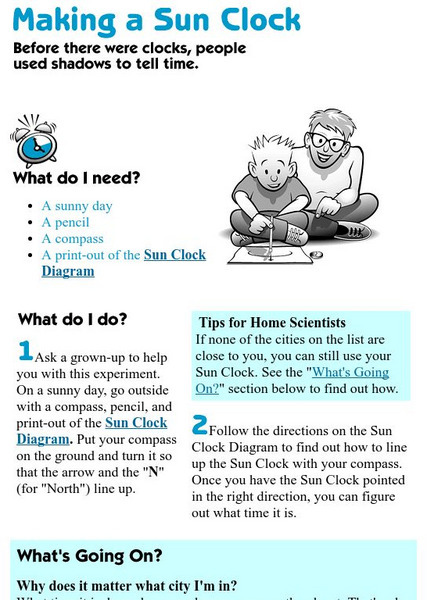
Exploratorium: Making a Sun Clock
Learn how to use the sun to tell time. This simple activity reinforces the concepts of light and shadow, night and day, time, and geographical north vs. magnetic north.
Curated OER
Using the Sun Clock
Very simple directions for making a sundial and a question and answer section that explains why and how a sun clock works.
Curated OER
Finding the Two North Poles
Very simple directions for making a sundial and a question and answer section that explains why and how a sun clock works.