Hi, what do you want to do?






Curated OER
Code Makers - Electron Configuration, Aufbau Principle
Students write the electron configuration of elements using the Aufbau principle. In this chemistry lesson, students build their own key that demonstrates the principle.

Curated OER
Color
In this color worksheet, students read where light comes from and the different colors created through a prism. Students compare light (additive color) with pigments (subtractive color). Then students complete 1 drawing, 6 matching, 22...

Alabama Learning Exchange
Alex: Atoms and Models of Atoms
This lesson introduces students to scientific models. The students will learn how models of the atom have changed as new evidence is gathered. The students will also learn about the current model of the atom. Each student will make a...
University of Colorado
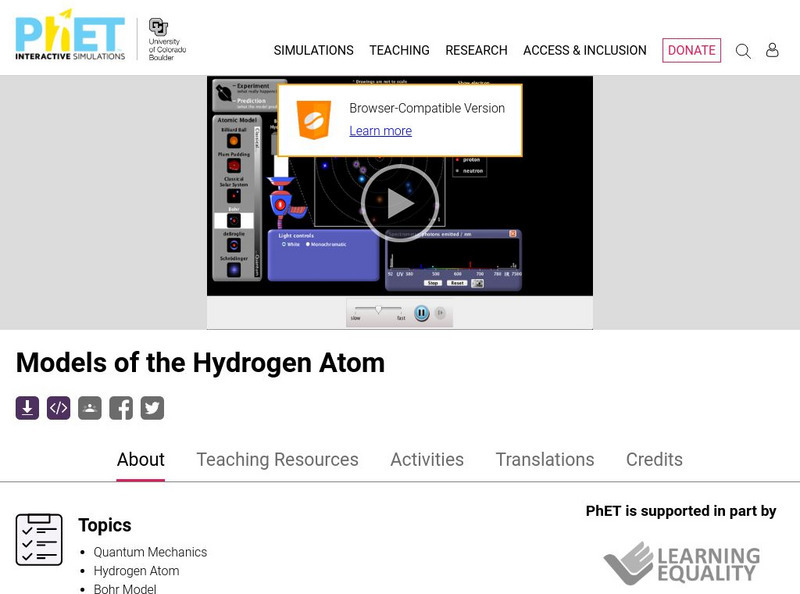
University of Colorado: Ph Et Interactive Simulations: Models of the Hydrogen Atom
How did scientists figure out the structure of atoms without looking at them? Try out different models by shooting light at the atom. Check how the prediction of the model matches the experimental results.

American Museum of Natural History
American Museum of Natural History: O Logy: Stuff to Do: Atomic Mobile
Illustrated instructions for how to make a model of an atom (an atom mobile).
Science Education Resource Center at Carleton College
Serc: Electron Energy Levels of Atoms and Ions
In this lab, students investigate basic electron structure by making a model using pennies and different sized filter papers.
Concord Consortium
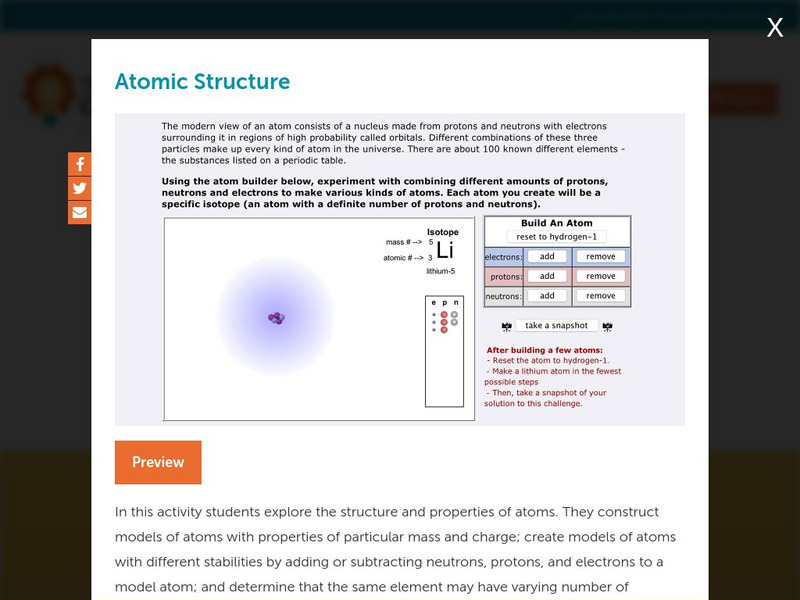
Concord Consortium: Stem Resources: Atomic Structure
Introduces learners to atomic models of the past and present, focusing on the orbital model and an explanation of its basis. Learners then have the opportunity to "make an atom" and contrast it with an ion, followed by an isotope. The...
CK-12 Foundation
Ck 12: Physical Science: Atoms
[Free Registration/Login may be required to access all resource tools.] Atoms and how they are related to elements, and the particles that make up atoms.
TeachEngineering
Teach Engineering: Gumdrop Atoms
In this activity, students make a model of a lithium atom using gumdrops and toothpicks. Using this model, they investigate the makeup of an atom, including its relative size. Students also practice adding and subtracting electrons from...
Science Education Resource Center at Carleton College
Serc: Tic Tac Toe Pick 3 in a Row Atomic Model Assignment
A choice menu assignment where students select between several extension activities that help understand the structure of the atom.
Other
Critical Thinking Community: Remodeling Lessons Grades 4 6
Learn to re-model your lesson plans to include room for critical thought and higher levels of learning. Re-modeled lessons cite specific critical thinking strategies. Wonderful examples include " Writing Haiku," "Myths," "Sojourner...
CK-12 Foundation
Ck 12: Chemistry Simulation: Rutherford's Gold Foil Experiment
[Free Registration/Login Required] How can we predict an atom's structure, if we cannot see an atom? Using the Rutherford's Gold Foil Experiment, make your own model and test out the model.
Other
Beautiful Chemistry: Beautiful Structures: Quasicrystals
An interactive display of quasicrystals allows students to study the inner components and molecular make-up of these structures. Since the discovery of quasicrystals, a lot of efforts have been put on finding the locations of atoms...

CK-12 Foundation
Ck 12: Plix: Aspartame Molecule: Peptides
[Free Registration/Login Required] Given prior knowledge of bonding and the molecular make up of aspartame, examine the model and determine which color represents which atom. Drag the labels at the bottom to the appropriate colored atom...