Hi, what do you want to do?






Pennsylvania Department of Education
Fraction Strips
Young scholars explore number sense by participating in a class fraction game. In this number value lesson, students utilize strips of paper with fractions written on them and conduct a trivia game in which teams challenge each other....

Pennsylvania Department of Education
Exploring Key Ideas and Details in Fiction and Nonfiction
Third graders participate in activities to differentiate fiction from nonfiction. In this fiction lesson, 3rd graders describe the elements of a fiction story. Students compare and contrast fiction and non fiction elements....

Pennsylvania Department of Education
Volume of Compound Figures
Fifth graders use patterns, models and relationships to solve equations. In this equations lesson, 5th graders define vocabulary for equations and complete worksheets explaining variables and solving problems.

Curated OER
Weather, Climate and Atmospheric Process
Students explore Earth science by completing a could identification activity. In this weather lesson, students discuss the different forms of measurement for the weather of Earth. Students discuss global warming and examine a list of...

Pennsylvania Department of Education
The Digestive System
Fourth graders simulate how the digestive system works. For this hands-on simulation, 4th graders complete six group activities that help students visualize how our body breaks down food into nutrients.

Curated OER
Build Your Own Submarine
Students construct their own submarine following a certain procedure. In this physics lesson plan, students calculate the density of objects using a mathematical formula. They explain why some object floats in water while some do not.

Curated OER
The Space Cadet's Laboratory: Using Electromagnetic Energy to Study Astronomy
Young scholars build their own spectrophotometer to study light. In this physics lesson, students explain the dual nature of light. They calculate the angle of incidence and refraction using Snell's law equation.

Curated OER
How to Inspire the Young Inventors in Your Classroom
Learning about inventing and innovation can be exciting and empowering for all students.
TED Talks
Ted: Ted Ed: Make Robots Smarter
There are three major rules that we want our robots to follow: do not harm a human, obey us, and protect us. The prerequisite for these rules? We need to make robots smarter. Ayanna Howard explains how robots can become smarter (hint: it...
TeachEngineering
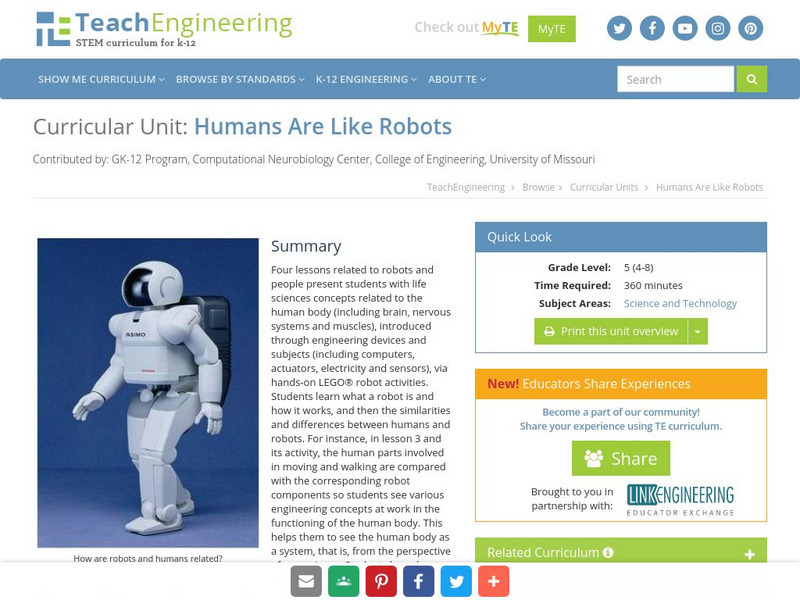
Teach Engineering: Humans Are Like Robots
Four lessons related to robots and people present students with life sciences concepts related to the human body (including brain, nervous systems and muscles), introduced through engineering devices and subjects (including computers,...
TeachEngineering
Teach Engineering: How Do You Make Loops and Switches?
Students learn how to program using loops and switches. Using the LEGO MINDSTORMS NXT robots, sensors and software, student pairs perform three mini programming activities using loops and switches individually, and then combined.

Curated OER
Cbc Kids: 10 of the Latest Inventions to Make Life a Little Easier
Learn about some of the nifty inventions that add more functionality to common objects. With the Smart toothbrush, your teeth will be clean in no time. The Albert Clock forces you to answer a Math question before it tells you the time....

Read Works
Read Works: How to Make a Better Robot
[Free Registration/Login Required] An informational text about improvements in robotics. A question sheet is available to help students build skills in reading comprehension.

ABCya
Ab Cya: Make a Robot
Kids will enjoy engaging in this interactive to build a virtual robot. Extend the activity by printing out the creation and incorporating language arts as students write a descriptive story about their new robotic friend or an expository...
TeachEngineering
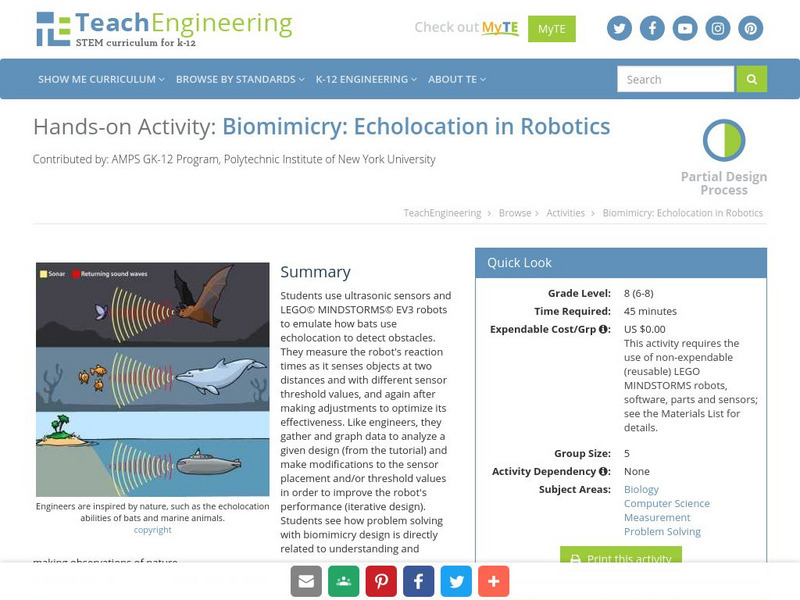
Teach Engineering: Biomimicry: Echolocation in Robotics
Students use ultrasonic sensors and LEGO MINDSTORMS NXT robots to emulate how bats use echolocation to detect obstacles. They measure the robot's reaction times as it senses objects at two distances and with different sensor threshold...
TeachEngineering
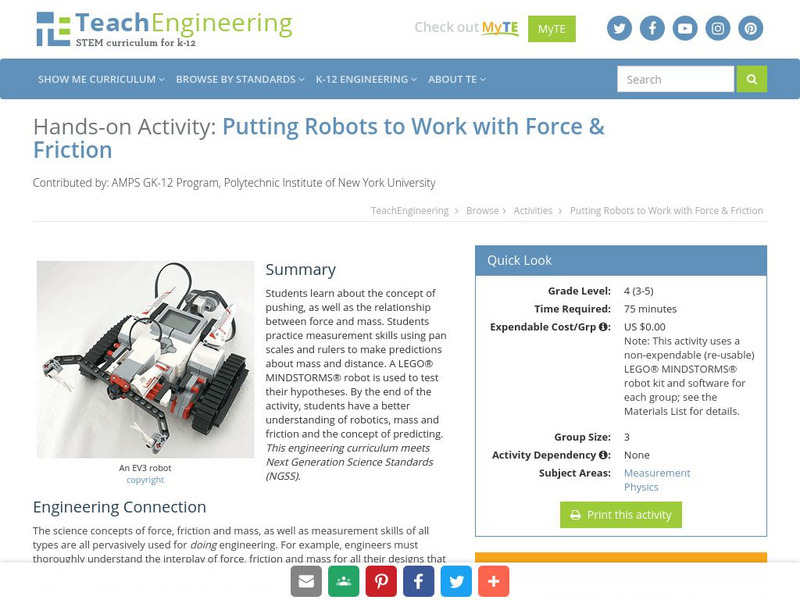
Teach Engineering: Putting Robots to Work With Force & Friction
Students learn about the concept of pushing, as well as the relationship between force and mass. Students practice measurement skills using pan scales and rulers to make predictions about mass and distance. A LEGO MINDSTORMS NXT robot is...
TeachEngineering
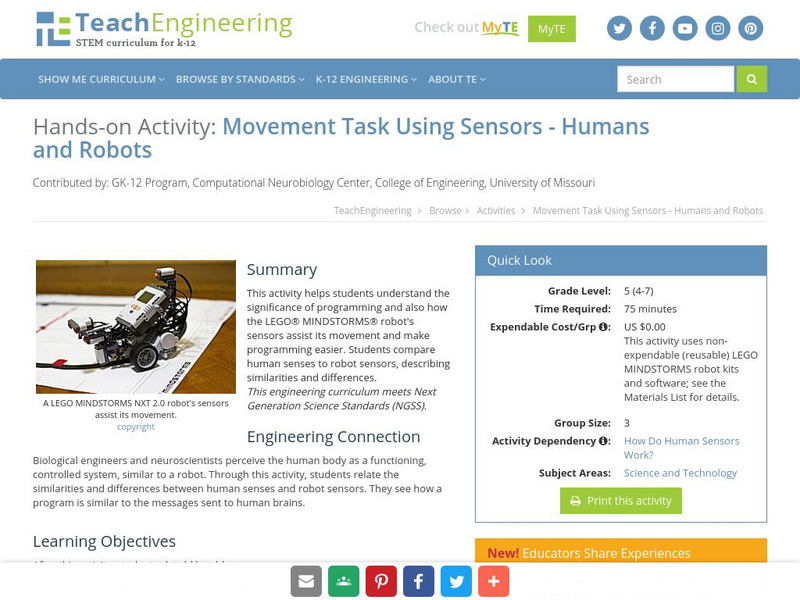
Teach Engineering: Movement Task Using Sensors Humans and Robots
This activity helps students understand the significance of programming and also how the LEGO MINDSTORMS NXT robot's sensors assist its movement and make programming easier. Students compare human senses to robot sensors, describing...
TeachEngineering
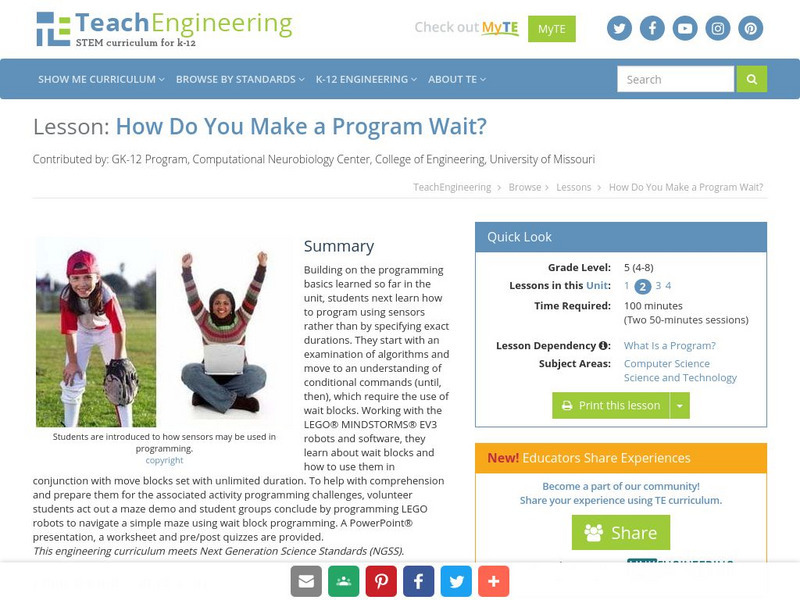
Teach Engineering: How Do You Make a Program Wait?
Building on the programming basics learned so far in a corresponding Robotics unit, students learn how to program using sensors rather than by specifying exact durations. Working with the LEGO MINDSTORMS NXT robots and software, they...
TeachEngineering
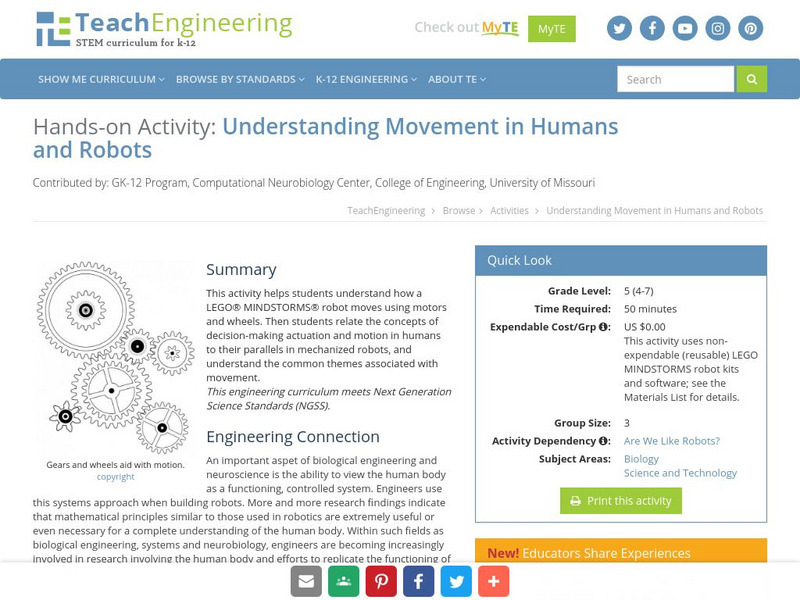
Teach Engineering: Understanding Movement in Humans and Robots
This activity helps students understand how a LEGO MINDSTORMS NXT robot moves using motors and wheels. Then students relate the concepts of decision-making actuation and motion in humans to their parallels in mechanized robots, and...
TeachEngineering
Teach Engineering: Human and Robot Sensors
Students are provided with a rigorous background in human "sensors" (including information on the main five senses, sensor anatomies, and nervous system process) and their engineering equivalents, setting the stage for three associated...
TeachEngineering
Teach Engineering: Are We Like Robots?
Students explore the similarities between how humans move and walk and how robots move, so they come to see the human body as a system from an engineering point-of-view. Movement results from decision making (deciding to walk and move)...

Technovation
Curiosity Machine: Challenges: Build a Robotic Face
Build a robotic face that can make facial expressions using simple machines on this website. This website includes the challenge, tips, a lesson plan, and a place for students to document their engineering design process.
Other
Allerin: How Green Robots Are Helping With Environmental Sustainability
Robots are now being used to fight climate change and protect our green environments. They help to fight forest fires, manage our waste, restore the oceans, support renewable energy initiatives, and make agriculture more-environmentally...
Better Lesson
Better Lesson: Creating a Robot (2 Days)
What do tin foil, surface area, and rectangular prisms make? A tin foil robot of course! This lesson includes practice problems about surface area, worksheets, a video explanation, and a reflection sheet.