Hi, what do you want to do?





Science Education Resource Center at Carleton College
Serc: At the Speed of Bowling
In this lab students will measure the energy of a bowling ball with vernier motion detectors. The students will calculate the energy of the ball at the beginning, mid point, and end of a bowling alley. Students will inquire about the...

PBS
Pbs Learning Media: Rocket Sled
Explore the relationship between thrust, drag, friction, weight, and acceleration in this interactive simulation and see if you can make the sled stop on a particular rock
Physics Aviary
Physics Aviary: Atwood Machine Lab
This lab was designed to have students practice the Atwood lab prior to doing it for real. Students can adjust the masses and the planet and then collect position vs. time data and velocity vs. time data.

Concord Consortium
The Concord Consortium: Molecular Workbench: A Pendulum
Change the mass of a suspended object to see how its movement and forces are affected by gravity.
Wikimedia
Wikipedia: Centripetal Force
Wikipedia's site on centripetal force provides a section explaining the difference between centripetal force and centrifugal force. Includes formulas and hyperlinked terms.
Physics Classroom
The Physics Classroom: Newtons Laws: Rocket Sledder Interactive
Experience the effect of friction, air resistance, and applied force upon a sledder. The speed, acceleration, and force values are displayed as the sled moves. Learners can vary the mass of the sledder and the size of the parachute...
Soft Schools
Soft Schools: Physics Quizzes: Newton's Three Laws
Assess your understanding of Newton's three laws of motion and the ability to distinguish between the three with this interactive multiple choice quiz. Receive immediate feedback to your answers.
TeachEngineering
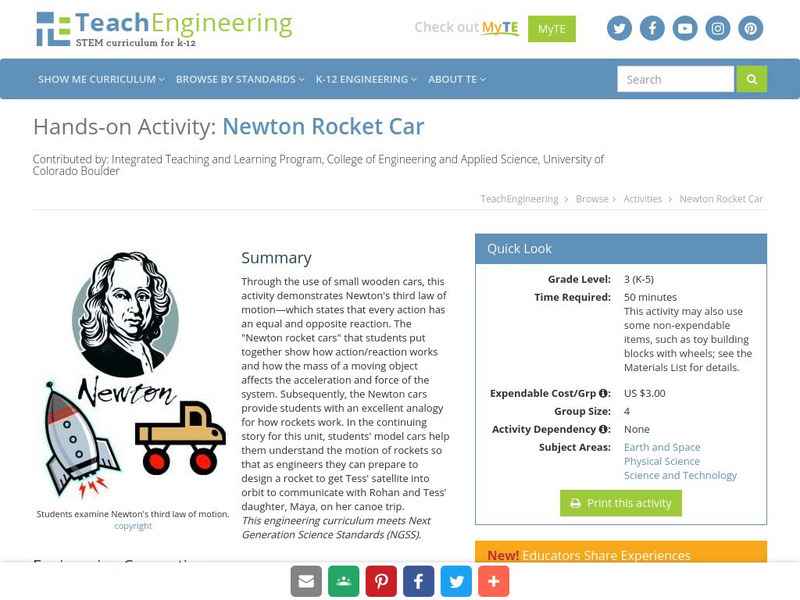
Teach Engineering: Newton Rocket Car
The purpose of this activity is to demonstrate Newton's third law of motion - which states that every action has an equal and opposite reaction - through a small wooden car. The Newton cars show how action/reaction works and how the mass...
Lawrence Berkeley National Laboratory
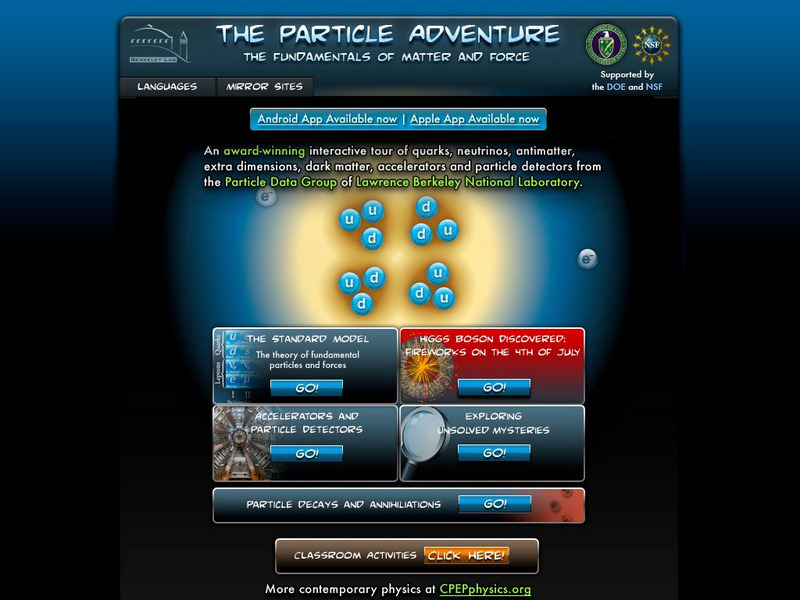
Berkeley Lab: The Particle Adventure
Visit this site for an interactive tour of the atom and all aspects of particle physics. View the animations available with almost every description on this site. A great place for the fundamentals of particles and forces including a...
University of Colorado
University of Colorado: Ph Et Interactive Simulations: Pendulum Lab
Manipulate the mass of a weight and the length of string in this interactive pendulum simulation. Change the speed, friction, and gravity to make the pendulum swing change as measurements are displayed on the screen. Younger students can...
Sophia Learning
Sophia: Newton's Second Law: Lesson 2
This lesson introduces Newton's Second Law and explains that force is equal to mass times acceleration. It is 2 of 3 in the series titled "Newton's Second Law."
Sophia Learning
Sophia: Newton's Second Law: Lesson 1
This lesson introduces Newton's Second Law and explains that force is equal to mass times acceleration. It is 1 of 3 in the series titled "Newton's Second Law."
Walter Fendt
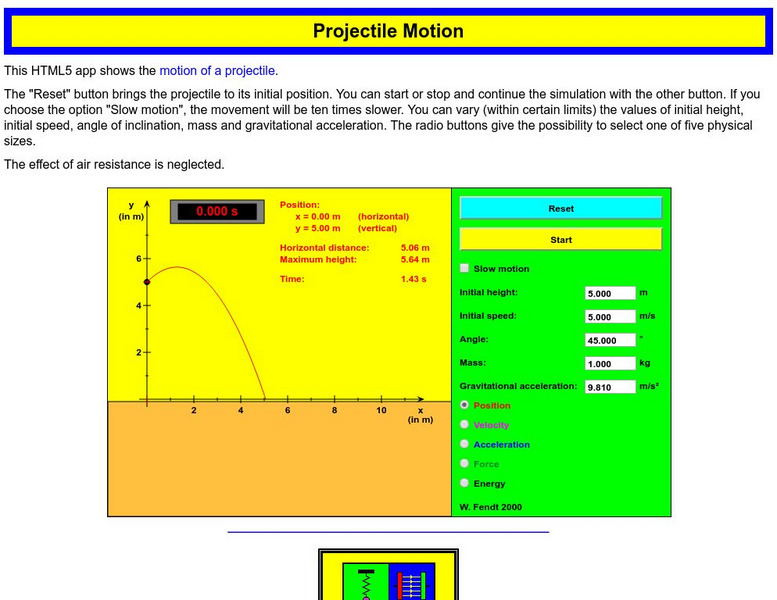
Walter Fendt: Projectile Motion
A short interactive activity to show the movement of a projectile. You can change the values of the initial height, velocity, angle of inclination, the mass and the gravitational acceleration.
Curated OER
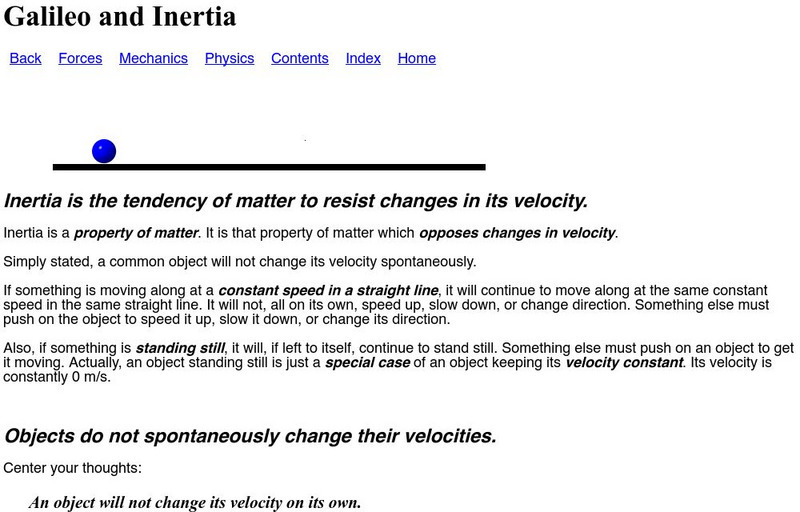
Zona Land: Galileo and Inertia
A tutorial with accompanying animations on classical mechanics. Well-illustrated. Good navigation.

University of Colorado
University of Colorado: Ph Et Interactive Simulations: My Solar System
An interactive simulation that teaches about motion, acceleration, and velocity by allowing students to build their own solar system and watch the effects of gravitational pull and how that changes with initial position, velocity, and...
National Institute of Standards and Technology (NIST)
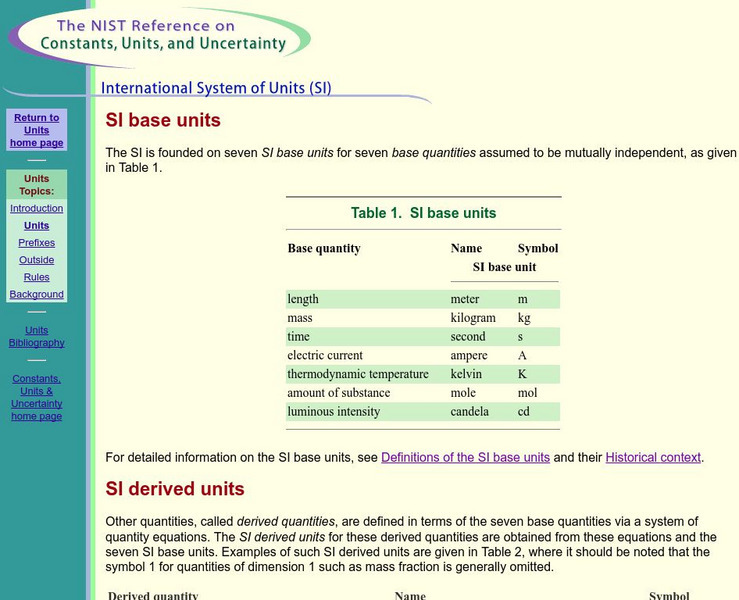
International System of Units: Si Base Units
This is the definitive source for information on SI base units, derived units, squares, cubes, luminosity, field strength and flux density.

University of St. Andrews (UK)
University of St. Andrews: Albert Einstein
A truly complete biography of the great man. Some adequate discussion of his theoretical and scientific work, but the accent here is on his personal life. Many anecdotes, many quotes from him, many references and hotlinks to other...
University of Virginia
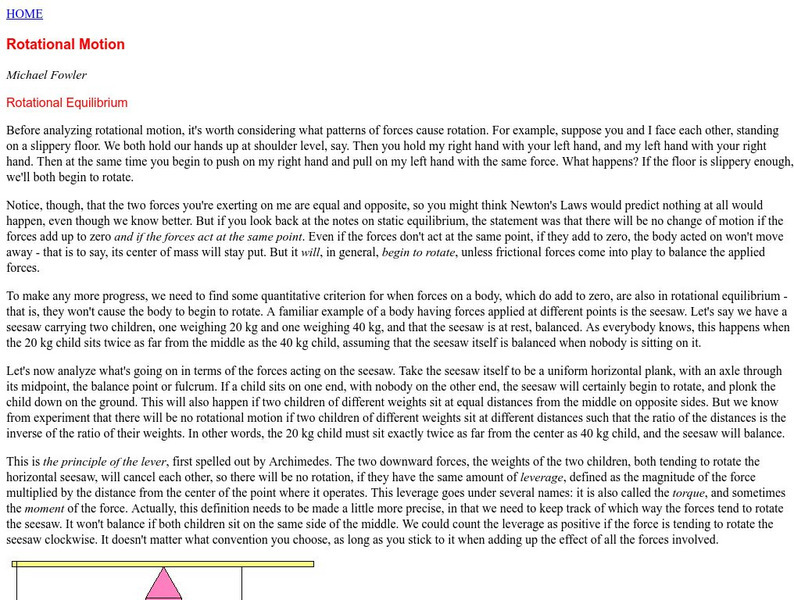
University of Virginia: Rotational Motion
A page describing rotational equilibrium and non-equilibrium situations. Includes graphics, equations, and many examples.
Physics Aviary
Physics Aviary: Newton's Law Lab
This lab was designed to have students investigate the factors that affect the acceleration of an object on a frictionless horizontal surface. The simulation will give the students position vs. time data and they will have to determine...
Physics Classroom
The Physics Classroom: Circular & Satellite Motion: Uniform Circular Motion
Manipulate variables while exploring principles and relationships related to moving in a circle at a constant speed. Students change the radius of the circle, the speed of the object, and the mass of the object and investigate the effect...
Math Is Fun
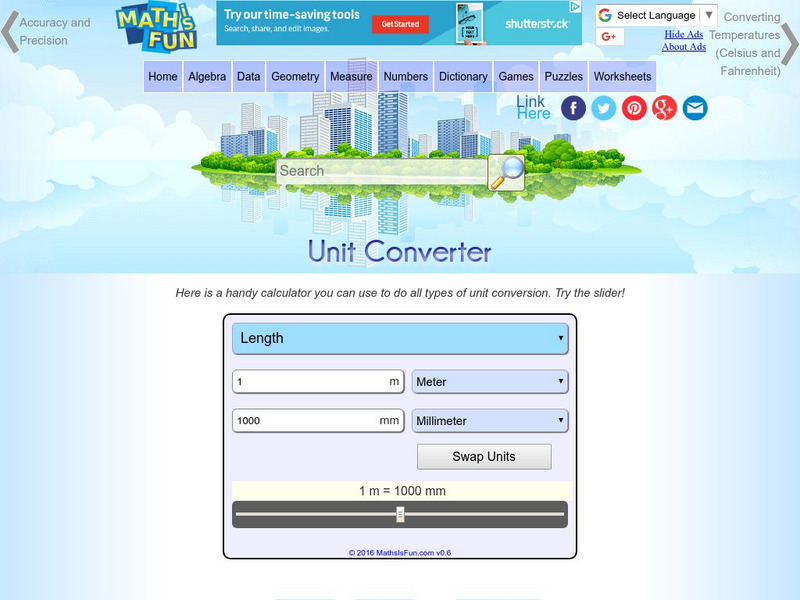
Math Is Fun: Unit Conversion Tool
Use this online tool to convert measurements of acceleration, area, density, electricity, energy, force, length, mass, and other measurable properties.
Texas Instruments
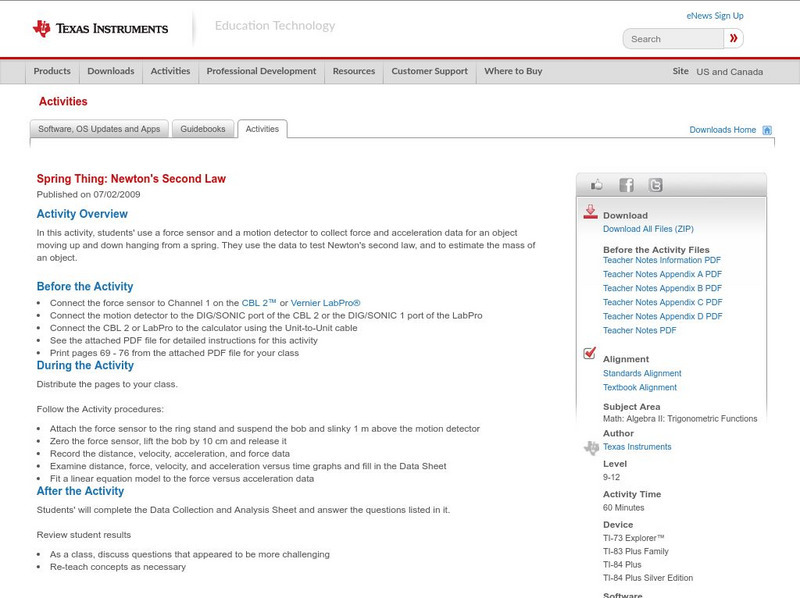
Texas Instruments: Spring Thing: Newton's Second Law
In this activity, students' use a force sensor and a motion detector to collect force and acceleration data for an object moving up and down hanging from a spring. They use the data to test Newton's second law, and to estimate the mass...
TeachEngineering
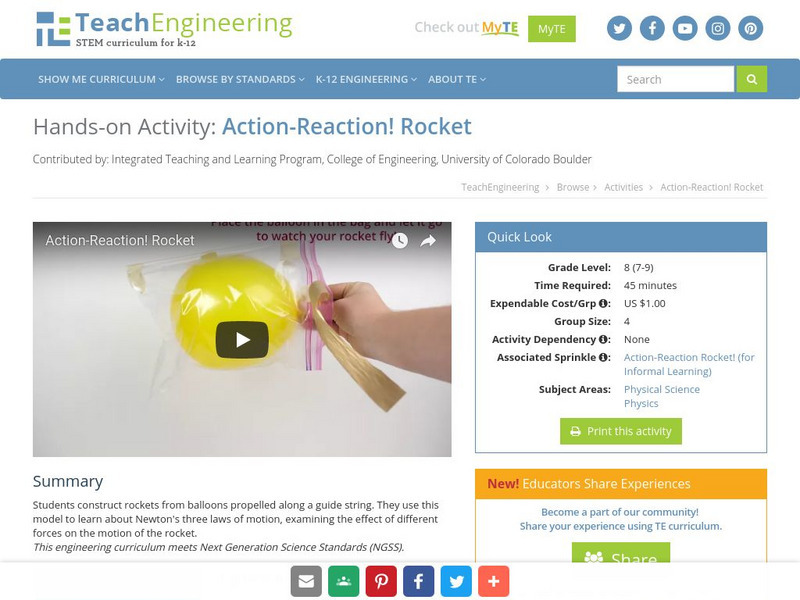
Teach Engineering: Action Reaction! Rocket
Students construct a rocket from a balloon propelled along a guide string. They use this model to learn about Newton's three laws of motion, examining the effect of different forces on the motion of the rocket.
TeachEngineering
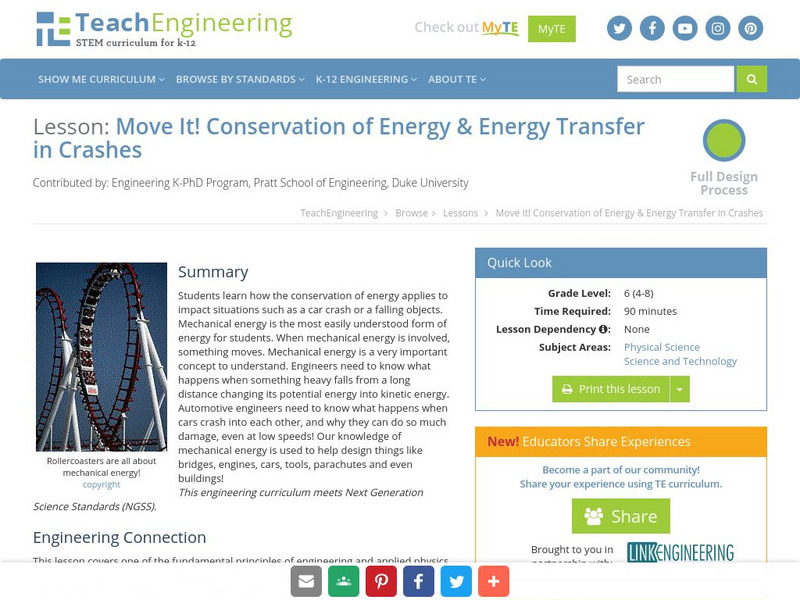
Teach Engineering: Move It!
Mechanical energy is the most easily understood form of energy for students. When there is mechanical energy involved, something moves. Mechanical energy is a very important concept to understand. Engineers need to know what happens when...