Hi, what do you want to do?





Science and Mathematics Initiative for Learning Enhancement (SMILE)
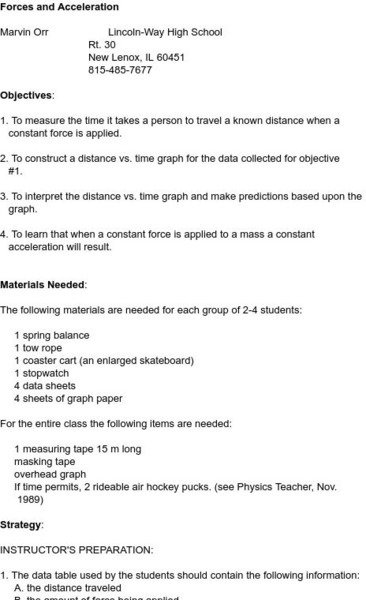
Smile: Lab Work Forces & Acceleration
The Illinois Institute of Technology provides this site. The site contains a graphing activity which illustrates that a constant force exerted upon an object results in constant acceleration. Rolling carts and stopwatches are used to...
Wikimedia
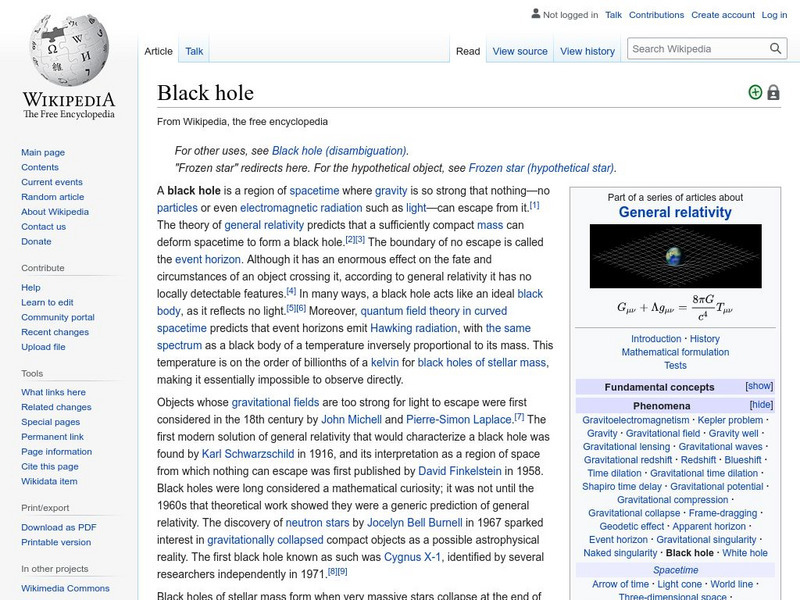
Wikipedia: The Black Hole
This site examines the black hole as an object in astrophysics. Delve into this comprehensive resource that covers this concept from its history, to qualitative physics, the reality of black holes, mathematical physics and more.

Other
Online Conversion
Conversion calculators galore! Convert just about anything from one measureable unit into another measureable unit here with over two dozen calculators. Each of the links is specific to a measureable quantity. Some examples include...
Science Education Resource Center at Carleton College
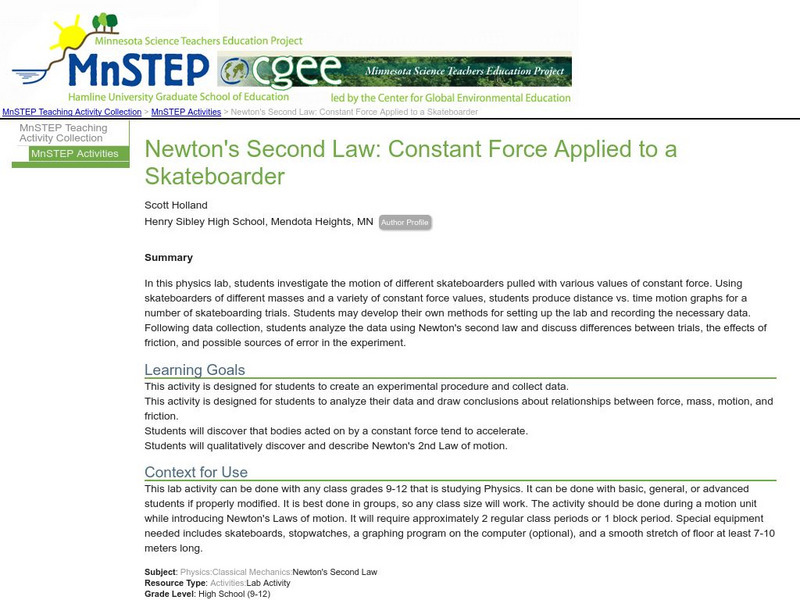
Serc: Newton's Second Law: Constant Force Applied to a Skateboarder
In this lab activity, young scholars will become familiar with Newton's 2nd Law of Motion. By investigating the motion of different skateboarders pulled with a variety of constant force values, they will discover that bodies acted on by...
Walter Fendt
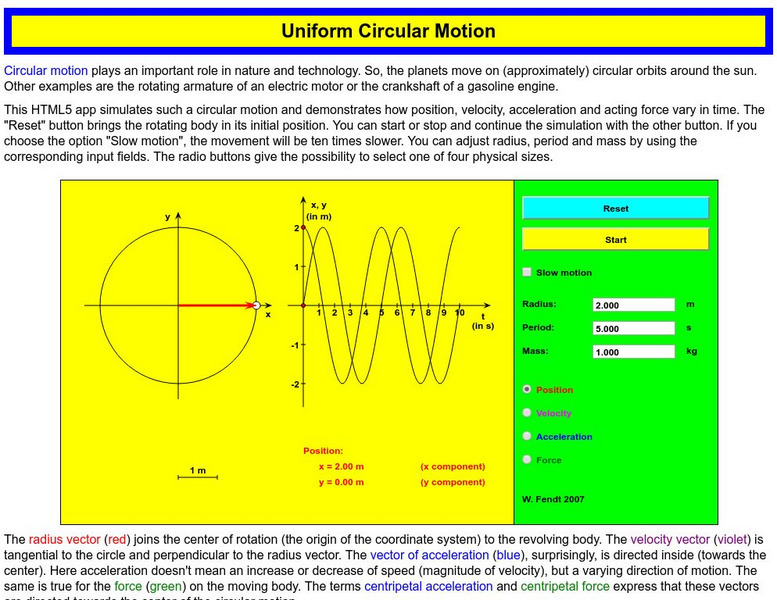
Walter Fendt: Uniform Circular Motion
This app simulates circular movement and demonstrates how the position, speed, acceleration, and the applied force vary depending on the time. You may choose the option "slow animation" to make the movement ten times slower. You can also...
Texas Instruments
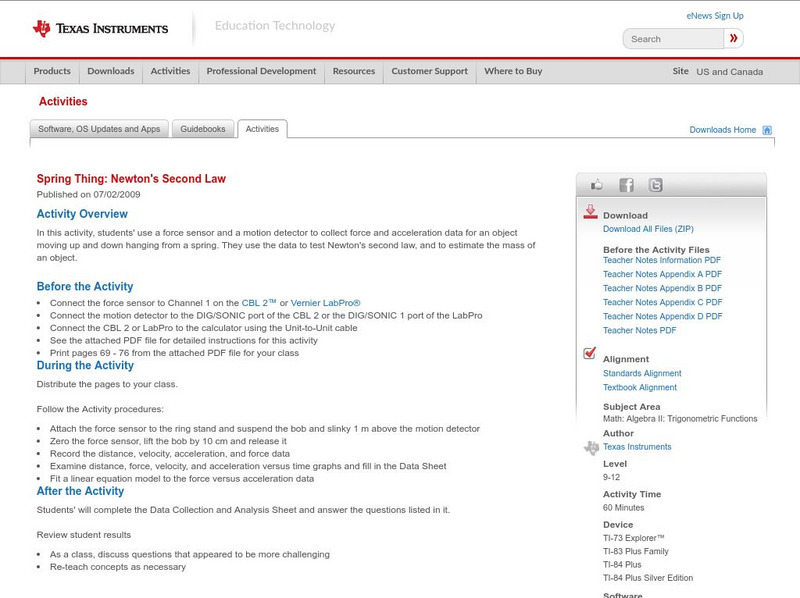
Texas Instruments: Spring Thing
This activity uses the CBL, TI-83 Plus/TI-84 Plus, force probe, and motion detector to investigate the acceleration of a mass on a spring. It also investigates Hooke's Law.

Physics Classroom
The Physics Classroom: 1 D Kinematics: The Big Misconception
An introduction to the ideas behind the misconception and misunderstanding of why all objects accelerate at the same rate. This explanation involves the concepts of force and mass.
Physics Aviary
Physics Aviary: Satellite Lab
This lab is designed to allow students to explore different aspects of satellite motion. Students can vary the mass of the satellite, the orbital radius of the satellite and the body that the satellite is orbiting. Students can measure...
Physics Aviary
Physics Aviary: Inclined Plane Lab
This lab was designed to have students discover the connection between the angle of incline and the acceleration of the object on the incline. Students can vary the angle and the mass of the frictionless object.
Physics Classroom
The Physics Classroom: Newtons Laws: Atwoods Machine Interactive
Create an Atwood's machine and a modified Atwood's machine in this interactive. Change the amount of mass on either object, introduce friction forces, and measure distance and time in order to calculate the acceleration.
Science Education Resource Center at Carleton College
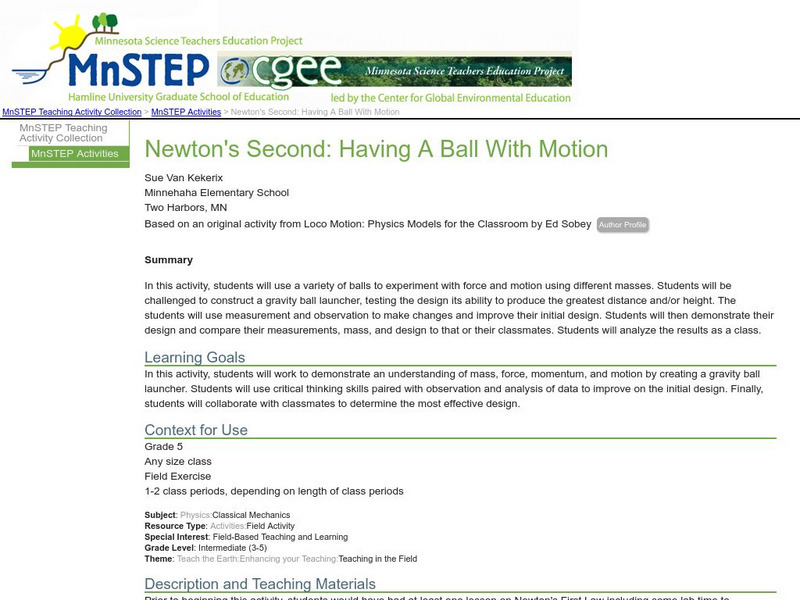
Serc: Newton's Second: Having a Ball With Motion
Students will create a gravity ball launcher to demonstrate their understanding of mass, force, momentum, and motion. The students will use critical thinking, measurement, and observation and analysis of data to make changes and improve...
Physics Classroom
The Physics Classroom: Finding Individual Forces
Explore the world of finding individual forces. "The process of determining the value of the individual forces acting upon an object involve [sic] an application of Newton's Second law and an application of the meaning of the net force."
Alabama Learning Exchange
Alex: Newton's Laws of Motion
Students use toy cars, a CBR sonic motion detector, and pennies to investigate Newton's Laws of Motion.
Physics Classroom
The Physics Classroom: Newton's Laws: Finding Individual Forces
Through illustrated examples and interactive practice problems, students find the value of forces acting upon objects using force equations.
Other
Uc Riverside: Usenet Relativity Faq
A physics usenet listing of frequently asked questions relating to relativity, answered by a number of scientists. Administrivia and Reference, Speed of Light, Special Relativity, General Relativity and Cosmology, Black Holes. Loads of...
Concord Consortium
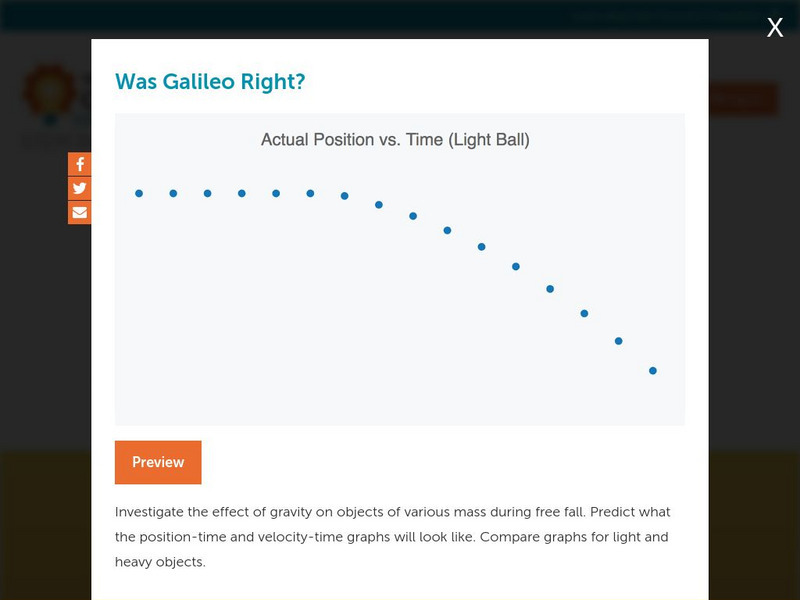
Concord Consortium: Was Galileo Right?
Investigate the effect of gravity on objects of various mass during free fall. Predict what the position-time and velocity-time graphs will look like. Compare graphs for light and heavy objects.
Physics Aviary
Physics Aviary: Pvc Freefall
This lab was designed to give students practice collecting and analyzing data for the PVC Freefall Lab. Masses are dropped from different heights and the speed of the object as it passes through a photogate is calculated. The...
TeachEngineering
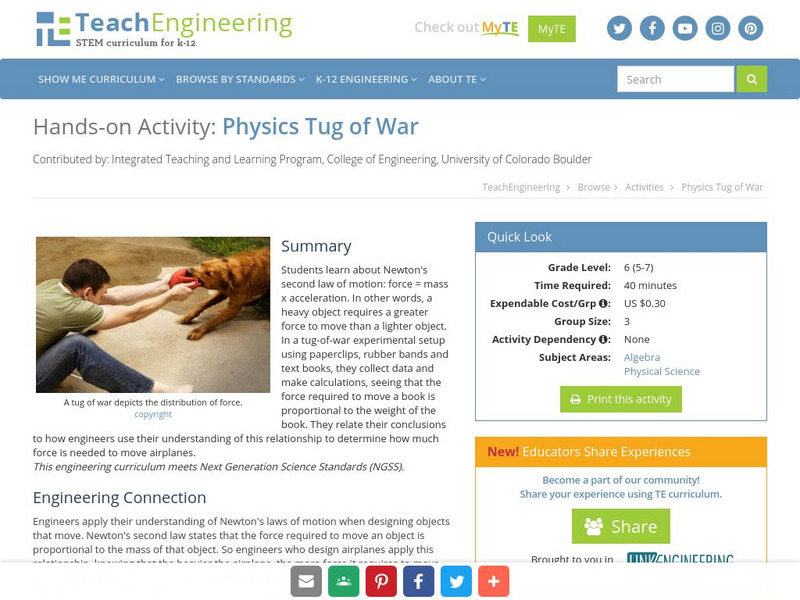
Teach Engineering: Physics Tug of War
In this activity, students will learn about Newton's 2nd Law of Motion. They will learn that the force required to move a book is proportional to the weight of the book. Engineers use this relationship to determine how much force they...
PBS
Pbs Learning Media: Defying Gravity
Students are asked how acceleration, mass, momentum and velocity are involved in mountain boarding. [0:32]
CK-12 Foundation
Ck 12: Episd: Newton's Second Law
[Free Registration/Login may be required to access all resource tools.] Break down how the relationship between acceleration and mass directly relates to the mass of an object.
San Jose State University
San Jose State University: Buildings in Earthquakes [Ppt]
Explains the physics of building movement during an earthquake through a discussion of force, mass, acceleration, frequency, and period. Then looks at the factors that affect a building's resilience versus the damage it could sustain.
Science and Mathematics Initiative for Learning Enhancement (SMILE)
Smile: Colliding Spheres
This lab activity from the Illinois Institute of Technology lets students investigate the impact of collisions upon the velocity and momentum of the colliding objects. Requires understanding of vectors.
Science and Mathematics Initiative for Learning Enhancement (SMILE)
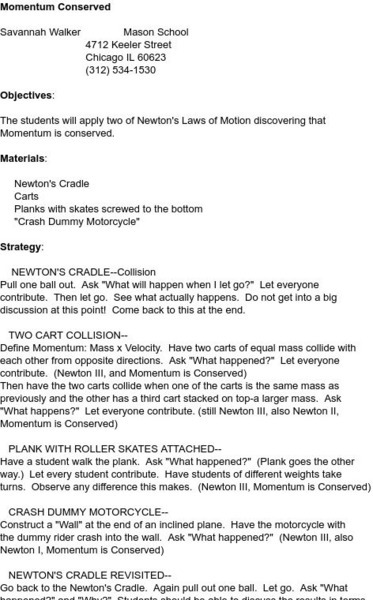
Smile: Momentum Conserved
This site by the Illinois Institute of Technology gives a Lab activity in which students use a variety of toys to discover Newton's second law and momentum conservation. Newton's cradle, skate boards, and a toy motorcycle are incoporated...
University of California
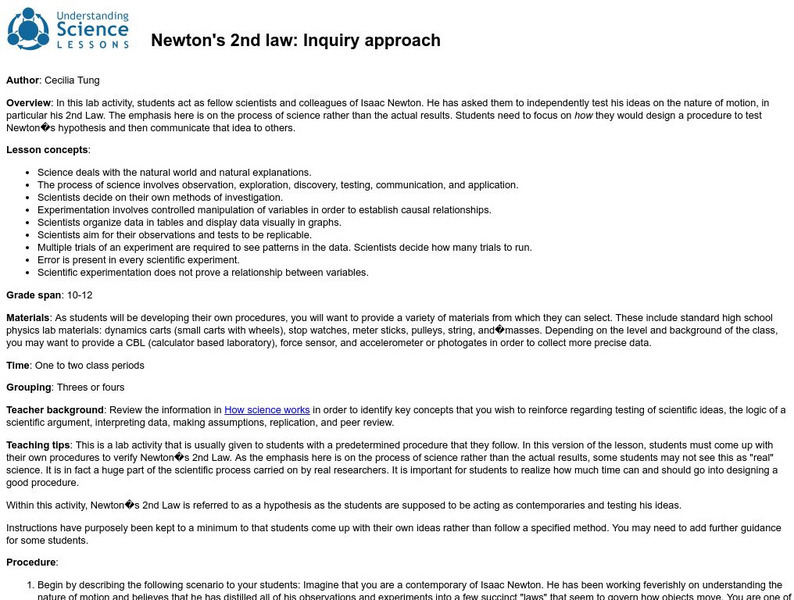
Understanding Science: Newton's 2nd Law: Inquiry Approach Lesson
For this lesson, students develop their own scientific experiment to test Newton's hypothesis that the acceleration of an object depends on the net force acting upon it and its mass. After completing their designed experiment, students...