Hi, what do you want to do?





CK-12 Foundation
Ck 12: Elem Math: Greatest to Least Value From a Set of Fractions and Decimals
[Free Registration/Login may be required to access all resource tools.] For this learning module, students compare fractions and decimals by first converting the fractions into decimals to determine which is the greatest or least....

E-learning for Kids
E Learning for Kids: Math: Baseball: Percentages
Students will compare percentages and convert them to fractions and decimals.
CK-12 Foundation
Ck 12: Write and Compare Probabilities as Fractions, Decimals and Percents
[Free Registration/Login may be required to access all resource tools.] Explains how to represent a probability in the format of fractions, decimals, and percent. Includes a probability problem with a set of sixteen questions, and a...
CK-12 Foundation
Ck 12: Elem Math: Determining Mixed Number and Decimal Equivalency
[Free Registration/Login may be required to access all resource tools.] For this learning module, students compare mixed numbers to decimals and state whether they are equivalent. Includes video demonstrating a sample problem [1:03] and...

CK-12 Foundation
Ck 12: Elem Math: Determining Less Than or Greater Than Values of a Decimal
[Free Registration/Login may be required to access all resource tools.] For this learning module, students must compare the values of fractions and decimals and state which is greater or less. Includes video demonstrating a sample...
CK-12 Foundation
Ck 12: Elem Math: Identifying Greater and Lesser Amounts
[Free Registration/Login may be required to access all resource tools.] The interactive resource is a series of questions where students have to determine which monetary value is greater than, less than, or in between the given values.
CK-12 Foundation
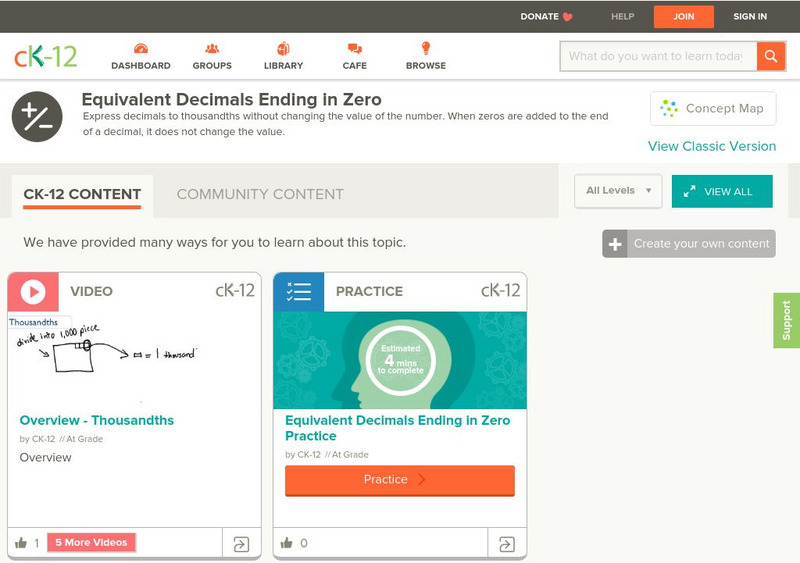
Ck 12: Elem Math: Expressing an Equivalent Decimal Ending in Zero to Thousandths
[Free Registration/Login may be required to access all resource tools.] The video describes how to add zeros as place holders at the end of a decimal to make an equivalent decimal out to the thousandths place value in this example.
National Council of Teachers of Mathematics
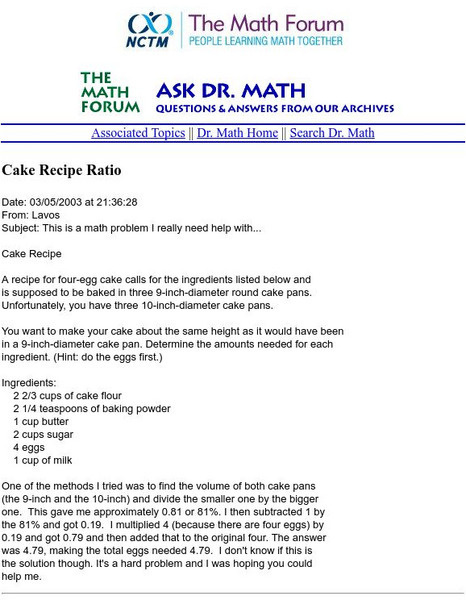
The Math Forum: Ask Dr. Math: Cake Recipe Ratio
Dr. Math has to go into the kitchen to solve this real-world problem. A student is looking for a solution to a ratio problem about baking a cake. You'll need to stir up your knowledge of ratios, fractions, decimals, proportions, and...
Math Slice
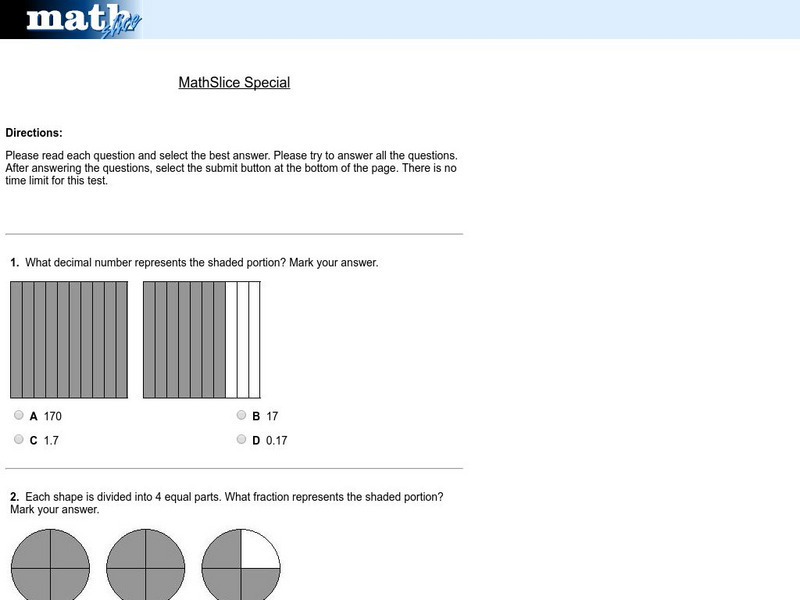
Math Slice: Fraction Slice Special Test
A succinct tool for assessing decimal and fraction concepts. Assessment is scored online. An excellent tool for use as a quick assessment.
Education Development Center
Tune in to Learning: What's a Fraction
Use this interactive lesson to learn about fractions. You will find equivalent fractions, compare fractions, and more. Immediate feedback is given to your answers. Links to related videos.
Khan Academy
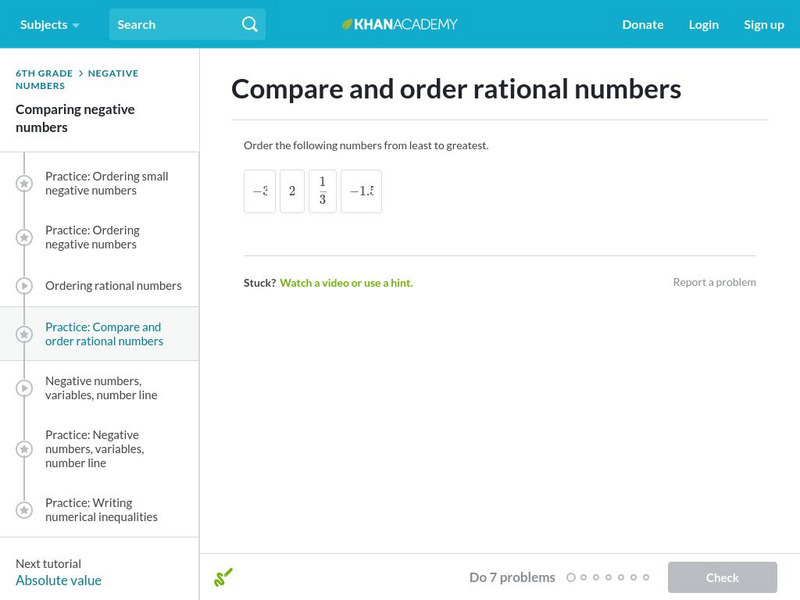
Khan Academy: Ordering Rational Numbers
Practice putting positive and negative fractions and decimals in order. For example, -12/4, -2.5, and 3.25. Students receive immediate feedback and have the opportunity to try questions repeatedly, watch a video or receive hints.

Illustrative Mathematics
Illustrative Mathematics: 6.ns Movie Tickets
In this task, 6th graders are asked to compare the buying power of $20 in 1987 and 2012 with respect to the cost of movie tickets. Aligns with 6.NS.B.3.
ArtsNow
Arts Now Learning: Moving With Fractions [Pdf]
In this activity, 4th graders use movement phrases to model common fractions and decimal fractions with like denominators. They compare the fraction of locomotor and non-locomotor movements in a movement phrase. Students then create...