Hi, what do you want to do?






Better Lesson
Better Lesson: Compare Parts of a Whole
Given a set of fractions students will be able to compare unit fractions by using models to determine that the more equal parts there are in the whole, the smaller each part will be. This lesson includes a detailed plan, samples of...

Math Is Fun
Math Is Fun: Number Line
What is a number line? How can you use one to compare large and small numbers? Find the answers to these questions, play with an interactive number line, and follow links to information on adding, subtracting, and understanding absolute...
Education Place
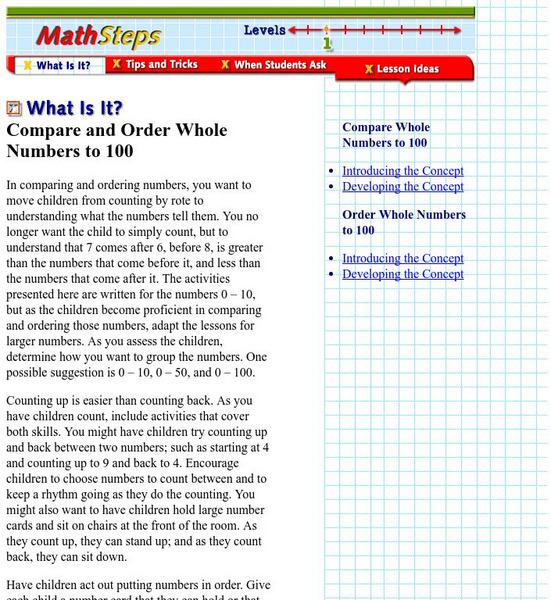
Houghton Mifflin: Eduplace: Compare and Order Whole Numbers to 100
In order to help children understand what numbers mean, it is helpful to teach them how to compare and order them. This site provides lesson plans, tips & tricks, and frequently asked questions. It's concise and easy to understand.
Khan Academy
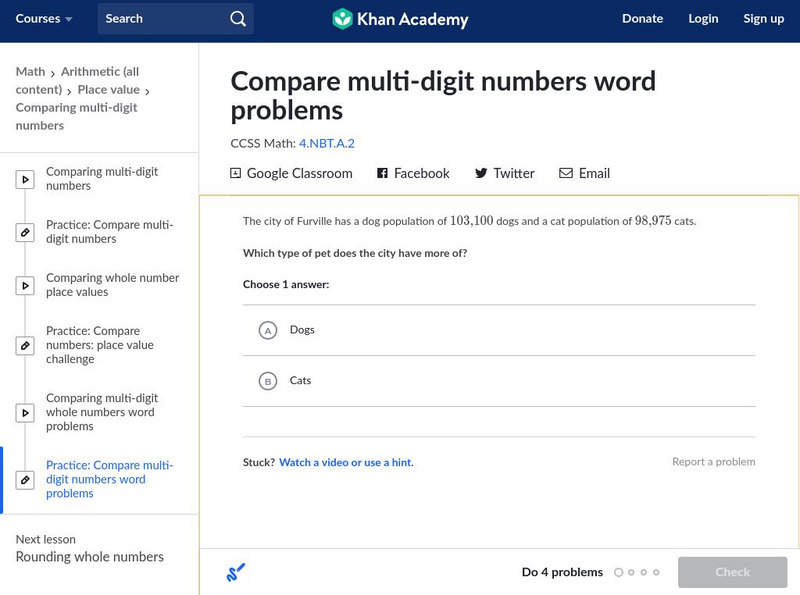
Khan Academy: Compare Multi Digit Numbers Word Problems
Solve word problems by comparing whole numbers. Students receive immediate feedback and have the opportunity to try questions repeatedly, watch a video or receive hints.
Better Lesson
Better Lesson: Math Trash
A lesson where students collect trash, sort, and record the mass in grams. They will use their knowledge of numbers to figure out what category of trash had the most. The biggest idea of the lesson is that students will be more likely to...
Other
Nearpod: Place Value: Fall Edition
In this lesson, students will use base ten blocks and a place value chart to show their understanding of two-digit and three-digit numbers. They will also use place value to compare numbers.
Better Lesson
Better Lesson: How Are They Different?
SWBAT order a set of numbers and quantities up to 12 and compare two quantities up to 10 to see which one is greater. The students will also demonstrate their knowledge of how the numbers in the counting sequence are related (that each...
Better Lesson
Better Lesson: Building Towers
SWBAT count a set of up to 20 objects by 1's. SWBAT use number names and written numbers to label the quantities they represent. SWBAT order a set of numbers and quantities up to 12.
Math Slice
Math Slice: Greatest Common Divisor (Factor)
This resource allows students to practice finding the greatest common factor among 2, 3, or 4 numbers. Students are able to select parameters of how many numbers they will compare, and the range of possible numbers. There are ten...
Math Slice
Math Slice: Least Common Multiple
This resource allows students to practice finding the least common multiple among 2, 3, or 4 numbers. Students are able to select parameters of how many numbers they will compare, and the range of possible numbers. There are ten problems...
Better Lesson
Better Lesson: Ordering Numbers: Unit Review and Test
SWBAT share their knowledge through the assessment provided
Better Lesson
Better Lesson: Heading Back
7, 8, 9, 10, 11, 12, Now Stop and Turn It Around! That is the idea today as the students are introduced to the idea of counting back to 1.
Better Lesson
Better Lesson: Is the Statement True or False?
Second graders use their knowledge of place value to determine whether a comparison statement is true or false.
PBS
Pbs: The Lowdown: Rot and Rubbish: The Rancid Truth About How Much Food We Waste
Explore the math of worldwide food waste, with focus on percentage, in this infographic from KQED. In the accompanying classroom activity, students predict the percent of food in each of the various categories (e.g., grains, fruit, etc.)...