Hi, what do you want to do?






Khan Academy
Khan: Lsn 8: Interpreting Relationships in Scatterplots/graphs/tables/equations
This lesson focuses on Interpreting and analyzing linear, quadratic, and exponential models and graphs. Students will use best fit lines to interpret contexts, distinguish whether contexts are linear or exponential functions, use the...
Illustrative Mathematics
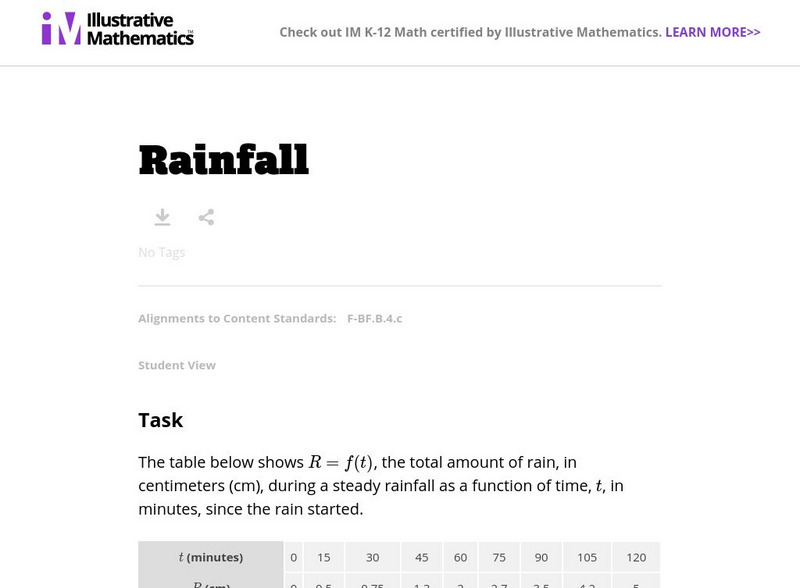
Illustrative Mathematics: F Bf Rainfall
In this task, students are asked to analyze a function and its inverse when the function is given as a table of values. In addition to finding values of the inverse function from the table, they also have to explain why the given...
Illustrative Mathematics
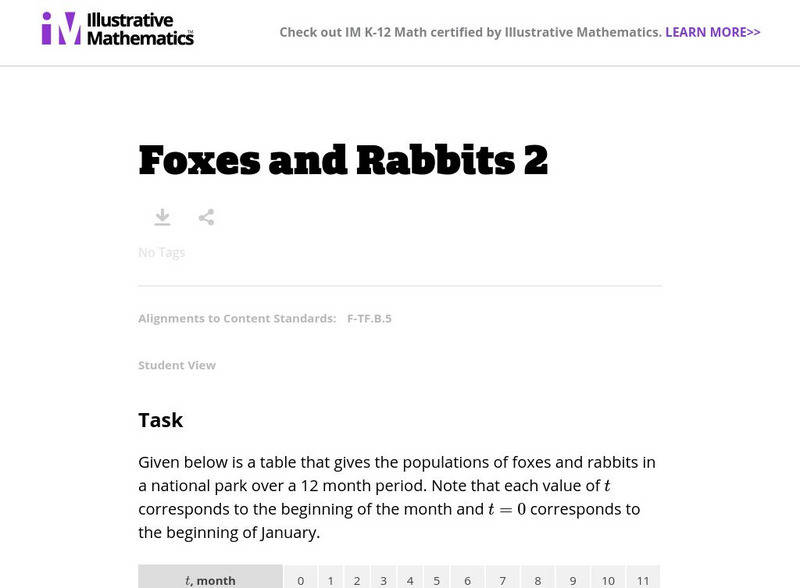
Illustrative Mathematics: F Tf Foxes and Rabbits 2
Students are presented with a table that shows the populations of foxes and rabbits in a national park over a 12-month period. This is the second Foxes and Rabbits task. In this problem, students must find trigonometric functions that...
Illustrative Mathematics
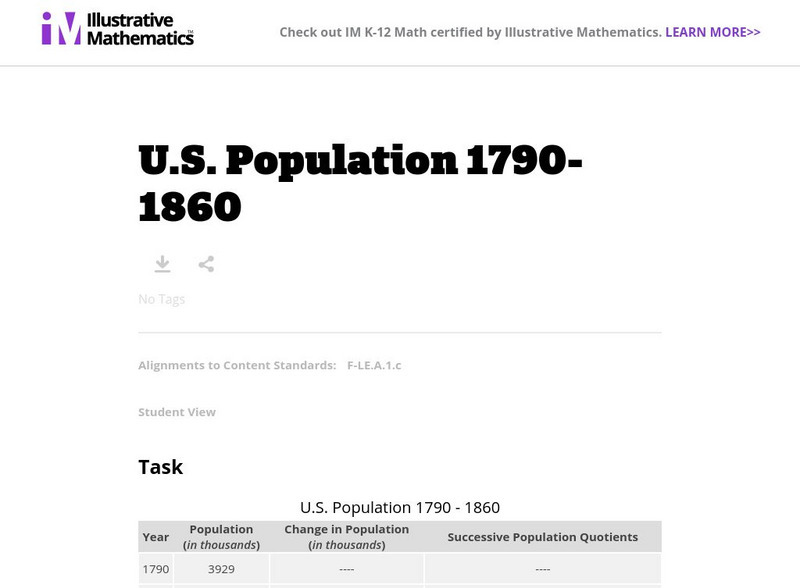
Illustrative Mathematics: F Le Us Population 1790 1860
For this task, students are shown a table of U.S. population data between 1790 and 1860 and are asked to explore whether exponential functions would be appropriate to model relationships within the data. The purpose of the task is to...
Illustrative Mathematics
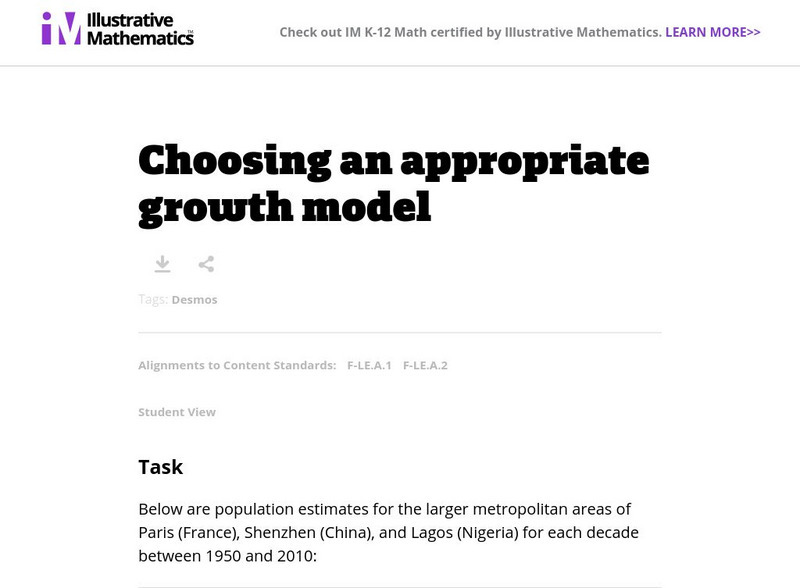
Illustrative Mathematics: F Le Choosing an Appropriate Growth Model
The goal of this task is to examine some population data for large cities from a modeling perspective. Students are asked to decide if the population data can be accurately modeled by a linear, quadratic, and/or exponential function, and...

Illustrative Mathematics
Illustrative Mathematics: F Le Basketball Bounces, Assessment Variation 2
This task asks students to analyze a set of data about the height of a basketball for each time it bounces. They choose a model that reasonably fits the data and use the model to answer questions about the physical context. This second...