Hi, what do you want to do?





Interactive Mathematics
Interactive Mathematics: Graphs of the Trigonometric Functions
The tutorial investigates period and frequency by examining the shapes of the sine and cosine functions. The resource consists of definitions, animations, interactive graphs, and examples. Practice problems with solutions are included.
Illustrative Mathematics
Illustrative Mathematics: G Gmd Area of a Circle
For this task, students investigate and develop an understanding of the formula for the area of a circle. Aligns with G-GMD.A.1.
Illustrative Mathematics
Illustrative Mathematics: F Le Do Two Points Determine an Exponential Function?
In this task, students investigate whether exponential functions will always be determined by two points. It complements the task "Do two points always determine a linear function?" Aligns with F-LE.A.2.
Illustrative Mathematics
Illustrative Mathematics: F Le in the Billions and Exponential Modeling
For this task, students examine world population data from 1804 to 2012 and investigate whether an exponential function is appropriate for modeling the relationship between the world population and the year. Aligns with F-LE.A.1.c.
Illustrative Mathematics
Illustrative Mathematics: F Le a Saturating Exponential
For this problem, learners use an exponential equation to investigate the warming up of a cold beverage on a summer day and analyze a graph to estimate temperatures. Aligns with F-LE.B.5 and F-BF.B.

Illustrative Mathematics
Illustrative Mathematics: N Cn, a Rei Complex Square Roots
Working with complex numbers allows us to solve equations that cannot be solved with real numbers. Here we will investigate complex numbers which arise as square roots of certain complex numbers. Aligns with N-CN.A.2 and A-REI.A.1.
Illustrative Mathematics
Illustrative Mathematics: F if Pizza Place Promotion
For this task, students investigate the price of pizza at a new restaurant, how to get the best deal, and what equations represent the functions. Aligns with F-IF.B.
Stefan Warner and Steven R. Costenoble
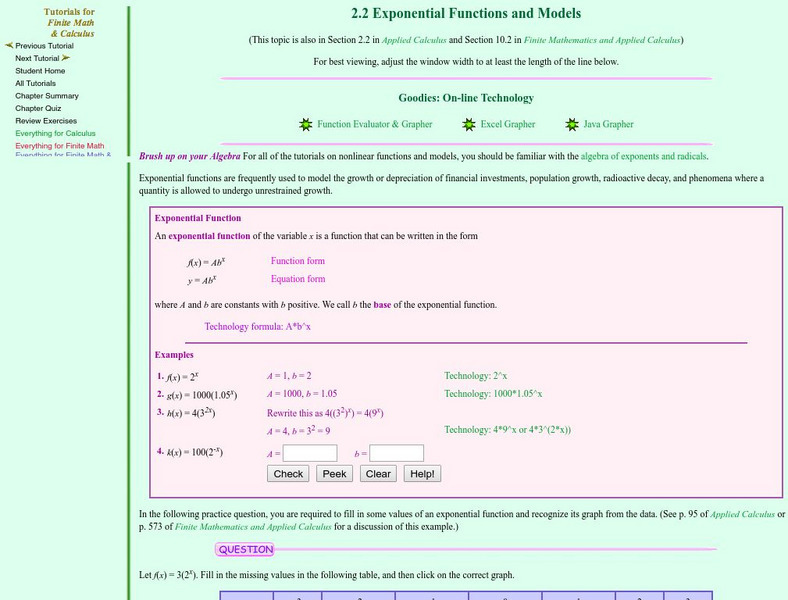
Finite Mathematics & Applied Calculus: Exponential Functions and Models
The resource investigates exponential functions and models. Students learn about the concepts through notes and examples. A chapter quiz, review exercises, and chapter summary are included.

Stefan Warner and Steven R. Costenoble
Finite Mathematics & Applied Calculus: Mean, Median & Standard Deviation
Students learn about mean, median, variance, and standard deviation. The tutorial investigates the statistics concepts though class notes and examples. Review exercises are included.
Science Buddies
Science Buddies: M&m Geometry
Geometry is the study of how to use math to describe and investigate different points, lines and shapes. The way that a shape is described in geometry is with a formula, which is simply a mathematical way to calculate different...
Science Buddies
Science Buddies: Measuring Up
Measurements are very important for scientists. It is especially important that the measurements be accurate. Think about how important accuracy is when you want to know if you are taller than a friend of yours, every inch counts. In...
New York Times
New York Times: Steven Strogatz on the Elements of Math Series the New York Times
[Free Registration/Login Required] On this site, Cornell University mathematics professor, Steven Strogatz, shares his 15-part series of columns on the elements of math. He investigates topics ranging from negative numbers to subtraction...
Texas Education Agency
Texas Gateway: Physics: The Scientific Methods
By the end of this section, you will be able to explain how the methods of science are used to make scientific discoveries; define a scientific model and describe examples of physical and mathematical models used in physics; and compare...

Stefan Warner and Steven R. Costenoble
Finite Mathematics & Applied Calculus: Monty Hall Simulation
The simulation investigates the Monty Hall problem.
Lawrence Berkeley National Laboratory
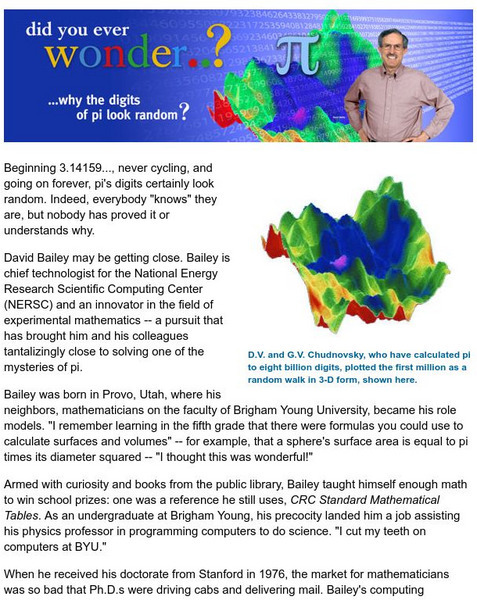
Berkeley Lab: Did You Ever Wonder? Why the Digits of Pi Look Random?
Students investigate the randomness of the digits of pi. The article discusses David Bailey, experimental mathematics, and numerical algorithms. The resource consists of pictures, quotes, and links to additional resources.

University of Georgia
University of Georgia: Slope of Lines
This site provides a detailed unit on finding the slope of lines that investigates methods for solving systems of equations. Good lesson plan for class.
University of Cambridge
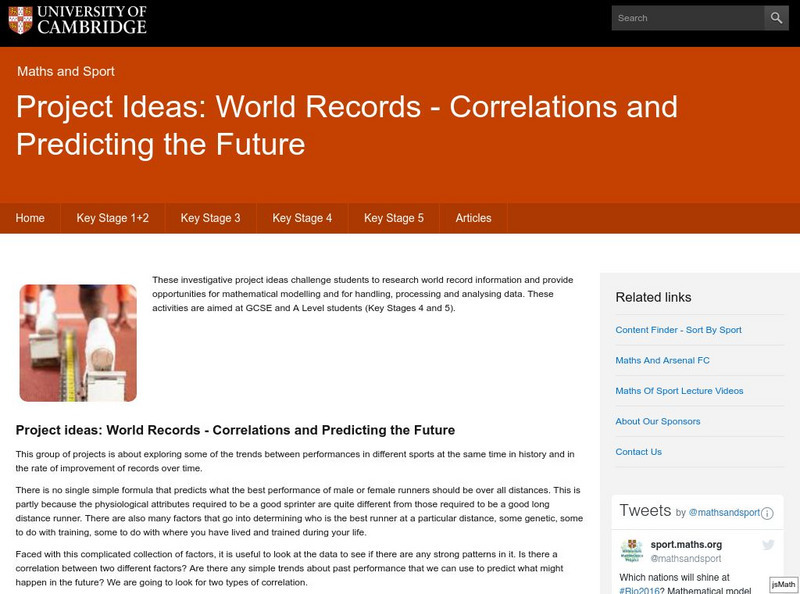
University of Cambridge: Maths and Sports: Project Ideas: World Records
This activity suggests a number of investigative projects, focusing on athletics and swimming, exploring some of the trends between performances in different sports at the same time in history and in the rate of improvement of records...

Dartmouth College
Dartmouth College: Mqed: Feedback Automation
The downloadable monograph investigates feedback and automation.
Other
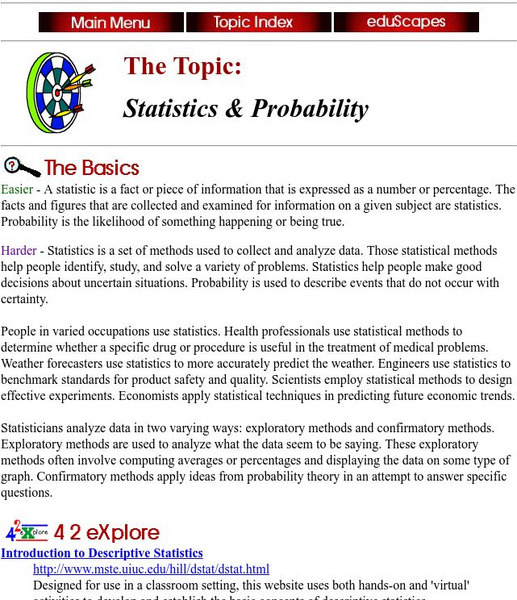
42e Xplore: Statistics and Probability
An extensive collection of links on statistics and probability can be found here! Discussions ranging from the basics of stats through more complex data analysis. Topics are broken down into sections for teachers, students, WebQuest...
University of Cambridge
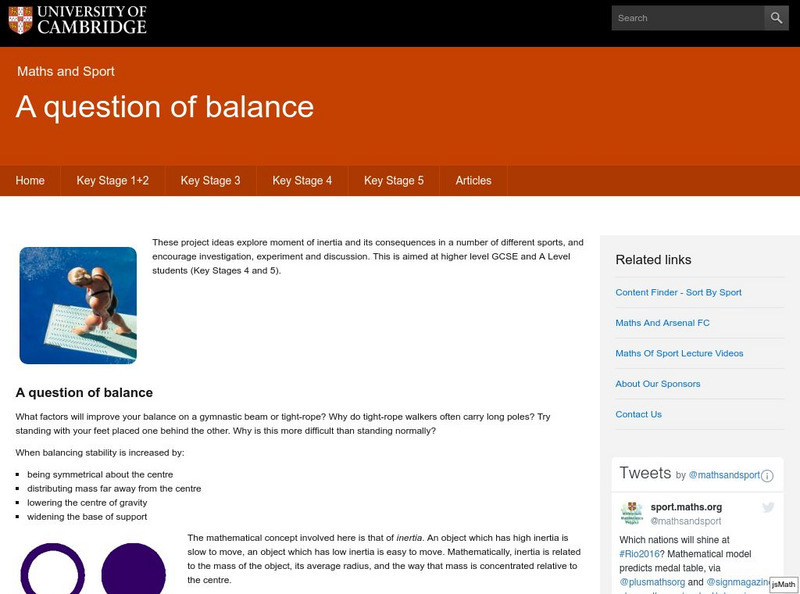
University of Cambridge: Maths and Sports: A Question of Balance
These project ideas explore moment of inertia and its consequences in a number of different sports including diving, gymnastics and cycling, and encourage investigation, experiment and discussion. This activity is aimed at higher level...
Science and Mathematics Initiative for Learning Enhancement (SMILE)
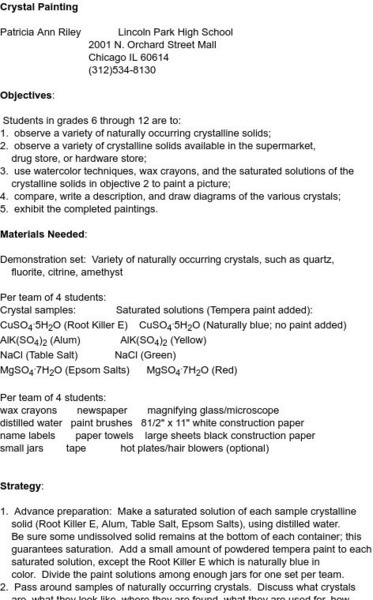
Smile: Crystal Painting
From the Science and Mathematics Initiative for Learning Enhancement (SMILE) program. A lesson plan in which students explore the nature and structure of a variety of naturally occurring crystals, such as quartz, fluorite, citrine,...
Physics Classroom
The Physics Classroom: Light Waves and Color: The Path Difference
After looking at a representative two-point source interference pattern with accompanying order numbers, students investigate the rationale behind the numbering system, and develop some mathematical equations that relate the features of...

Alabama Learning Exchange
Alex: Can You Curl Your Tongue?
This instructional activity is adapted from a Connected Mathematics Unit, How Likely is It? This investigation introduces biology as a source of applications for probability. In this instructional activity, Curling your Tongue, learners...