Hi, what do you want to do?






Mocomi & Anibrain Digital Technologies
Mocomi: Molecules
When two or more atoms combine they give rise to a molecule. A molecule can be made up of many atoms of the same element. There are 112 elements known to man, so can you imagine the different permutations and combinations of molecules...
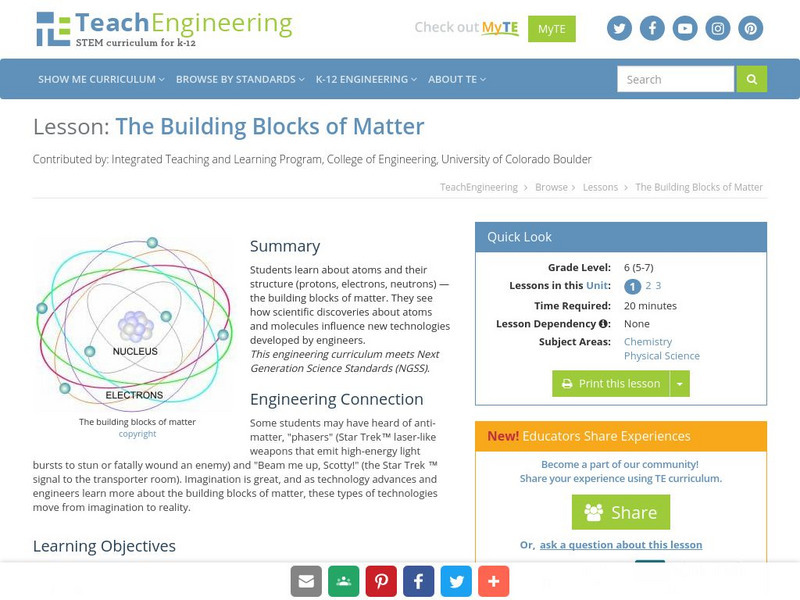
TeachEngineering
Teach Engineering: The Fundamental Building Blocks of Matter
This lesson plan explores the fundamentals of atoms and their structure. The building blocks of matter (protons, electrons, neutrons) are covered in detail. Young scholars think about how atoms and molecules can influence new...
American Chemical Society
Middle School Chemistry: Changing State: Melting
Discover the concept that energy transfer and molecular motion cause the change in state from a solid to a liquid. Also compare state changes of water to the state changes of other substances.
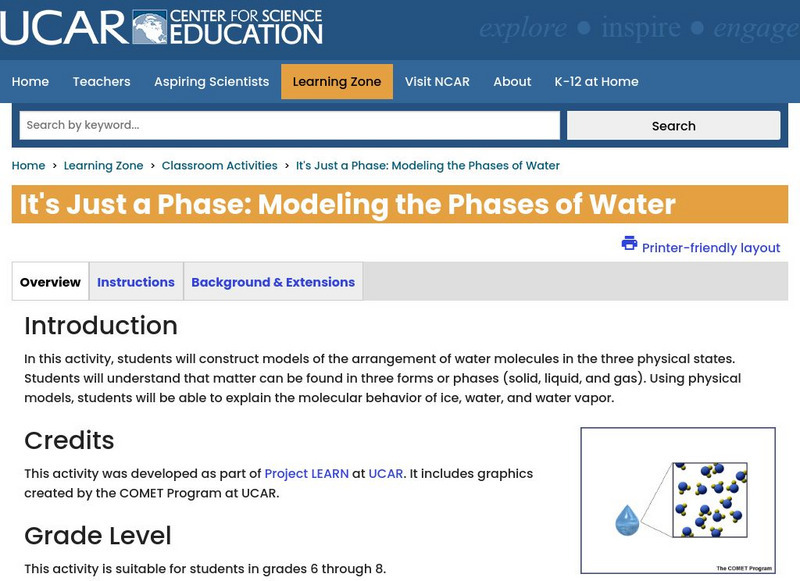
University Corporation for Atmospheric Research
Ucar: Just a Phase: Water as a Solid, Liquid, and Gas
This site helps students construct a model of the arrangement of water molecules when present as solid, liquid or gas. Includes background information, lesson plans, links to standards and assessment ideas.
Other
Beautiful Chemistry: Beautiful Structures: Gas and Liquid
In Beautiful Chemistry, we talk about crystals, quasicrystals and glasses, which are all solids. Here, we see the molecular structure of gases and liquids.
PBS
Pbs Learning Media: Chemical Bonds
This interactive activity developed for Teachers' Domain demonstrates how attractive forces between atoms create chemical bonds, resulting in the formation of molecules and compounds.
American Chemical Society
Middle School Chemistry: What Is Density?
Calculate the density of cubes made of different materials to determine what type of material it contains. Using this information explain that the size, mass, and arrangement of the atoms or molecules of a substance determines its density.
PBS
Pbs Learning Media: Molecular Shapes
In this interactive activity from ChemThink, students will learn about covalent molecules and how the VSEPR theory predicts the shapes of covalently-bonded molecules.
Annenberg Foundation
Annenberg Learner: 5 Question Survey: Chemical Change
Find out your or your students' basic knowledge of concepts like matter, molecules and open and closed systems. Afterwards you can see how others answered the questions.