Hi, what do you want to do?






Curated OER
Science Quiz-Grade 6
In this grade 6 science quiz worksheet, 6th graders complete a 15 question multiple choice quiz covering a variety of grade 6 concepts.

Pennsylvania Department of Education
Pennsylvania’s Energy Supply
Third graders become familiar with the various types of energy and which types are found in Pennsylvania. In this Pennsylvanian energy resources lesson, 3rd graders, identify wind and water as sources of energy. Students...

Curated OER
Dissolving Salt
Fifth graders, in groups, complete an experiment/activity in which they dissolve salt in a cup of hot water and then observe what happens as the water evaporates over the next few weeks.

Curated OER
Let's Settle It!
Students investigate and record data about sedimentation rates. They make a sedimentation bottle using aquarium gravel, sand and potting soil. They discuss the sedimentation rates that they see in their bottles.

Curated OER
Activity #19 The Density of Alka Seltzer Gas
Students (teachers) complete the activity, they should not come in contact with Alka-Seltzer. They comprehend that the density of a gas can be calculated from its mass and volume. Pupils calculate the volume of gas generated by...

Curated OER
The Path of Pollution
Students follow the path of pollution from the Chernobyl accident. Students name and locate countries where radiation traveled to, describe how air pollution travels from one area to another, and seqence the travel of radiation in...

Curated OER
The Path of Pollution
Students conduct a brainstorming exercise that asks them to list all the ideas about air pollution that can be recalled. The ideas are recorded on a chart that the teacher has prepared. The lesson contains sufficient background...

Curated OER
Using Maps To Make Public Health Decisions Case Study: Wildfires in Mexico 2000
Students study environmental health. Using actual NOAA satellite imagery, students investigate the basic concepts of mapping. They explore the relationship between monitoring satellite images and public health decision making.

Curated OER
Air Pollution: Visible And Invisible
Fourth graders observe air pollution that is visible and invisible with experimentation. During the experiment the students collect data that needs analysis. The observations are recorded in the lab journal. The data also is represented...

Curated OER
Making Sense of Density
Students identify the concepts of density, mass, and volume that define the property of a substance. They also determine that the properties of materials, such as, density and volume, can be compared and measured by using rulers,...

Curated OER
Where My Peeps At?
Students conduct a series of activity that demonstrates Charles' and Boyle's Law. In this chemistry lesson plan, students determine the relationship among pressure, volume and temperature. They solve problems using mathematical...

Center for Literacy and Disability Studies, University of North Carolina at Chapel Hill
Tar Heel Reader: Three Kinds of Matter: Solids, Liquids, and Gases
Find out about the three states of matter: solids, liquids, and gases.
The Association of the British Pharmaceutical Industry
Abpi: Solids, Liquids, and Gases
Students learn about solids, liquids, and gases in this interactive slide show. Animated cartoon characters explain concepts having to do with properties of matter. A self-checking quiz follows the lesson.
Texas Education Agency
Texas Gateway: Solids, Liquids, and Gases
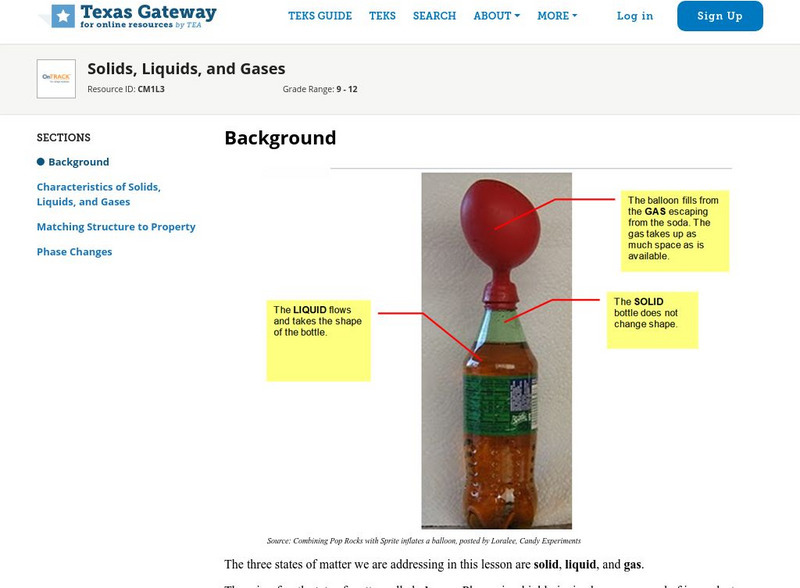
Given descriptions, scenarios, or illustrations, students will distinguish between the compressibility, structure, shape, and volume of solids, liquids, and gases.
The Association of the British Pharmaceutical Industry
Association of the British Pharmaceutical Industry: Solids, Liquids, and Gasses
A collection of cartoon animations that teach students what they need to understand about solids, liquids, and gases.

American Chemical Society
American Chemical Society: Science for Kids: Solids, Liquids and Gases
Engaging hands on science lessons for grades 2-6 on the three states of matter.
Science Education Resource Center at Carleton College
Serc: Investigating Matter, Solid or Liquid: Barthlomew and the Oobleck
Background information: This activity is an extension of the children's exposure to states of matter in the Scott Foresman science series for Grade 2. This lesson has a Literacy component. Using the book by Dr. Seuss, "Bartholomew and...
American Chemical Society
Middle School Chemistry: Chapter 1: Solids, Liquids, and Gases
Five exemplary chemistry lessons about the three states of matter complete with handouts and animations.
PBS
Pbs Learning Media: States of Matter Fitness Lesson Plan
In this instructional activity, students use their science knowledge and apply it using physical activity! Learning about the stages of matter, solid, liquid and gas, students perform an exercise for each as the teacher calls out an...
Concord Consortium
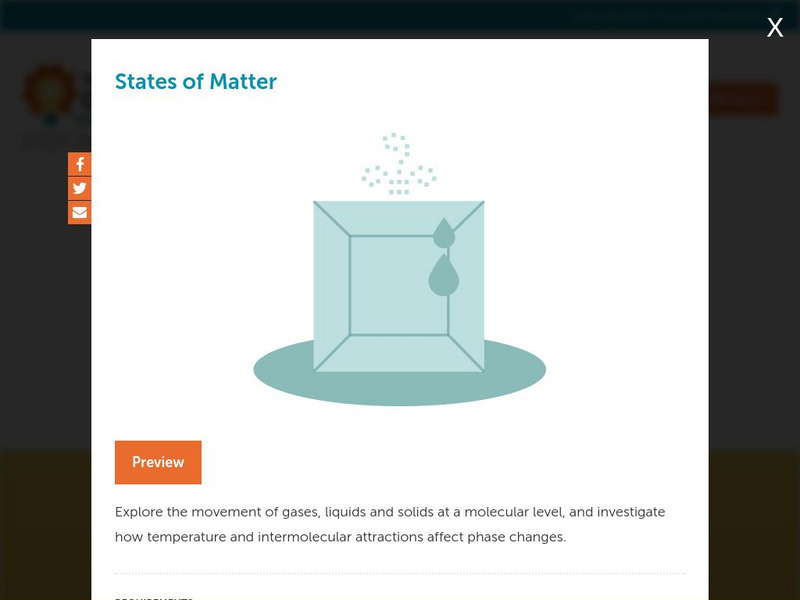
Concord Consortium: Stem Resources: States of Matter
Using simulations observe what solids, liquids, and gases look like at the atomic scale. After observing the different states of matter at their atomic level, students will be able to conclude about the forces and attractions that exist...
University Corporation for Atmospheric Research
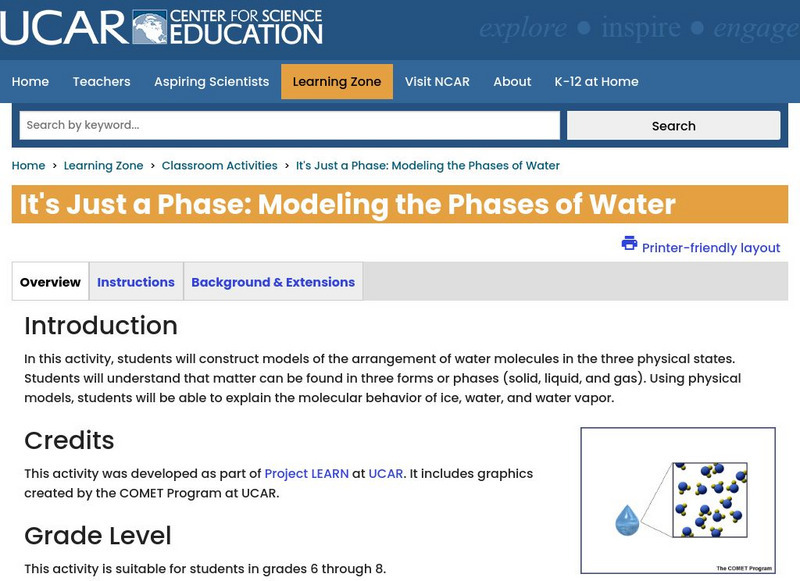
Ucar: Just a Phase: Water as a Solid, Liquid, and Gas
This site helps students construct a model of the arrangement of water molecules when present as solid, liquid or gas. Includes background information, lesson plans, links to standards and assessment ideas.

Chiral Publishing
Chiral Publishing: An Introduction to Chemistry: Solids, Liquids, and Gases: Audio Book
An interactive guide to the basics of solids, liquids, and gases. Wonderful pictures show the makeup of each and how the particles move in these states of matter.

E-learning for Kids
E Learning for Kids: Norway Fjords: What Are Solids, Liquids and Gases?
The differences between solids, liquids, and gases and the properties of each are presented in this lesson.
CK-12 Foundation
Ck 12: Chemistry Simulation: States of Matter
[Free Registration/Login Required] Compare three states of matter: solid, liquid, and gas.