Hi, what do you want to do?






Curated OER
Task: Miniature Golf
"Fore!" All right, no one really yells this out in miniature golf, but this well-defined activity will have your charges using lots of numbers in their unique design of a miniature golf hole. Included in the activity criteria is the...

PBS
Arguing over Area
With the help of the Area Officers and Perimeter Patrol, you learners will develop a better understanding of area and its relationship to perimeter. First, they view a video clip from Cyberchase, and then they visit a website to...

Noyce Foundation
Lawn Mowing
This is how long we mow the lawn together. The assessment requires the class to work with combining ratios and proportional reasoning. Pupils determine the unit rate of mowers and calculate the time required to mow a lawn if they work...

American Statistical Association
Exploring Geometric Probabilities with Buffon’s Coin Problem
Scholars create and perform experiments attempting to answer Buffon's Coin problem. They discover the relationships between geometry and probability, empirical and theoretical probabilities, and area of a circle and square.

Achieve
Fences
Pupils design a fence for a backyard pool. Scholars develop a fence design based on given constraints, determine the amount of material they need, and calculate the cost of the project.

Curated OER
Integrate Algebra Regents Exam Bimodal Questions Worksheet #1
In this Integrated Algebra worksheet, students solve problems that reflect the topics covered during the course of work. The answer key identifies each question by standard and topic. The twenty-four page worksheet...

Curated OER
Cell Size and Division or How Big Would You Want To Be if You Were a Cell?
Students investigate why cells divide. In this cell size lesson plan, students observe how far a solution travels into 3 different size model cells of agar. They answer questions about the most effect movement of "nutrients" into the...

Curated OER
Rep Tiles
Third graders use pattern blocks of one shape at a time to try to create a similar shape. They compare the perimeter of the new figure with the perimeter of the original shape and look for a pattern. Students use the pattern to predict...

Curated OER
Change It
Fourth graders expand their knowledge about how the physical properties of a substances can be changed. They are given multiple opportunities, using first-hand experiences and familiar objects in different contexts, to identify...

Curated OER
Polyhedra
Students analyze convex polyhedra through hands on methods. In this geometrical shapes instructional activity, students construct paper models of convex polyhedra and identify the different properties including the number of sides, faces...

Curated OER
Analyzing 3-D Shapes and 2-D Representations
Students can analyze 3-D objects better with actual physical models and by also drawing 2-D representations of them.
Khan Academy
Khan Academy: Volume of Rectangular Prisms With Unit Cubes
Find volume of 3-dimensional figures by counting unit cubes. Students receive immediate feedback and have the opportunity to try questions repeatedly, watch a video or receive hints.
Khan Academy
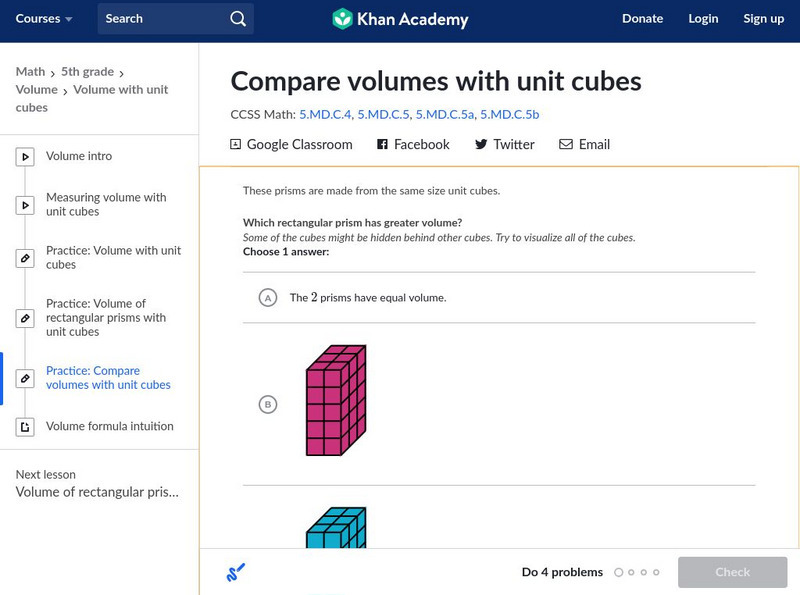
Khan Academy: Compare Volumes With Unit Cubes
Recognize volume as an attribute of solid figures and understand concepts of volume measurement. Students receive immediate feedback and have the opportunity to try questions repeatedly, watch a video or receive hints.
Khan Academy
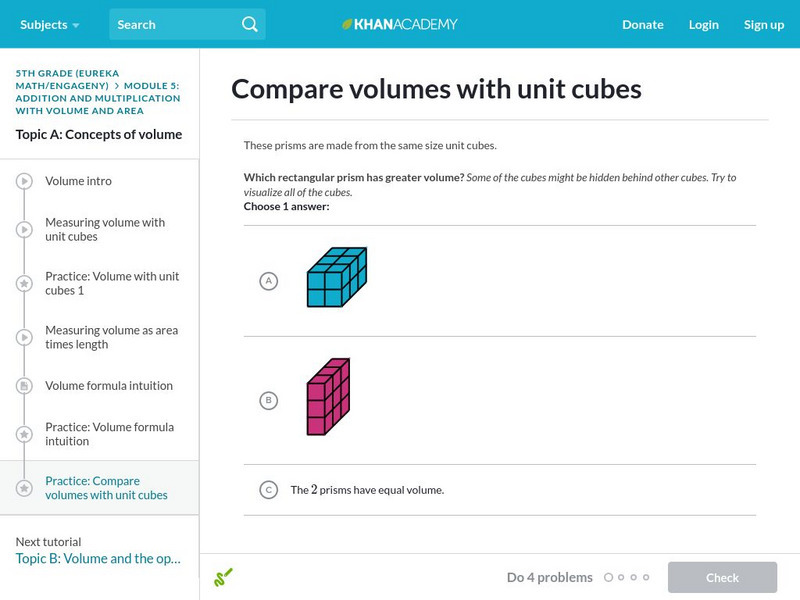
Khan Academy: Comparing Volumes With Unit Cubes
In this exercise, students practice comparing volumes with unit cubes. Students receive immediate feedback and have the opportunity to get hints and try questions repeatedly.
PBS
Nova Online: How Many Pearls? A Weight & Volume Game
This interactive game has students apply skills in estimation, measurement, and basic addition using pearls. Students are asked to estimate the number of pearls in a treasure chest by making predictions and using number sense. The skills...

BBC
Bbc Bitesize: Volume
Pick up some valuable pointers on how to figure out the volume of various shapes. When you finish working your way through the pages you can take an online "Test Bite" and check your understanding.

Illustrative Mathematics
Illustrative Mathematics: 5.md Box of Clay
This task provides an opportunity to compare the relative volumes of boxes in order to calculate the mass of clay required to fill them. Aligns with 5.MD.C.
University of South Florida
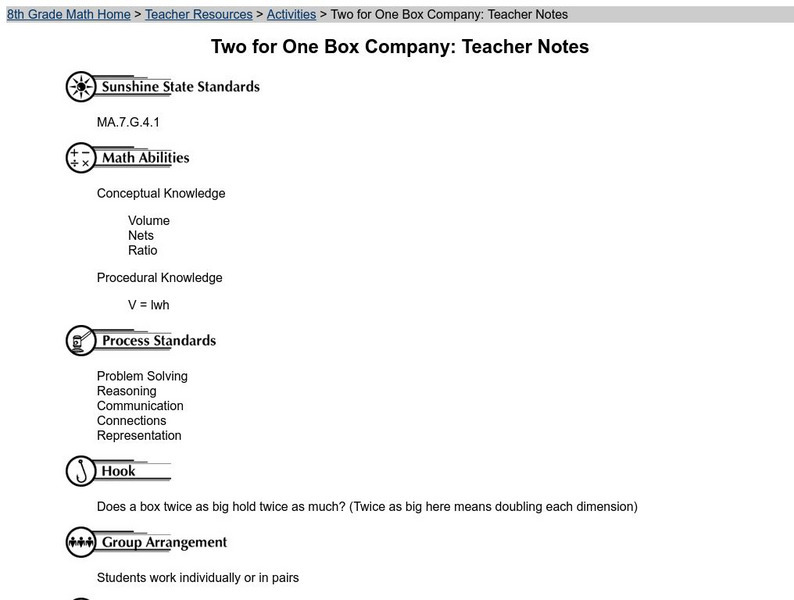
Fcat: Two for One Box Company: Teacher Notes
At this site students use proportions to explore how volume is effected by dimension changes. This hands-on activity can be done individually or in pairs.
National Institute of Standards and Technology (NIST)
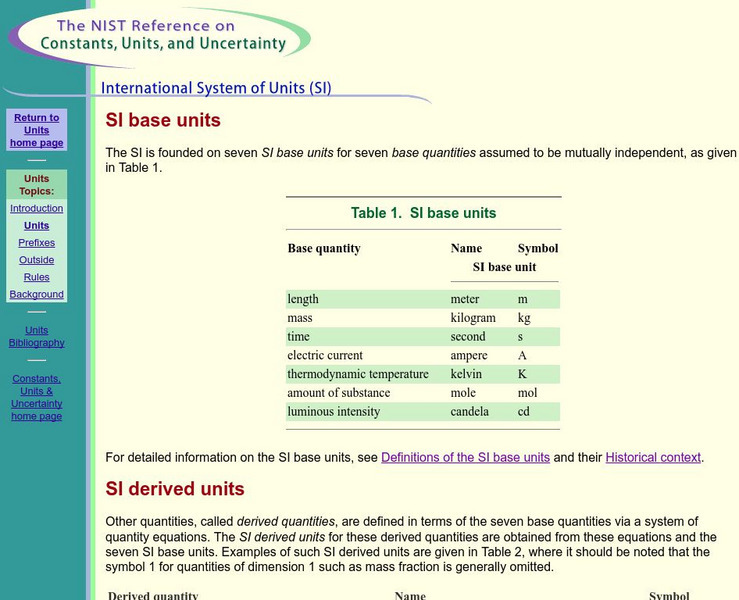
International System of Units: Si Base Units
This is the definitive source for information on SI base units, derived units, squares, cubes, luminosity, field strength and flux density.
TeachEngineering
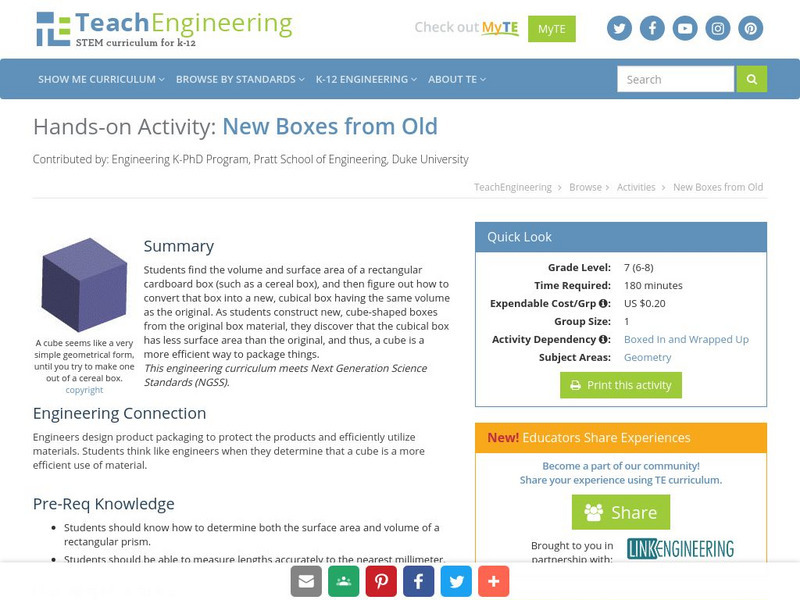
Teach Engineering: New Boxes From Old
Students find the volume and surface area of a rectangular box (e.g., a cereal box), and then figure out how to convert that box into a new, cubical box having the same volume as the original. As they construct the new, cube-shaped box...
National Council of Teachers of Mathematics
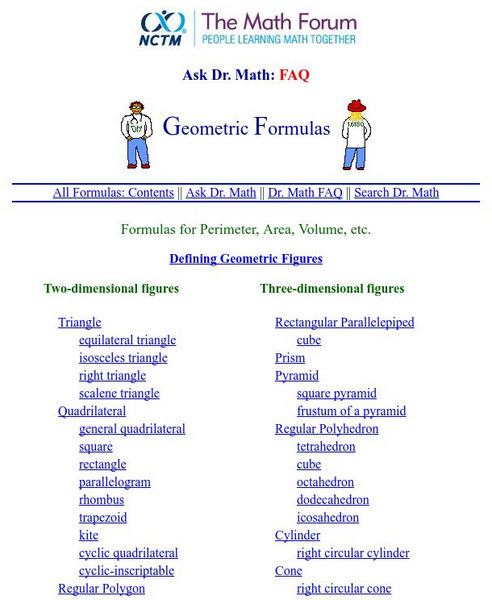
The Math Forum: Ask Dr. Math: Faq, Geometric Figures
This page brings you to a table of contents of three-dimensional figures. Selecting a figure will bring you to a page defining and illustrating the figure with applicable formulas listed.