Hi, what do you want to do?





PBS
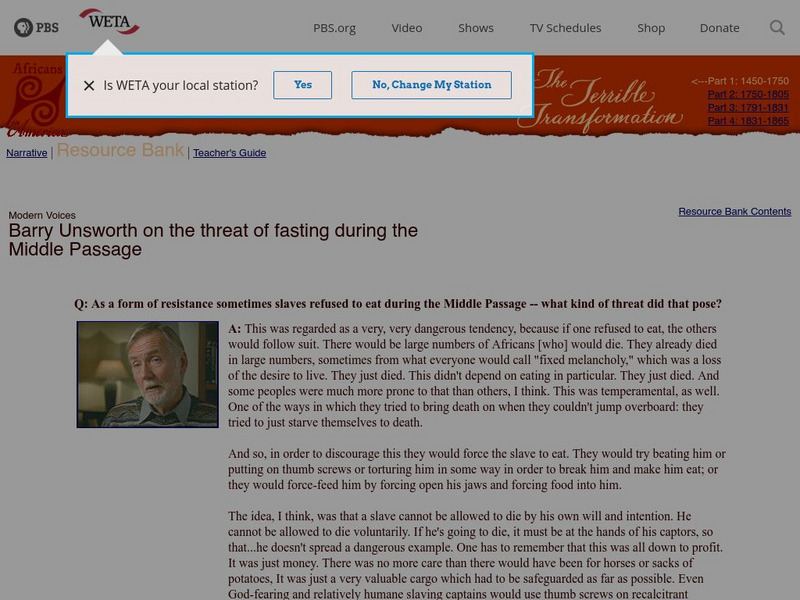
Pbs: Cet: Africans in America: The Threat of Fasting During the Middle Passage
Description of how slaves tried to starve themselves to death on slave ships as a form of resistance, and how the slave traders forced them to eat so they would not lose money. Click on Teacher's Guide for teaching resources.

Huntington Library
Huntington Library: Triangular Trade
In this instructional activity, 5th graders learn about the many societal structures that developed in colonial days, including the conditions for self-government in America, the free-market economy, and the slavery system. Background...
Other
Read Works: West Africa: West African Slave Trade [Pdf]
An informational text about the West African slave trade. A question sheet is available to help students build skills in reading comprehension.
Other
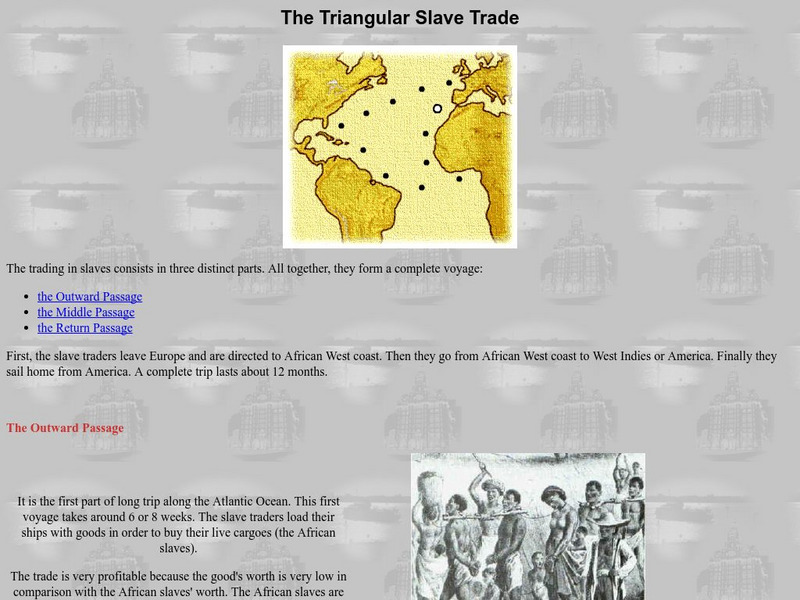
Liverpool and the Slave Trade: The Triangular Slave Trade
Information is provided on the three routes of the triangular slave trade: the middle passage, the outward passage, and the return passage.
Digital History
Digital History: Middle Passage
The number of Africans who died or were enslaved as a result of slave trading both across the Atlantic and into the Arabian peninsula is truly shocking. Read about the Middle Passage which brought millions of slaves to the New World, see...
Digital History
Digital History: The Slave Trade [Pdf]
Read Olaudah Equiano's account of being captured in his village in Africa, and placed on a slave ship to be taken to America. He describes the middle passage of the triangular trade route, as well as the leg from Europe to Africa. [pdf]
The History Cat
The History Cat: Us History: The Middle Passage
A detailed look at the trans-Atlantic slave trade that lasted from the 1500s to the 1800s.
Independence Hall Association
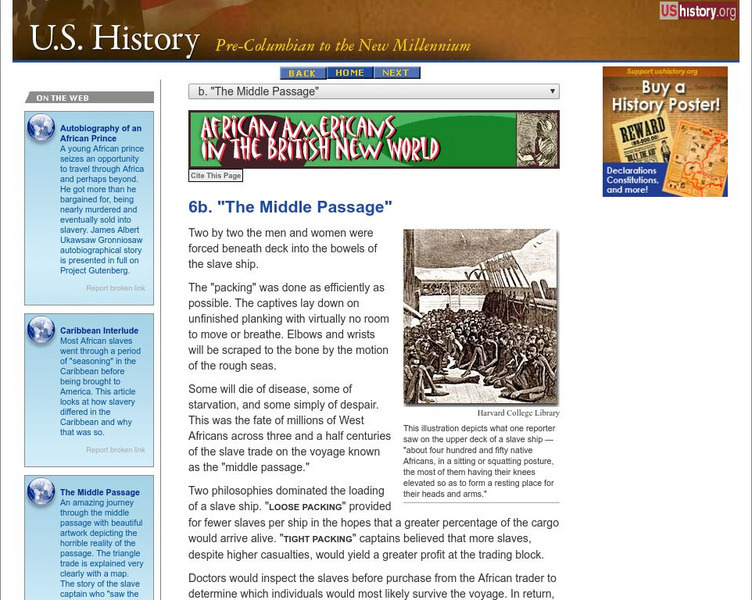
U.s. History: African Americans in the British New World: The Middle Passage
A description of the Middle Passage, the leg of the triangular trade that brought slaves from Africa to America. Read descriptions of the way slaves were transported in the ships across the ocean.
Georgetown University
Georgetown: Putting a Human Face on the Domestic Slave Trade
This unit will introduce students to the history of the domestic slave trade through the lens of the "GU272," the community of people sold south by the Maryland Jesuits in 1838 to help finance Georgetown College. This unit consists of...
C3 Teachers
C3 Teachers: Inquiries: Slavery
A comprehensive learning module on slavery that includes three supporting questions accompanied by formative tasks and primary source materials, followed by a summative performance task. Students will examine the role of sugar production...
PBS
Pbs Learning Media: The African American Migration Story
From the transatlantic slave trade to today's New Great Migration, learn about the major African-American migrations and how those movements changed the course of American history.
BBC
Bbc: The Triangular Trade
Approximately 6 million Africans were taken as slaves to the Americas. Follow the steps of the Triangular Slave Trade with an accompanying map. The map shows which goods and services were traded between the countries.

Understanding Slavery Initiative
Understanding Slavery Initiative: Atlantic Crossing
Discover the period some refer to as "Middle Passage," when enslaved Africans were transported across the Atlantic Ocean to the Caribbean or America. Read first-hand accounts of the torture and deprivation experienced by thousands of...
Gilder Lehrman Institute of American History
Gilder Lehrman Institute: History Now: African Immigration to Colonial America
An interesting essay on the forced migration of Africans to America by way of the Middle Passage. Read where the slaves were off-loaded, how the population of slaves increased, and the inhumanities inflicted on the slaves both on the...
Other
Hillcrest High School: The Colonies Come of Age: The Agricultural South [Pdf]
A chapter from a history text that looks at the plantation economy of the Southern colonies, which relied on slave labor. It discusses the role of women as second class citizens, the cash crops that were grown, indentured servitude, the...

Understanding Slavery Initiative
Understanding Slavery Initiative: Resistance and Rebellion
Enslaved Africans fought hard to win back their freedom through resistance, rebellions, and uprisings. Rebellions along the Middle Passage and in places like the Caribbean were important to the retention of African culture.
Other
West Chester University: The Trans Atlantic Economy in 1800
This short but good article examines the state of trade as it existed in 1800 between Europe, the Americas and Africa. There is a nice discussion on the slave trade as well as the need for the Europeans to acquire more markets for their...
Other
Mel Fisher Maritime Heritage Society: The Henrietta Marie
Description and pictures of what was found on the shipwreck, the Henrietta Marie. This ship contained many important objects from the early years of the slave trade.

Understanding Slavery Initiative
Understanding Slavery: Atlantic Crossing: First Hand Accounts Case Study
Read eye-witness accounts of the brutality and cruelty suffered by enslaved Africans as they traveled across the Atlantic on slave ships.
Other
United States History: Ch. 3 Sec. 1: The Southern Colonies [Pdf]
A chapter from a history text that looks at the development of the Southern Colonies. It discusses the Southern agricultural economy that relied on slave labor, tobacco as a cash crop, Southern society, indentured servitude, Bacon's...
PBS
Africans in America: Olaudah Equiano
This site from PBS' Africans in America series provides a biography of Olaudah Equiano, one of the many Africans forced to travel the Middle Passage. Links to related entries.
Independence Hall Association
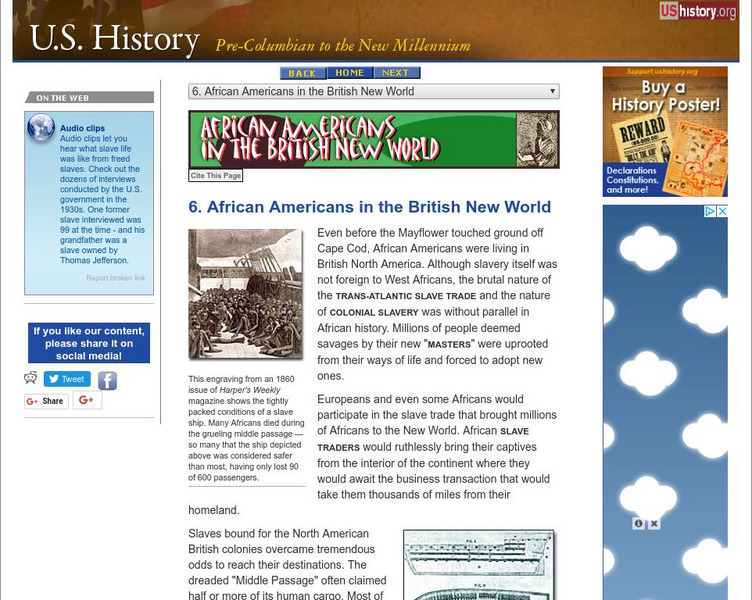
U.s. History: African Americans in the British New World
Read about the transit of Africans from their homeland to the American British colonies to work on plantations in the south as part of leg in the triangular trade.
PBS
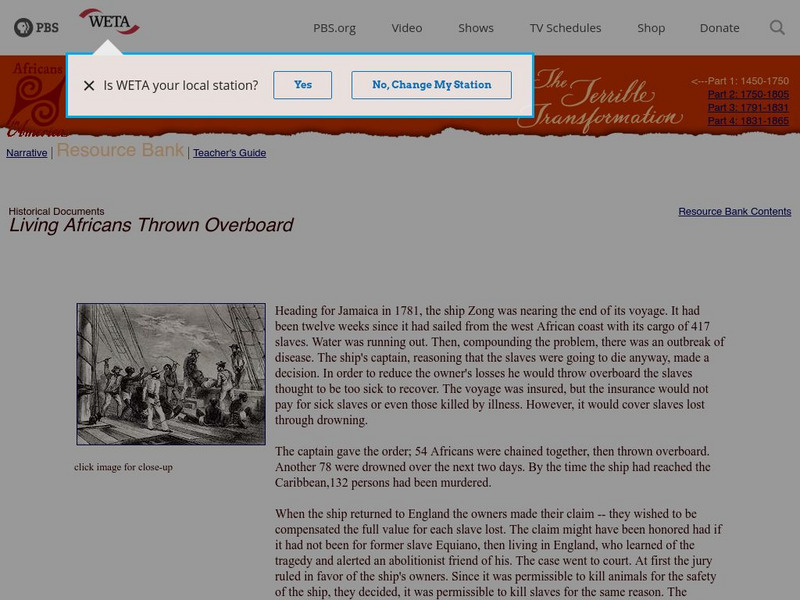
Africans in America: Living Africans Thrown Overboard
This site is provided for by PBS. In order to receive insurance money, a captain ordered 132 slaves thrown overboard alive. The case went to court, and a landmark decision was made that the Africans on the ship were actually people.

National Humanities Center
National Humanities Center: Toolbox Library: Senegambia, Making of African American Identity: V. 1
Drawings of West Africans and two accounts of Africans before enslavement, one by an African of Gambia, one by a French traveler to Senegal. They examine how Africans lived in freedom before enslavement.