Hi, what do you want to do?






Deliberating in a Democracy
Freedom of Movement
Class members examine human migration. For this population lesson, they read an article entitled, "Freedom of Movement" and respond to discussion questions about the article related to guest worker programs.
Wikimedia
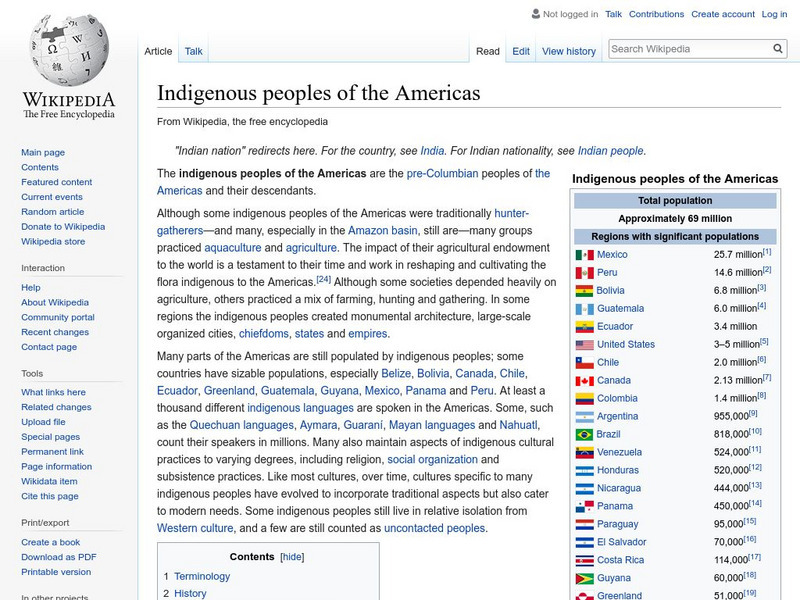
Wikipedia: Indigenous Peoples of the Americas
Looks at migration theories proposed in regard to the early peopling of the Americas, European colonization, early agriculture and culture. Also looks at contemporary indigenous groups, then groups within each country in the Americas.
Other
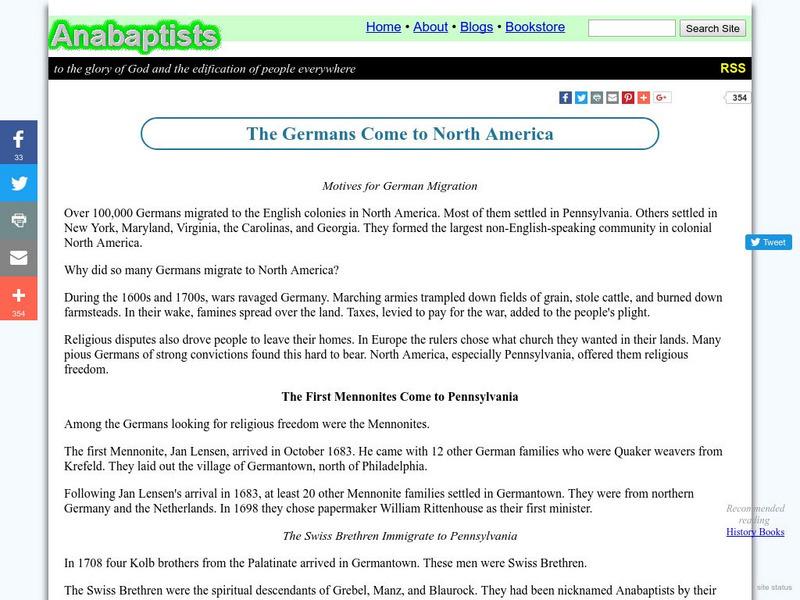
Anabaptists: The Germans Come to North America
This site explains what brought various German religious groups to America.

University of North Carolina
Unc: History of the Negro Church: Electronic Edition
This website is quite unique, in that it compiles historical data in a segmented form of the birth and evolution of Black Christianity in America. Carter G. Woodson, one of the most respected names relative to the anthology of the Negro,...
Library of Congress
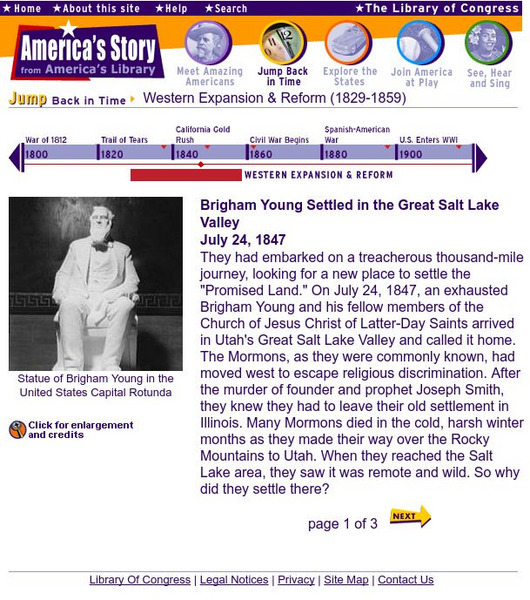
Loc: America's Story: Settling the Great Salt Lake
This site provides a brief account of Brigham Young and his Mormon followers as they settled in the Great Salt Lake Valley.

Other
Redistricting America: Baker v. Carr
Charles Baker, a resident of an urban neighborhood in Tennessee, filed suit in federal court against Joe Carr, then Secretary of State of Tennessee. Baker sought a court injunction to postpone elections until the State had fulfilled its...
New Advent
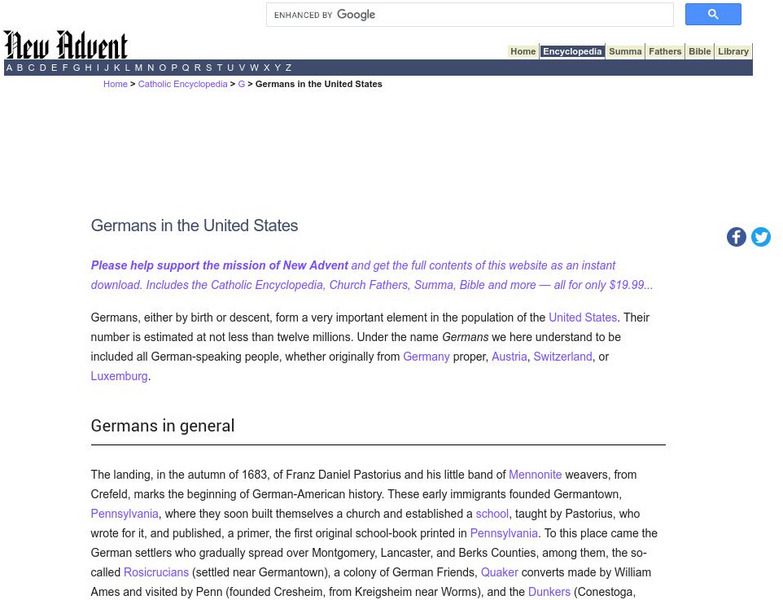
Catholic Encyclopedia: Germans in the United States
Detailed information (much more than you will need) about German-speaking immigrants to America. The site highlights Pennsylvania as a hub for immigrants. Includes information about religious backgrounds and reasons for leaving their...
Other
Cabrillo College: The Men From Spirit Cave and Wizard's Beach
Read about the discoveries of the Spirit Lake Man and Wizard's Beach Man.
USA Today
Minorities Make a Choice to Live With Their Own
Intriguing article explaining the trend illustrated through the 2000 Census information that minorities have broken segregation ties but still choose to live in areas with other members of their racial background.
University of Groningen
American History: Outlines: Settlers, Slaves and Servants
Men and women with little active interest in a new life in America were often induced to make the move to the New World by the skillful persuasion of promoters. William Penn, for example, publicized the opportunities awaiting newcomers...
The History Cat
The History Cat: America Enters the Ring
Describes the events leading up to America's entry into World War I and the changes that took place in America soon after. These included legislation such as the Selective Service Act and the Espionage and Sedition Acts, protests by...
Smithsonian Institution
Smithsonian Education: "Gypsies" in the United States
This site has many photos from the Carlos de Wendler-Funaro Gypsy Research Collection. The site is an introduction to several groups of people from other countries who refer to themselves as "gypsies" in English. Each group, which has a...
Countries and Their Cultures
Countries and Their Cultures: Multicultural America: Croatian Americans
Provides an overview of the traditional culture and lifestyle of Croatian Americans. (Note: Content is not the most current.)

Alberta Online Encyclopedia
Alberta Online Encyclopedia: The Land of Opportunity: Heritage Trails
This is a collection of audio and text files that describes Alberta's early history as the west is opened for settlement. Included are the stories about the great migration of immigrants from all over Europe, Asia and North America who...

San Jacinto Museum of History
San Jacinto Museum: How Did the Battle of San Jacinto Change the World?
This is an interesting look at the impact of the Battle of San Jacinto not only for the Republic of Texas, but for places in North America and in Europe. Links to additional information.
University of California
Beringia Chronology: Prehistoric Beringia
The last ice age exposed the ocean floor between Asia and North America for thousands of years. During this time, Nomadic tribes from Asia used the "land bridge" to migrate into North America.
Smithsonian Institution
National Museum of Natural History: American Mammals: Tundra Vole
Tundra Voles have the northernmost distribution of any North American species of Microtus. They are widespread in northern latitudes in Eurasia, too, where they are known as Root Voles, and probably migrated to North America across the...
Smithsonian Institution
National Museum of Natural History: American Mammals: Mexican Long Tongued Bat
Mexican long-tongued bats feed on fruits, pollen, nectar, and probably insects. The populations that summer in the United States migrate to Mexico and northern Central America in winter, following the blooming cycle of plants such as...