Hi, what do you want to do?






Curated OER
To See or Not to See: The Colors of Light
Seventh graders describe and conduct an experiment that identifies the physical properties of light. They explore sources of visible light and an electromagnetic spectrum. Students explain the conversion of one form of energy to another.

Curated OER
Start the Space Flight Time Line
Students research space flight exploration and technology. In small groups, they research a significant event from early time until the start of the space age. A class time line is created from the research groups.

Curated OER
Making a Periscope
Students experiment with a simple periscope to see how it reflects light. They draw a diagram of the path a ray of light follows as it travels from an object, through the periscope, and into your eye.

Curated OER
Microscope Word Search
In this word search worksheet, students locate 12 words related microscopes. The word list includes ocular lens, and stage clips.

Curated OER
Geometry: Practical Applications of the Distance Formula
Students, working independently and in groups, apply the distance formula to practical situations. After solving various problems, students in pairs design coordinate planes from the school blue print to measure the distance from the...

Curated OER
The KAO Telescope
Students explore the basic principles of the operation of the NASA's KAO telescope. They construct a simplified model of it using film canisters and other everyday objects. Step by step directions are included in plan.

Curated OER
Reflection & Refraction
In this online interactive reflection and refraction learning exercise, students respond to 7 multiple choice and fill in the blank questions regarding the information included in the provided paragraphs.

Curated OER
Kaleidoscope of Color
Students study the history of the invention of the kaleidoscope by Sir David Brewster. They create a kaleidoscope using art supplies.

Curated OER
Pinhole Viewer
Students make a pinhole viewer to demonstrate how it inverts light passing through it which produces inverted images.

Physics Classroom
The Physics Classroom: Reflection and Mirrors: Optics Bench Interactive
Find out about the physics behind those fun-house mirrors. Students manipulate a virtual optics bench to explore the images formed by mirrors and lenses.

Georgia State University
Georgia State University: Hyper Physics: Mirror Instruments
This site from Georgia State University discusses the means by which mirrors and lenses are combined to produce an optical instrument which accomplishes a specific purpose. Good illustrations.
Optical Society
Optical Society of America: Optics for Kids: Lenses and Geometrical Optics
Article explaining what lenses are and how they work. At the end of the article, there are links to several hands-on activities for investigating lenses.
University of New South Wales (Australia)
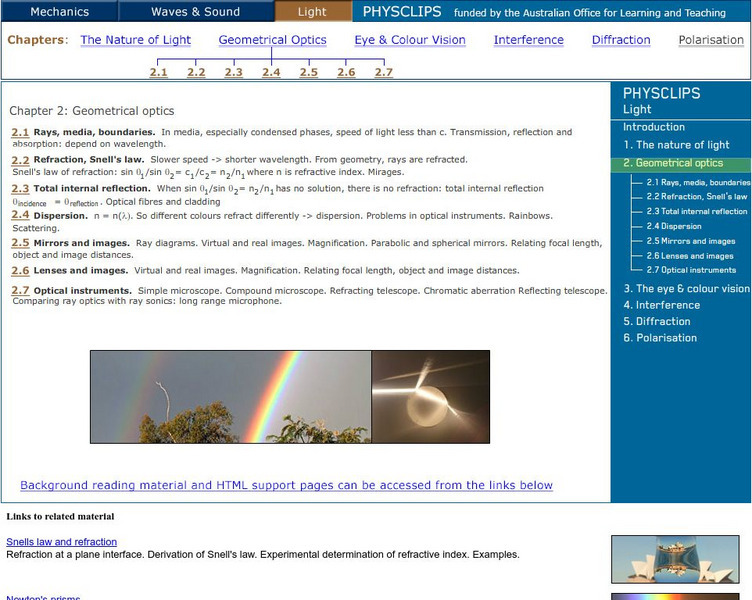
University of New South Wales: School of Physics: Physclips: Geometrical Optics
Physiclips thoroughly presents geometrical optics concepts like rays, refraction, Snell's law, total internal reflection, dispersion, mirrors, and lenses with animations and film clips.
PBS
Pbs Learning Media: Lens and Mirror Lab
Determine the location of the image in this interactive simulation of a lens and mirror optics bench. Both converging and diverging lenses and mirrors are included.
My Science Site
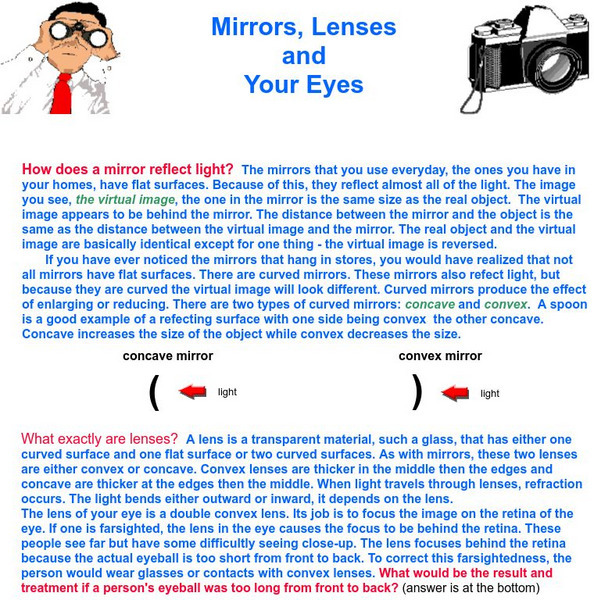
Mirrors, Lenses and Your Eyes
This resource explores the science behind light and how mirrors reflect it. Also contains information on lenses both convex and concave.
My Science Site
Optics: Energy and Control [Pdf]
A very comprehensive unit including topics such as light and its source, visible sources of light, transparency of objects and much more. Also offers a resource list, blackline masters, and expectation list, expectation summary and a...
NASA
Nasa: Starlight Riddle
This site from NASA provides an interestinnng approach to telescopes. "Almost all telescopes nowadays use mirrors, not lenses, to gather and focus the light from celestial objects. We have just seen, though, that mirrors reverse the...
University of Chicago
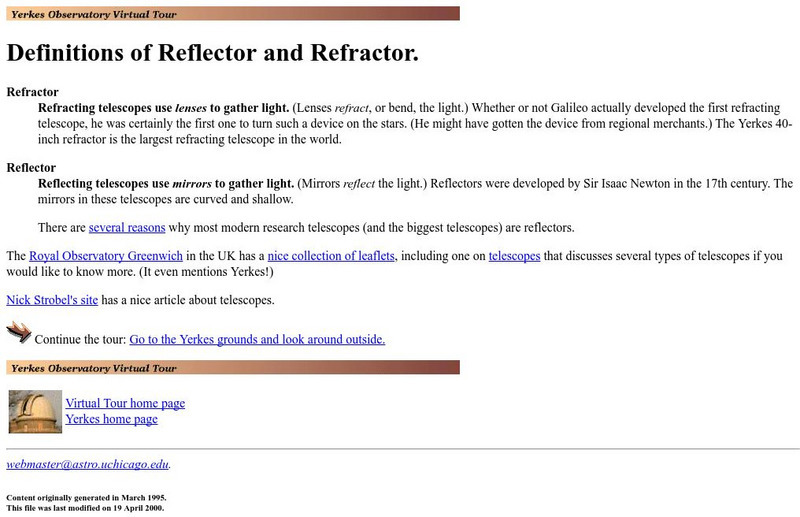
University of Chicago: Reflector and Refractor
From the Yerkes Observatory Virtual Tour web site. Compares and contrasts reflecting and refracting telescopes. A link from the page leads to a second page which explains why most modern research telescopes are reflecting telescopes.
ClassFlow
Class Flow: Introduction to Light
[Free Registration/Login Required] This flipchart introduces fifth graders to the science of light. Principles such as transparent, translucent, opaque, reflection, and refraction are covered. Concave and convex mirrors and lenses are...
CK-12 Foundation
Ck 12: Physical Science: Lens
[Free Registration/Login may be required to access all resource tools.] What a lens is and what it does, concave and convex lenses.
CK-12 Foundation
Ck 12: Physics: Geometric Optics Study Guide
Learn and understand geometric optics with this review resource.
University of Maryland
Optics Highlights: The Telescope
Part of an anecdotal history of optics and the study of light. Extremely thorough treatment of the invention of the telescope. Includes a short biographical sketch and discusses the work of Isaac Newton which focuses on his contribution...
Ducksters
Ducksters: Physics for Kids: Telescopes
Kids learn about telescopes in the science of physics including lenses, mirrors, refracting, reflecting, the history, and the Hubble Space Telescope.