Hi, what do you want to do?






Curated OER
What Does That DNA Molecule Really Look Like???
Students extract DNA from animal liver cells. They separate, collect and describe the appearance from the extracted DNA while role playing as an intern in a city's forensics.

Curated OER
Mystery of the Eleven Unknown Substances
Fourth graders identify eleven white substances that are commonly found in the household. They, in pairs, perform experiments on a variety of substances, and must identify them based on the reactions they observe.

Curated OER
A Burst of Light
Students discover the many uses of minerals in industry. They use minerals to conduct flame tests and to demostrate color. They practice safety tips in the lab.

Curated OER
Root Beer Production
In this fermentation learning exercise, learners conduct an experiment to illustrate how the yeast fermentation process is used to produce carbonation. This learning exercise has 5 short answer questions.

Curated OER
Straw Chromatography
Students separate food coloring using liquid chromatography. In this chemistry lesson, students explain the effects of different solvents on the rate of separation.

Curated OER
Thin Layer Chromatography (TLC) Separation of Plant Pigments - Chlorophyll, Carotene
Middle schoolers use TLC separations to identify various substances. In this chlorophyll lesson students separate pigments found in different plants.

Curated OER
Chlorophyll
Learners use thin layer chromatography, TLC, to separate various pigments found in plants.

Curated OER
Striking it Rich with Chemistry
Students identify the composition of different pennies. In this chemistry lesson, students use a post 1982 penny to observe chemical change. They explain how to turn a penny from copper to gold.
TeachEngineering
Teach Engineering: Chromatography Lab
To increase students' awareness of possible invisible pollutants in drinking water sources, students perform an exciting lab requiring them to think about how solutions and mixtures exist even in unsuspecting places such as ink. They use...
Science Education Resource Center at Carleton College
Serc: Investigating Chromatography: Selecting Variables
In this lab, students will demonstrate observation skills as they design an experiment to separate colors of various water-based pens in order to learn about mixtures and solutions. Students will determine a variable to test and complete...
Science Education Resource Center at Carleton College
Serc: Do Water Molecules Have Space Between Them?
In this chemistry lab, students investigate whether water molecules have any space between them by filling a glass with water, and adding salt without the water overflowing. They will also experiment with the temperature of the water.
Science Education Resource Center at Carleton College
Serc: Does Salt & Vinegar Have an Effect on Pennies?
During this lab students will experiment to see whether a salt and vinegar solution can clean a tarnished penny. Included on site is lesson plan and student worksheet.
Other
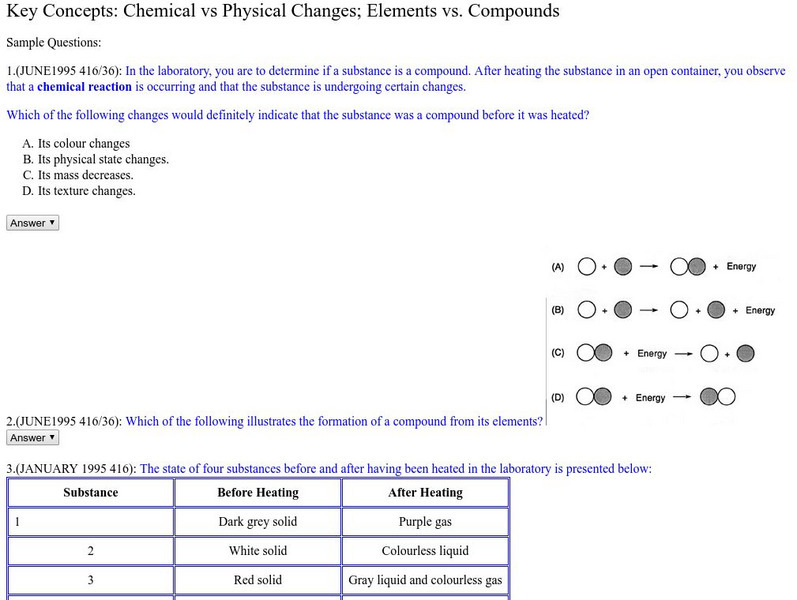
English Montreal School: Chemical vs. Physical Changes: Elements vs. Compounds
A laboratory experiment where students classify matter into a homogenous mixture, heterogeneous mixture, solution, or pure substance. Also students will test for physical and chemical changes.
Science Education Resource Center at Carleton College
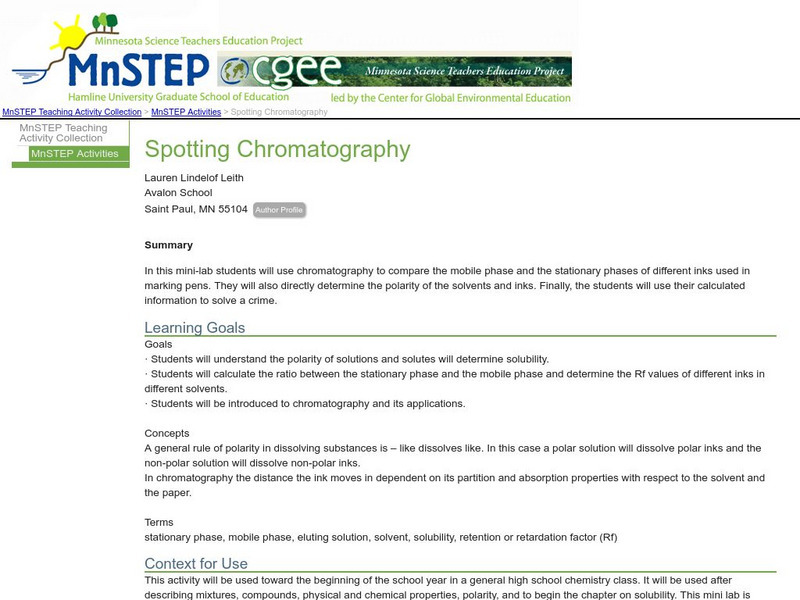
Serc: Mn Step: Spotting Chromatography
A lab activity that introduces chromatography using markers, plus water and acetone as the solvents. Students will take measurements to compare the mobile and stationary phases of the inks, and find the polarity of the inks and solvents....