Hi, what do you want to do?





American Association of Physics Teachers
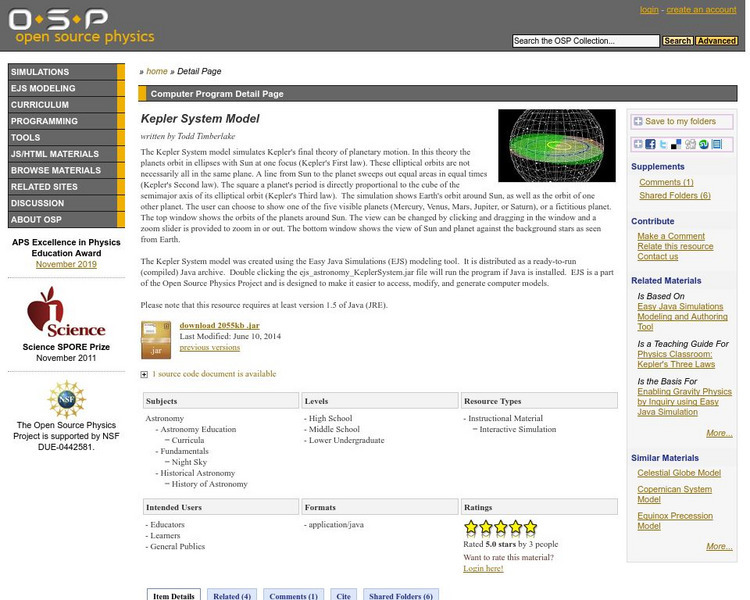
Com Padre Digital Library: Open Source Physics: Kepler System Model
This site from Open Source Physics offers a file with a simulation of Kepler's theory of planetary motion, tested with the Earth rotating around the sun and another planet of the user's choosing. The download requires Java.

ClassFlow
Class Flow: Earth, Sun and Moon
[Free Registration/Login Required] In this unit children learn about the shapes and relative sizes of the Earth, Sun and Moon. Using models they learn how the three bodies move relative to each other and how these movements relate to...
Science Education Resource Center at Carleton College
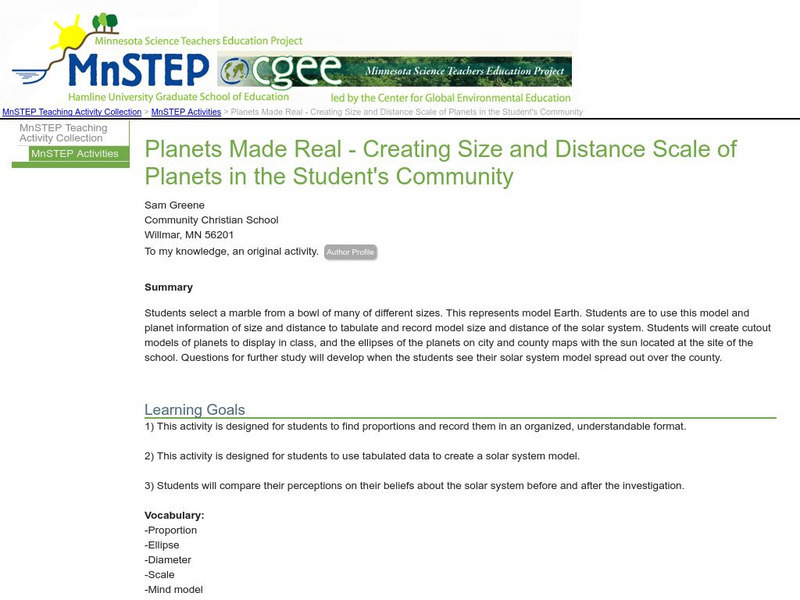
Serc: Planets Made Real: Creating Size and Distance Scale of Planets
An activity where students build a scale model of the solar system based on a marble they pick from a bowl. After choosing a marble that represents Earth, students must calculate the size of the other planets and the sun. Site includes...
Science Education Resource Center at Carleton College
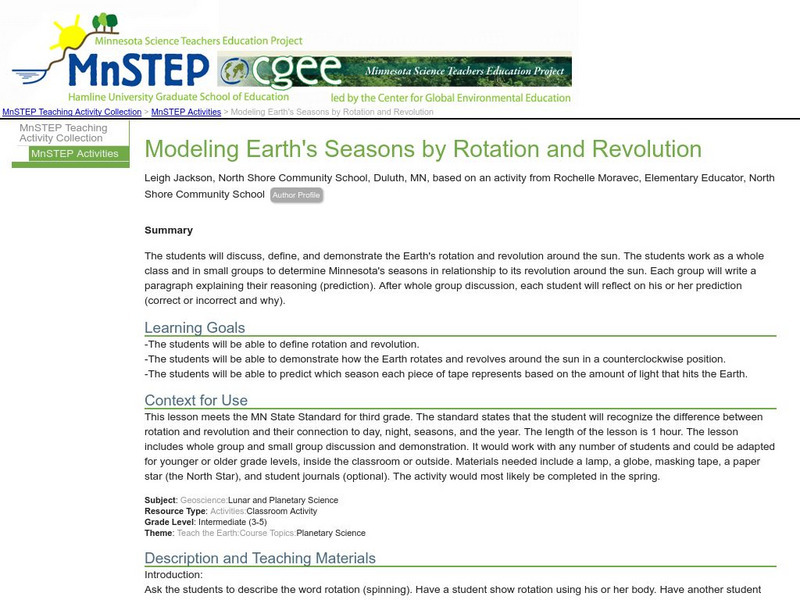
Serc: Modeling Earth's Seasons by Rotation and Revolution
In this lesson, young scholars will discuss, define, and demonstrate the Earth's rotation and revolution around the sun in a counterclockwise position. They will be able to predict seasons based on the amount of light that hits the Earth.
![Arts Now Learning: Phases of the Moon [Pdf] Lesson Plan](https://static.lp.lexp.cloud/images/attachment_defaults/resource/large/FPO-knovation.png "Arts Now Learning: Phases of the Moon [Pdf] Lesson Plan")
ArtsNow
Arts Now Learning: Phases of the Moon [Pdf]
In this lesson, 4th graders use their bodies to model the day/night cycles of the Sun and Earth. Next, they discuss the moon's role in the solar system and explore the eight phases of the moon by acting out a story. Finally, a song...
Science Education Resource Center at Carleton College
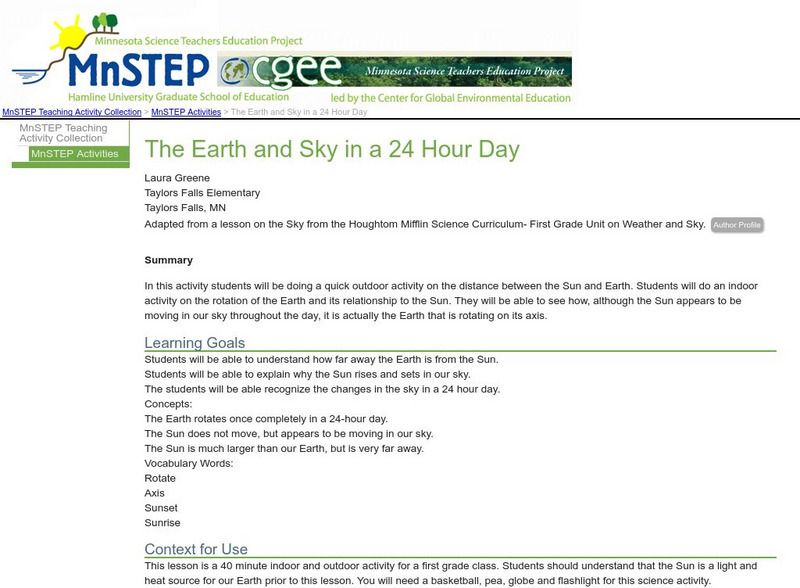
Serc: Mn Step: The Earth and Sky in a 24 Hour Day
An activity where students learn, through modeling and demonstration, about the relative sizes of the Earth and Sun, the distance between them, and how the Earth rotates in a 24-hour period.

Science Education Resource Center at Carleton College
Serc: Mn Step: Rotation of the Earth
A KWL activity combined with a demonstration model. Students record their ideas and questions about why we have day and night. They then shine a flashlight (the Sun) on a rotating styrofoam ball (the Earth) and record their observations....
American Association of Physics Teachers
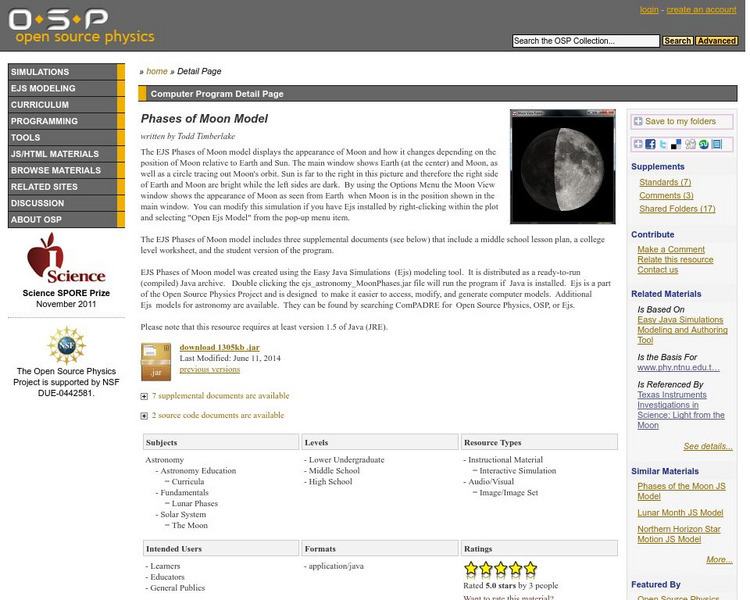
Com Padre Digital Library: Open Source Physics: Phases of the Moon Model
Examine the changes that occur with the moon's movement in relationship to the Earth and Sun with this astronomy simulation.
Science Education Resource Center at Carleton College
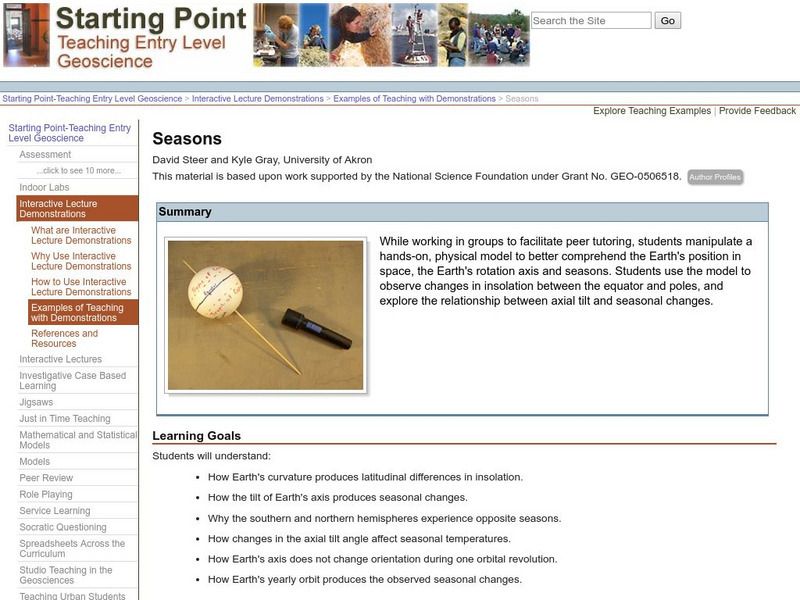
Serc: Seasons
For this activity, students create a small model of the Earth using a styrofoam ball and a skewer. They then explore the relationship between the Earth and the Sun (a flashlight) to understand why it is hottest at the Equator, and why we...
Harvard University
Harvard Smithsonian: Everyday Classroom Tools
The focus of this series of lessons is to engage students in an exploration of the world around them. The emphasis is on inquiry as students learn about the earth, sun, light, shapes and more.

Enchanted Learning
Enchanted Learning: Zoom Astronomy
Where is our Solar System? How far away is the sun? What makes up the sun? Find out all you want to know about our solar system. This is a comprehensive on-line site about space and astronomy. Check out all of the excitement!
Other
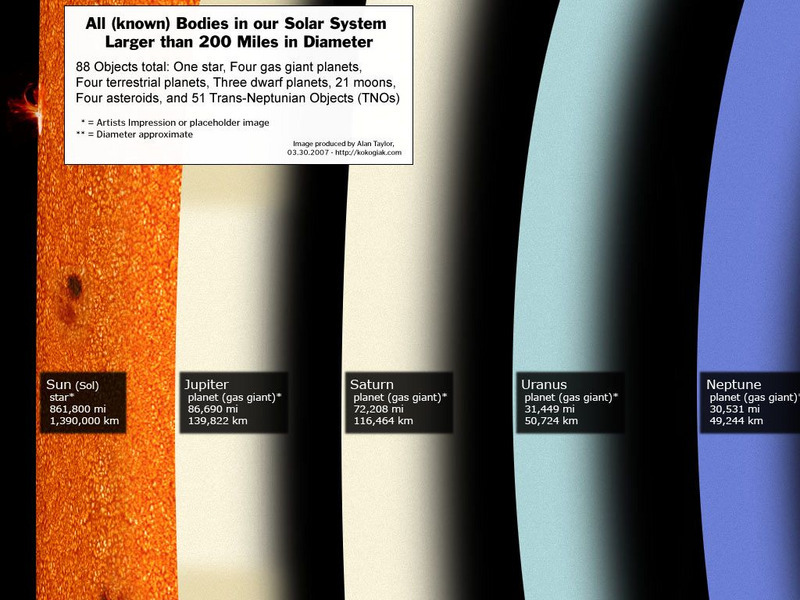
All (Known) Bodies in Our Solar System Larger Than 200 Miles in Diameter
How big is the Earth compared to the Sun? Is Mars bigger than the Moon? Seeing all bodies in the solar system larger than 200 miles in diameter side by side provides an excellent comparison and an interesting perspective.
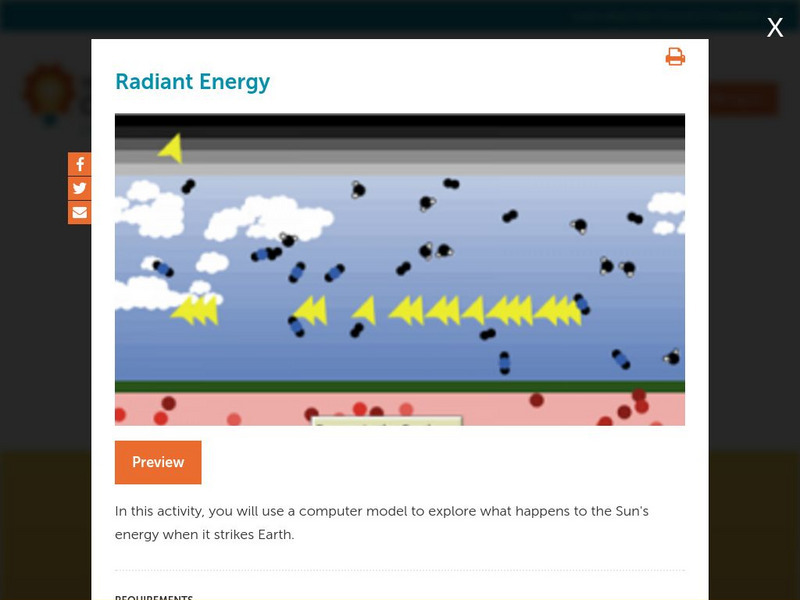
Concord Consortium
Concord Consortium: Stem Resources: Radiant Energy Flow
A virtual lab to look at the physical features of Earth that affect the amount of the Sun's energy that hits Earth. Students investigate how solar and infrared radiations enters and leaves the atmosphere with this model. Virtual lab...