Hi, what do you want to do?






PBS
Pbs Learning Media: Scaled Images of the Solar System
Use the following lithographs to envision the scale of our solar system. View different models of planets at different scales, an infographic about the relative sizes of the planets and distance from the sun, and images of the largest...
PBS
Pbs Learning Media: Solar System Scale Model
Teach the concept of scale models and the size of the solar system through this extensive lesson plan. Young scholars will learn about scale models, estimate which objects to use to create a scale model of Earth and Sun, and figure out...
Other
Making a Scale Model of the Solar System
In this lesson plan site, students are asked to construct a scale model of the planets to help visualize the relative size of planets and their relative distance from the Sun. Links are provided to the Sun and the planets which contain...
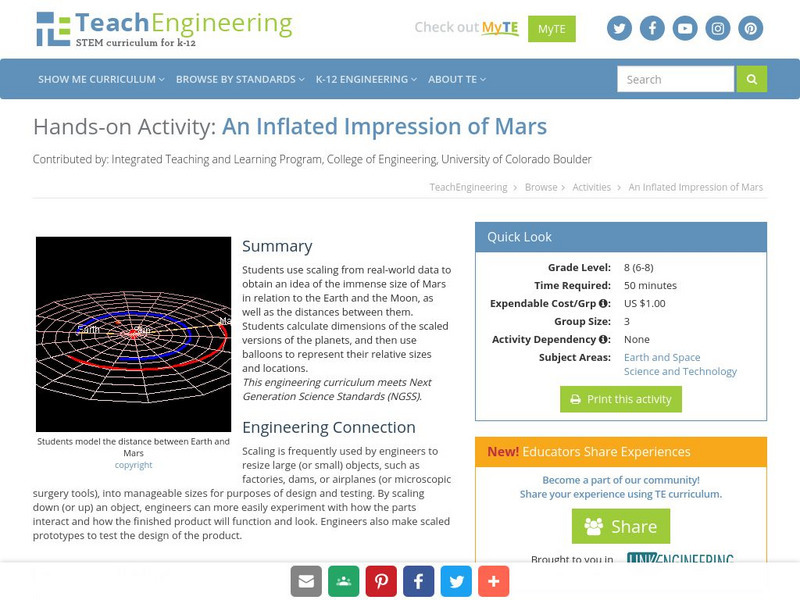
TeachEngineering
Teach Engineering: An Inflated Impression of Mars
The purpose of this activity is to use scaling in order to give students an idea of the size of Mars in relation to the Earth and the Moon as well as the distance between them. The students will have to calculate dimensions of the scaled...
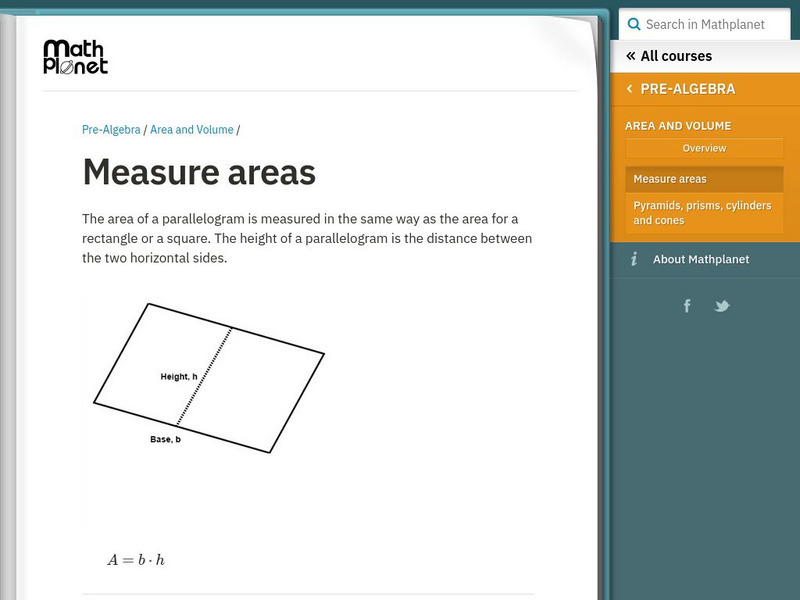
Math Planet
Math Planet: Pre Algebra: Measure Areas
Demonstrates how to calculate the area of two-dimensional shapes using formulas. Covers parallelogram, triangle, trapezoid, and circle. Includes a video modeling how to find the area of a circle and a triangle. [0:59]
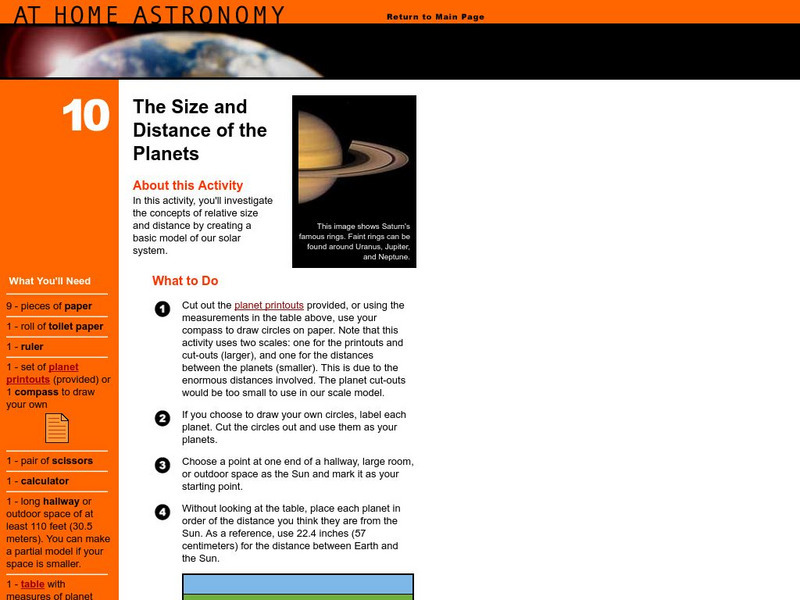
University of California
Uc Berkeley: At Home Astronomy: The Size and Distance of Planets
In this activity, "You will investigate the concepts of relative size and distance by creating a basic model of our solar system." Planet printouts are provided and this site contains related links.
Science Buddies
Science Buddies: Pop Goes the Geyser!
Our home, Earth, is a living planet. Earthquakes and volcanic eruptions are proof that the geological forces that shaped our planet and created the land masses are ongoing. An amazing example of geologic activity that is less damaging is...
Discovery Education
Discovery Education: Classroom Planetarium
Create a classroom model of the solar system while teaching about relative size of all the planets, and each planet's distance from the sun.
University Corporation for Atmospheric Research
Ucar: Visualizing Weather and Climate
With visualizations, we can see the entire planet from all angles at once. We can see the invisible - such as water vapor in the atmosphere and the way air flows around the world.
TeachEngineering
Teach Engineering: Soapy Stress
To experience the three types of material stress related to rocks - tensional, compressional and shear - students break bars of soap using only their hands. They apply force created by the muscles in their own hands to put pressure on...