Hi, what do you want to do?






Khan Academy
Khan Academy: Venturi, House in New Castle County, Delaware
Robert Venturi's New Castle County House offers a modest but instructive example of the Post-Modern style set. Even though he never liked the stylistic term Post Modern, his buildings and critical writings helped propel late 20th-century...

Khan Academy
Khan Academy: Kathe Kollwitz, in Memoriam Karl Liebknecht
German artist Kathe Kollwitz worked almost exclusively in printmaking and became known for her prints that celebrated the plight of the working-class. View pictures and read about her techniques in this essay.

Khan Academy
Khan Academy: Rivera, Dream of a Sunday Afternoon in Alameda Central Park
"In Dream of a Sunday Afternoon in Alameda Central Park", hundreds of characters from 400 years of Mexican history gather for a stroll through Mexico City's largest park. View pictures of this Diego Rivera painting and read about the...
J. Paul Getty Trust
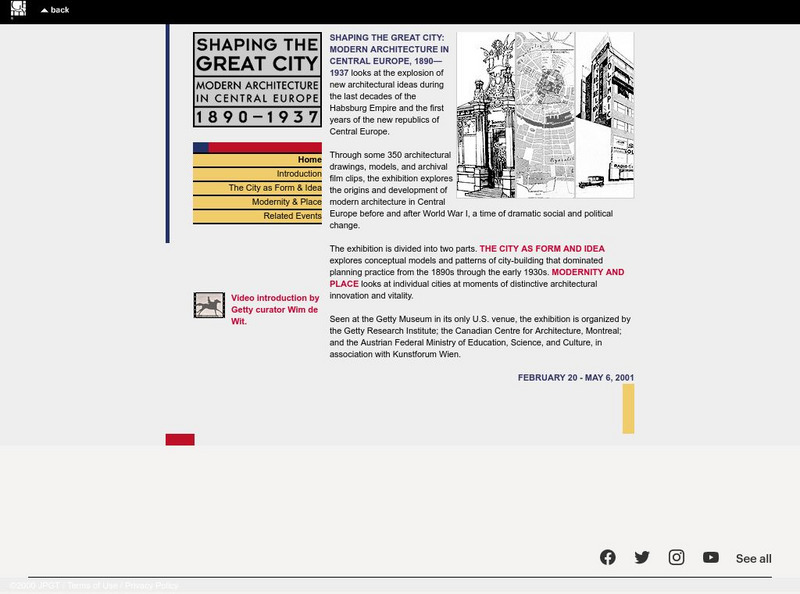
J. Paul Getty Museum: Getty Exhibitions: Shaping the Great City
Cities in Central Europe were required to expand their infrastructure due to industrialization and an increase in the need for workers. This exhibit details and illustrates the shift and growth through modern architecture of the era.
J. Paul Getty Trust
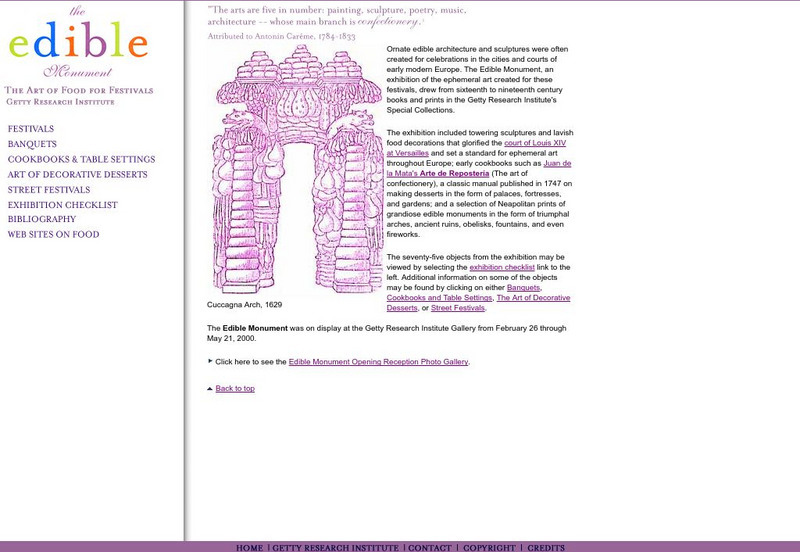
J. Paul Getty Museum: The Ediable Monument: Art of Food for Festivals
Ornate edible architecture and sculptures were often created for celebrations in the cities and courts of early modern Europe. The Edible Monument is an exhibition of the ephemeral art created for these festivals.

Khan Academy
Khan Academy: Cultural Heritage at Risk: Turkey
The modern state of Turkey is one of the most archeologically and culturally rich places in the world. This article discusses why these sites are endangered and the struggle to protect these sites.

Khan Academy
Khan Academy: Van Gogh, the Starry Night
Van Gogh's canvas "The Starry Night" is an exceptional work of art, not only in terms of its quality but also within the artist's collection, since in comparison to favored subjects like irises, sunflowers, or wheat fields, night...

Khan Academy
Khan Academy: Le Corbusier, Villa Savoye
Le Corbusier's famous dictum, that "The house should be a machine for living in," is perfectly realized within the forms, layout, materials, and siting of the Villa Savoye. View pictures and details of this house on this site.

Khan Academy
Khan Academy: Yayoi Kusama, Narcissus Garden
The pinnacle of Yayoi Kusama's success is the art installation "Narcissus Garden" where she staged stage 1,500 mass-produced plastic silver globes on the lawn outside the Italian Pavilion. View pictures and read the symbolism behind...

Khan Academy
Khan Academy: Mexican Muralism: Los Tres Grandes David Siqueiros, Diego Rivera
Siqueiros, Diego Rivera, and Jose Clemente Orozco-known as Los tres grandes-cultivated an artistic style that defined Mexican identity following the Revolution. They crafted epic murals on the walls of highly visible, public buildings...

Khan Academy
Khan Academy: Velasco, the Valley of Mexico
"The Valley of Mexico from the Hillside of Santa Isabel" by Velasco represents an important period in the development of Mexico's national identity and an important chapter in the history of Mexican art. Velasco's landscapes became...

Khan Academy
Khan Academy: Sullivan, Carson, Pirie, Scott Building
The Sullivan, Carson, Pirie, Scott Building in Chicago is an important example of early Chicago skyscraper architecture, and can also be seen as a fascinating indicator of the relationship between architecture and commerce. View pictures...

Khan Academy
Khan Academy: Meret Oppenheim, Object (Fur Covered Cup, Saucer, and Spoon)
The story behind the creation of "Object", an ordinary cup, spoon, and saucer wrapped evocatively in gazelle fur, has been told so many times its importance in modernist history transcends the fact it might be of dubious authenticity....

Khan Academy
Khan Academy: Lam, the Jungle
Wifredo Lam remains the most renowned painter from Cuba and "The Jungle" remains his best known work and an important painting in the history of Latin American art and the history of twentieth-century modernism more broadly. View...

Khan Academy
Khan Academy: Cassatt, the Coiffure
Mary Cassatt's motivation in making her prints was to make her art more accessible for a large audience. She believed that everyone, regardless of income or social position, should be able to experience art and to own works they enjoy....

Khan Academy
Khan Academy: Warhol, Marilyn Diptych
Andy Warhol's iconic Marilyn Monroe Diptych invites the viewer to consider the consequences of the increasing role of mass media images in our everyday lives. View pictures and read about his techniques and influences in this essay.

A&E Television
History.com: How Early Humans Survived the Ice Age
The most recent ice age peaked between 24,000 and 21,000 years ago, when vast ice sheets covered North America and northern Europe, and mountain ranges like Africa's Mt. Kilimanjaro and South America's Andes were encased in glaciers. At...
Curated OER
Educational Technology Clearinghouse: Clip Art Etc: Simon De Montfort
Simon de Montfort, 6th Earl of Leicester (1208 - August 4, 1265), was the principal leader of the baronial opposition to King Henry III of England. After the rebellion of 1263-1264, de Montfort became de facto ruler of England and called...

Khan Academy
Khan Academy: Courbet, the Stonebreakers
"The Stonebreakers" by Gustave Courbet seems to lack the basics of art (things like a composition that selects and organizes, aerial perspective and finish) and as a result, it feels more "real". View a picture and read a description in...

Khan Academy
Khan Academy: Munch, the Scream
Edvard Munch's "The Scream" is one of the most iconic human figures in the history of Western art. Since The Scream's first appearance, many critics and scholars have attempted to determine the exact scene depicted, as well as...

Khan Academy
Khan Academy: Analytic Cubism
In this essay, a professor explains Cubism to his class using a cold cup of coffee.

Khan Academy
Khan Academy: Gauguin, Where Do We Come From? What Are We? Where Are We Going?
"Where do we come from? What are we? Where are we going?" is a huge, brilliantly colored but enigmatic work painted on rough, heavy sackcloth. It is Paul Gauguin's largest painting, and he understood it to be his finest work. View...

Khan Academy
Khan Academy: Helen Frankenthaler, the Bay
Helen Frankenthaler was known for using a specific process of pouring paint on to the canvas rather than painting the colors onto the surface with a brush. View a picture of "The Bay" and read about her technique in this essay.

Khan Academy
Khan Academy: Basquiat, Horn Players
Jean-Michel Basquiat's 1983 painting "Horn Players" shows us all the main stylistic features we have come to expect from this renowned American artist. View pictures of his artwork and read about his life in this essay.