Hi, what do you want to do?






EngageNY
Complex Numbers and Transformations
Your learners combine their knowledge of real and imaginary numbers and matrices in an activity containing thirty lessons, two assessments (mid-module and end module), and their corresponding rubrics. Centered on complex numbers and...
OpenStax
Open Stax: Elasticity: Stress and Strain
In the following interactive students will learn about Hooke's Law. They will explain this law using graphical representation between deformation and applied force and discuss the three types of deformations such as changes in length,...
Texas Education Agency
Texas Gateway: Further Applications of Newton's: Elasticity: Stress and Strain
By the end of this section, you will be able to state Hooke's law; explain Hook's law using graphical representations between deformation and applied force; discuss the three types of deformations: changes in length, sideways shear, and...
Texas Education Agency
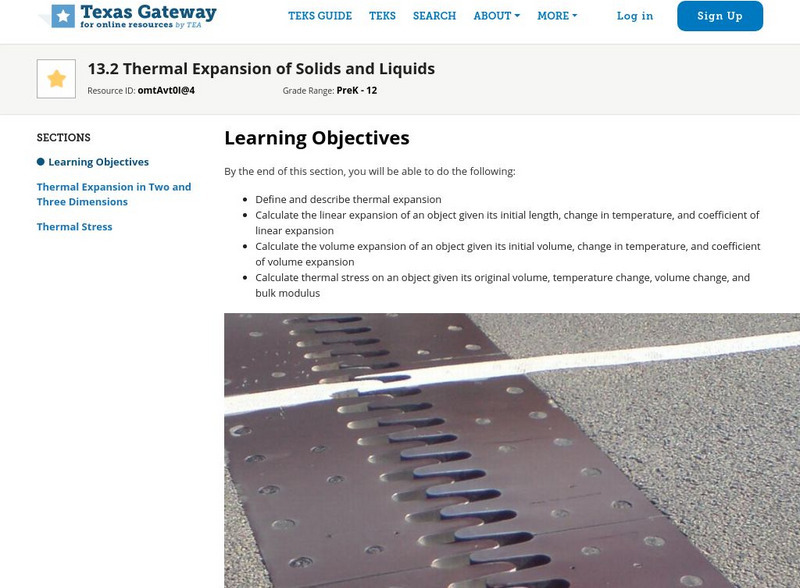
Texas Gateway: Thermal Expansion of Solids and Liquids
By the end of this section, you will be able to define and describe thermal expansion; calculate the linear expansion of an object given its initial length, change in temperature, and coefficient of linear expansion; and calculate the...

TeachEngineering
Teach Engineering: Using Stress and Strain to Detect Cancer
In this project, students are challenged to answer the question "Is there a way to detect the presence of tumors that isn't as painful as mammography but more reliable and quantifiable than a breast-self exam or clinical breast-exams?"....

CK-12 Foundation
Ck 12: Polar Form of Complex Numbers
[Free Registration/Login may be required to access all resource tools.] Calculate the distance between numbers in the complex plane as the modulus of the difference, and the midpoint of a segment as the average of the numbers at its...

Illustrative Mathematics
Illustrative Mathematics: Complex Distance
This problem is intended to reinforce the geometric interpretation of distance between complex numbers and midpoints as modulus of the difference and average respectively.