Hi, what do you want to do?






Curated OER
Hydrocarbons
In this hydrocarbon worksheet, students answer 13 questions about different types of organic molecules categorized as hydrocarbons. They explain the different hydrocarbons, they draw structural diagrams for different hydrocarbons and...

Curated OER
Antacid Lesson Plan
Eleventh graders use titration methods to study properties of antacids. They look at the strength, effectiveness, PH, and effect of supplements taken at the same time. They make observations after the different mixtures are combined and...

Curated OER
Concentration and Reaction Rates
Students investigate how varying the concentrations, volumes, and other factors affects reaction rates. Students design and conduct investigations to obtain data used to create graphs of an uncatalyzed reaction vs. a catalyzed reaction....

Curated OER
Brush Up On Your Teeth
Third graders examine the reasons why it is important to take care of their teeth. As a class, they sing the toothbrush song and read about tooth decay. They identify the parts of the teeth and identify foods that can keep the mouth...

Curated OER
Phosphate Testing Contract
Students examine how to prepare an experimental procedure. In this scientific method lesson students conduct an investigation on phosphate.

Curated OER
Introduction to Gas Chromatography
Students analyze gas chromatograms and suggest various applications for gas chromatography.

Curated OER
How Can We Accurately Make Different Solutions of Different Concentrations?
Students work together to create different solutions made from different concentrations of liquids. They record and analyze their data. They answer discussion questions to complete the lesson.

Curated OER
Determination of the percentage of Acetic Acid in Vinegar
Students determine the concentration of acetic acid when the concentration of the base with which is titrated is known. They investigate how to weigh a sample using the balance, measure volumes using graduated cylinder, explore the...

Curated OER
A Self Directed Inquiry into the Identification of Unknowns
High schoolers gain experience in designing an experiment and use logic in selecting specific tests for unknowns. Students recognize the use of spreadsheets in helping one to make clear comparisons.
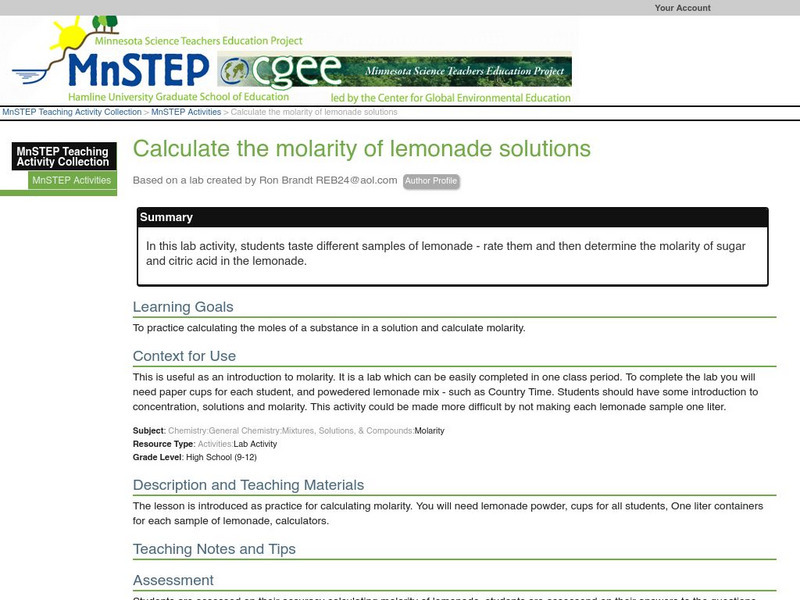
Science Education Resource Center at Carleton College
Serc:calculate the Molarity of Lemonade Solutions
In this lab activity, students taste different samples of lemonade - rate them and then determine the molarity of sugar and citric acid in the lemonade.

Dartmouth College
Dartmouth College: Chem Lab: Calorimetry 1 Enthalpy of Formation of Mg O
In this lab experiment students are asked to determine the standard molar enthalpy of formation of magnesium oxide, MgO. Students are asked to use Hess's Law and the enthalpy changes of several other solution reactions during this...

University of Colorado
University of Colorado: Ph Et Interactive Simulations: Beer's Law Lab
An interactive simulation that teaches about Beer's Law, solutions, concentration, spectrophotometry, and more through observations to explore how much light is absorbed and transmitted with changes in thickness and color. This...
Chemistry Collective
Chem Collective: Current Collection of Virtual Lab Problems
A collection of over 30 virtual chemistry problems with accompanying interactive activities. Each problem includes a word file for potential differentiation in your classroom.

Khan Academy
Khan Academy: Molarity vs.osmolarity
Molarity and osmolarity are two distinct concepts. Molarity (M) is the number of moles of solute per liter of solution. The unit of molarity is the mole (mol). Osmolarity (Osm/L) is the total concentration of all solutes in the solution....

Khan Academy
Khan Academy: Molarity vs. Molality
Learn how molarity and molality differ. The molality of a solution is equal to the moles of solute divided by the mass of solvent in kilograms, while the molarity of a solution is equal to the moles of solute divided by the volume of...
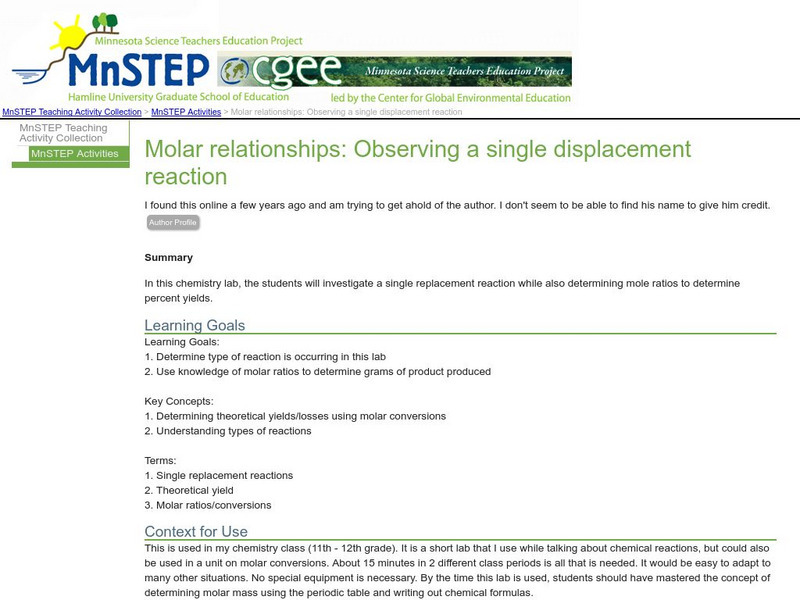
Science Education Resource Center at Carleton College
Serc: Molar Relationships: Observing a Single Displacement Reaction
In this chemistry lab, students will investigate a single replacement reaction while also using knowledge of molar ratios to determine percent yields.
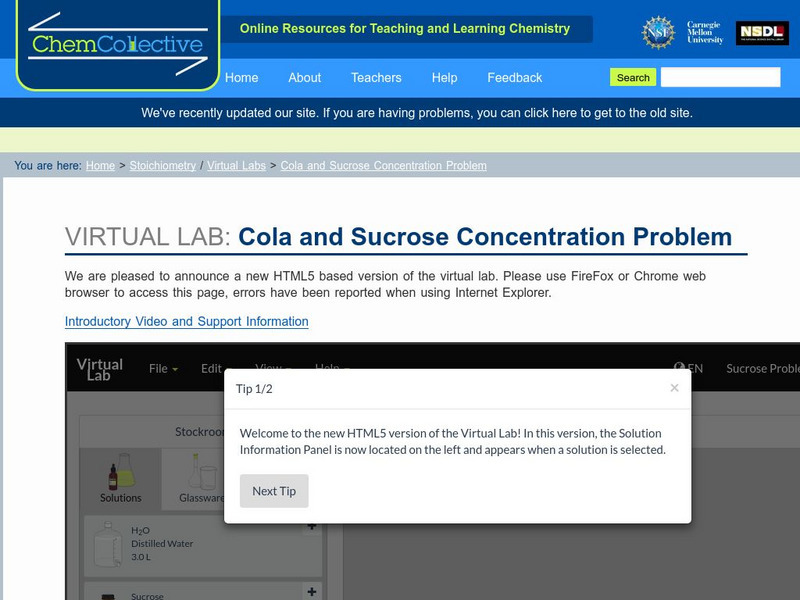
Chemistry Collective
Chem Collective: Cola and Sucrose Concentration Problem
In this activity, students use the virtual lab to prepare a sucrose solution for a soda recipe. They next calculate the concentration of their solution in terms of molarity, percent mass and density. Finally, they compare the density of...
Chemistry Collective
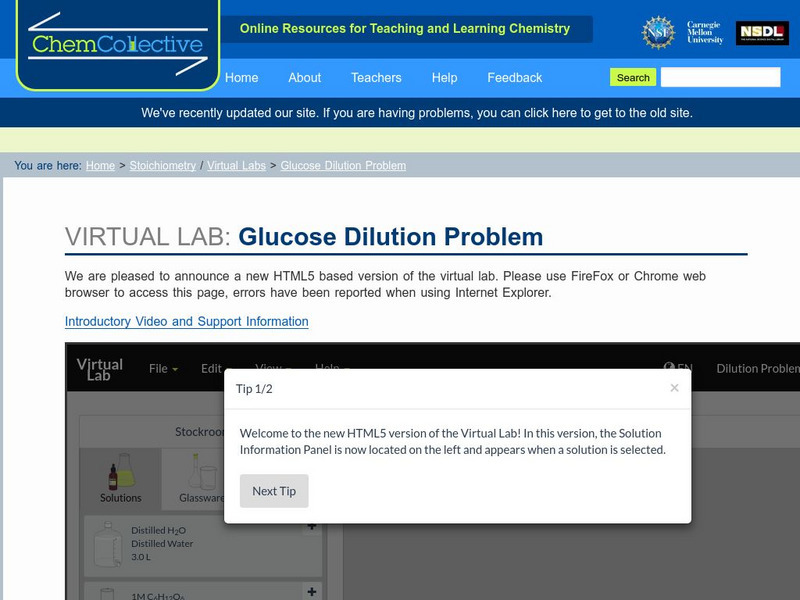
Chem Collective: Glucose Dilution Problem
In this activity, students use the virtual lab to create a 0.025M glucose solution from a standard 1M glucose solution. First, they calculate the correct volumes of 1M glucose solution and water to mix together to create the final 0.025M...
Chemistry Collective
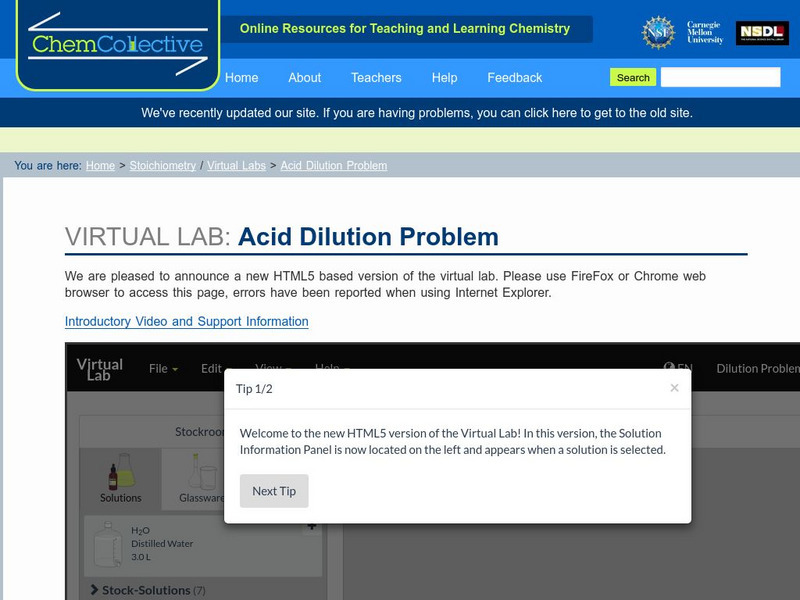
Chem Collective: Acid Dilution Problem
In this activity, students use the virtual lab to create 500mL of 3M HCl solution from a concentrated stock solution of 11.6M HCl. They must first calculate the correct volumes of 11.6M HCl solution and water to mix together to create...
Chemistry Collective
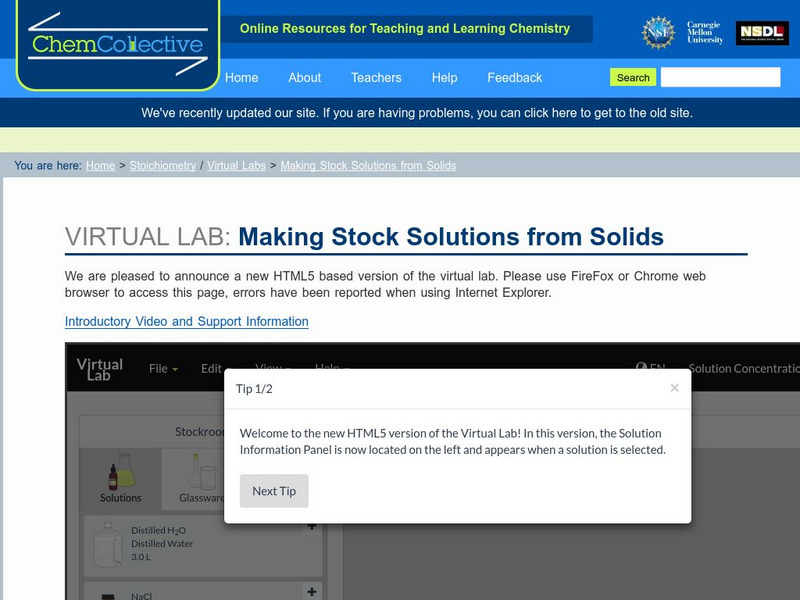
Chem Collective: Making Stock Solutions From Solids
In this activity, students use the virtual lab to create stock solutions starting from solid salts. Students must first calculate the correct amount of solid to make the solution. Next, they prepare the solution using the appropriate...
Chemistry Collective
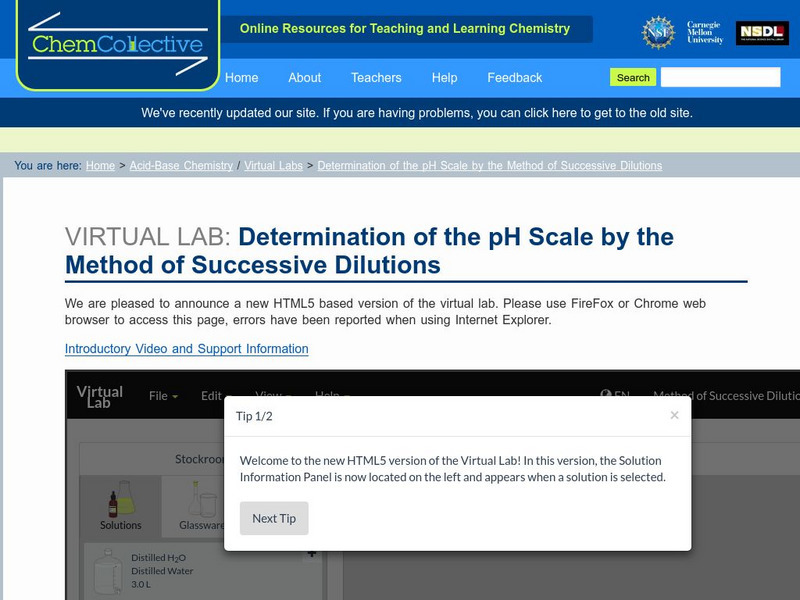
Chem Collective: Determination of the P H Scale
This virtual lab activity where students perform the method of successive dilutions using HCl, NaOH, a pH meter, and universal indicator solution to help understand the logarithmic nature of the pH scale.

Khan Academy
Khan Academy: Molarity, Molality, Osmolarity, Osmolality, and Tonicity What's the Difference?
See how each of these terms tells us something different about a solution.
Texas Instruments
Texas Instruments: Molar Gas Lab
Students use stoichiometry to determine the mass of oxygen gas in a bottle. They may also check their answer against the amount of potassium chloride produced during the reaction.
Chemistry Collective
Chem Collective: Creating a Stock Solution
In this activity, students use the virtual lab to create dilute solutions from a concentrated stock solution of acids or bases. They must first calculate the correct volumes of concentrated acid solution and water to mix together to...