Hi, what do you want to do?





Chiral Publishing
Chiral Publishing: An Introduction to Chemistry: Molar Mass Conversion Factors
Read how to use molar mass equations to find conversion factors and molecular compounds. View several examples using given formulas for molar mass.
CK-12 Foundation
Ck 12: Gas Mixtures and Molecular Speeds
[Free Registration/Login may be required to access all resource tools.] The following online tutorial helps students use Dalton's Law and mole fraction to calculate the partial pressure of a gas in a mixture. They will learn to calculate...

Carnegie Mellon University
Chem Collective: Stoichiometry Bridge Course
This is a complete course in chemical stoichiometry, set in a scenario that shows how stoichiometry calculations are used in real-world situations. This course has been designed to not only help you strengthen your skills with...
OpenStax
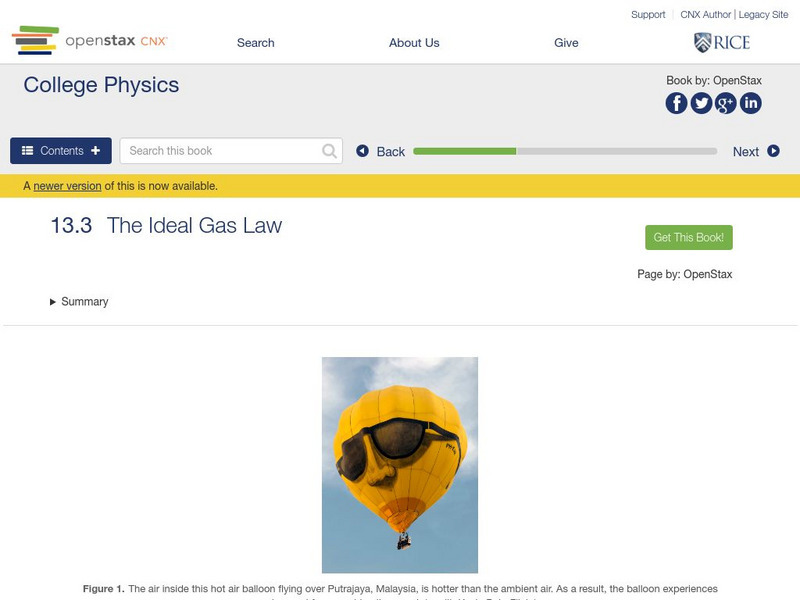
Open Stax: College Physics: The Ideal Gas Law
A section in a college textbook exploring the ideal gas law in relation to molecules and in terms of moles. Learn how to calculate the variables in the ideal gas law. Also become familiar with Avogadro's number and how to use it to...
Texas Education Agency
Texas Gateway: The Ideal Gas Law
Explore the thermal behavior of gases, in particular, examine the characteristics of atoms and molecules that compose gases. Learn about the ideal law of gases in terms of molecules and moles. Multiple formulas and examples are provided.
Georgia Department of Education
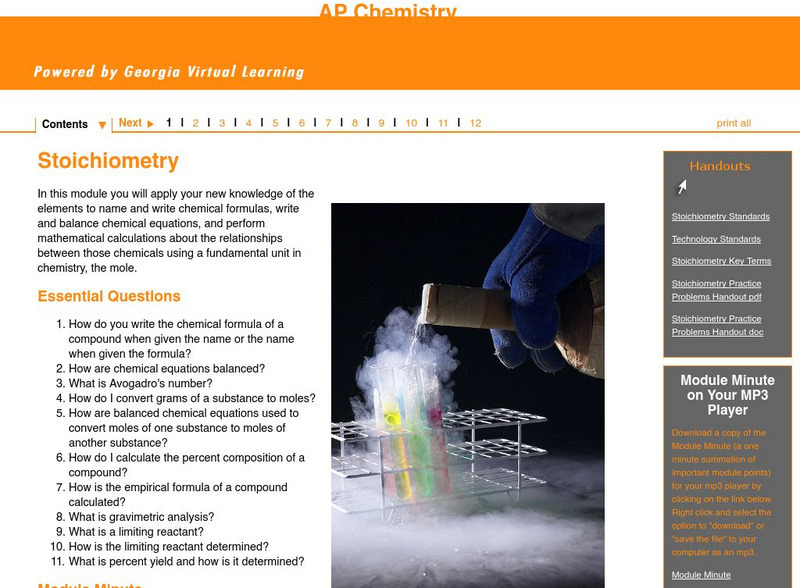
Ga Virtual Learning: Ap Chemistry: Stoichiometry
Students apply new knowledge of the elements to name and write chemical formulas, write and balance chemical equations, and perform mathematical calculations about the relationships between those chemicals, using a fundamental unit in...
CK-12 Foundation
Ck 12: Solubility Equilibrium
[Free Registration/Login may be required to access all resource tools.] Students write the solubility product constant expressions for nearly insoluble ionic compounds and perform calculations for compounds and solubility.
University of Colorado
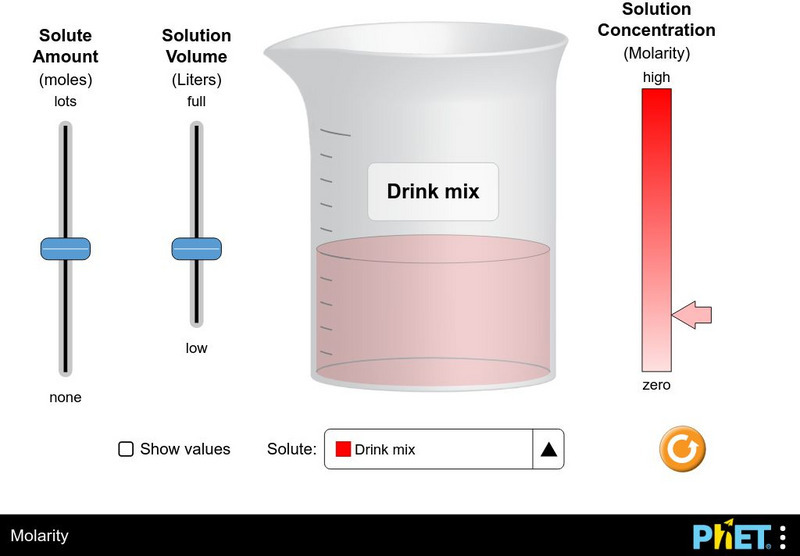
University of Colorado: Ph Et Interactive Simulations: Molarity
What determines the concentration of a solution? Learn about the relationships between moles, liters, and molarity by adjusting the amount of solute and solution volume. Change solutes to compare different chemical compounds in water.
Chemistry Collective
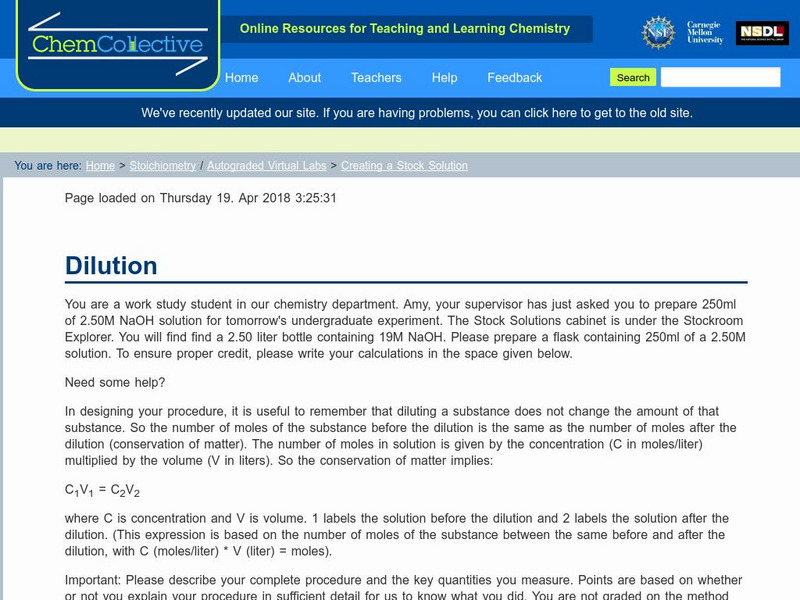
Chem Collective: Creating a Stock Solution
In this activity, students use the virtual lab to create dilute solutions from a concentrated stock solution of acids or bases. They must first calculate the correct volumes of concentrated acid solution and water to mix together to...
Chemistry Collective
Chem Collective: Glucose Dilution Problem
In this activity, students use the virtual lab to create a 0.025M glucose solution from a standard 1M glucose solution. First, they calculate the correct volumes of 1M glucose solution and water to mix together to create the final 0.025M...
Chemistry Collective
Chem Collective: Acid Dilution Problem
In this activity, students use the virtual lab to create 500mL of 3M HCl solution from a concentrated stock solution of 11.6M HCl. They must first calculate the correct volumes of 11.6M HCl solution and water to mix together to create...
Chemistry Collective
Chem Collective: Making Stock Solutions From Solids
In this activity, students use the virtual lab to create stock solutions starting from solid salts. Students must first calculate the correct amount of solid to make the solution. Next, they prepare the solution using the appropriate...

Texas Education Agency
Texas Gateway: The Ideal Gas Law
By the end of this section, you will be able to state the ideal gas law in terms of molecules and in terms of moles; use the ideal gas law to calculate pressure change, temperature change, volume change, or the number of molecules or...
CK-12 Foundation
Ck 12: Ideal Gases and Gas Stoichiometry
[Free Registration/Login may be required to access all resource tools.] In the following online tutorial students will learn the Ideal Gas Law, and know which of the different values for the ideal gas constant to use in a given...

Science Education Resource Center at Carleton College
Serc: Mn Step: Stoichiometry: Introduction to Stoichiometry
Using the example of a cake recipe, students find the ratios between different ingredients, which introduces the concept of mole ratios. They then calculate the mole ratios in a chemical equation, and learn how this applies to...

Science Struck
Science Struck: Molarity Formula
Explains what molarity is and how to calculate it using the molarity formula.
CK-12 Foundation
Ck 12: Gas Properties
[Free Registration/Login may be required to access all resource tools.] The following online tutorial describes how a gas can be compressed and identifies three factors that affect gas pressure. Students will describe the effects...
Other
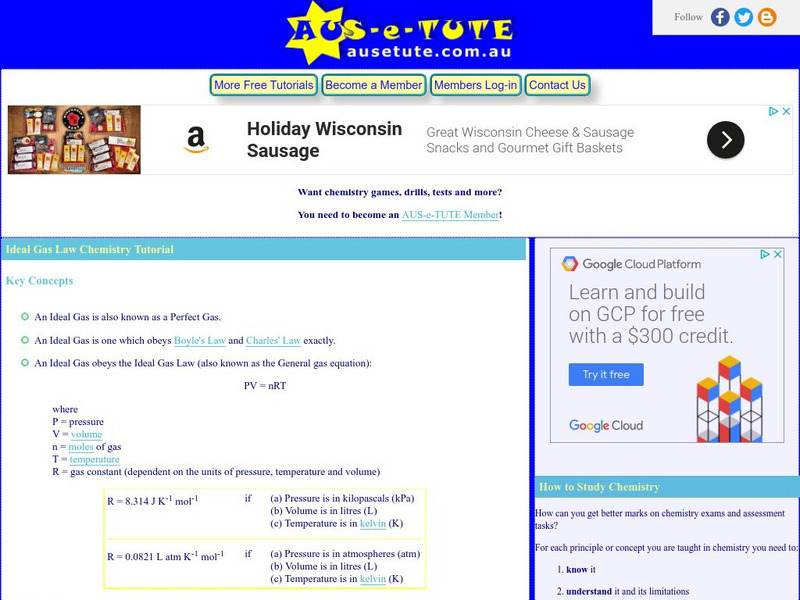
Aus E Tute: Ideal Gas Law
Some general information over ideal gases and the ideal gas law. The page shows you how to calculate the volume and pressure of ideal gas and how to calculate moles and gas temperature.

Davidson College
Davidson College: Le Chatelier's Principle Applet
This site includes an applet on Le Chatelier's principle. The applet allows the user to specify the initial amounts of carbon, water vapor, hydrogen gas, and carbon monoxide as well as the system temperature and volume. The applet will...

Khan Academy
Khan Academy: Stoichiometry
How to use mole ratios from a balanced reaction to calculate amounts of reactants.
Cosmo Learning
Cosmo Learning: Junior Chemistry With Chemguy
A collection of video lectures to teach junior high students topics in chemistry. Lectures cover topics in understanding the periodic table, compounds, chemical bonding, Avogadro's number, balancing chemical equations, stoichiometry,...