Hi, what do you want to do?






Royal Society of Chemistry
Shapes of Molecules—Distortion from the Pure Geometry
Ready to introduce the realities of molecular geometry to chemistry pupils? Use a logic-based interactive! Perfect as individual practice, the puzzles explore the bond angles and repulsions present in three common molecular shapes.

Royal Society of Chemistry
Shapes of Molecules—Hybrid Orbitals
Take your chemistry class' knowledge of molecular geometry to the next level! Introduce orbital hybridization with a series of related games. Individuals complete a data table in the first activity, then solve Sudoku-like puzzles using...

Royal Society of Chemistry
Shapes of Molecules—Geometry of Central Atom
How is a molecule's shape determined? Explore bond angles, lone pairs, and VSEPR theory through a logic-based activity. Chemists pull together information about the major molecular shapes, then use it to solve puzzles.
Concord Consortium
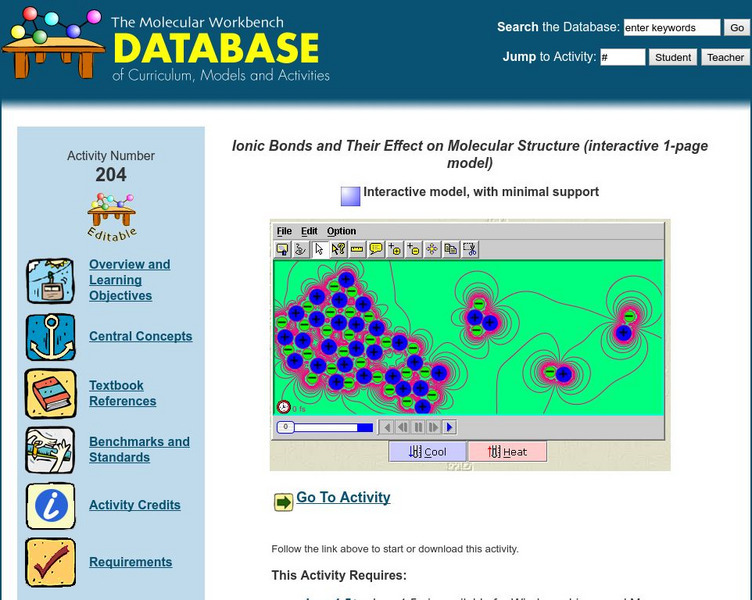
The Molecular Workbench Database: Ionic Bonds
In this simulation observe ionic bonds and how they affect the structure of the molecule.
Concord Consortium
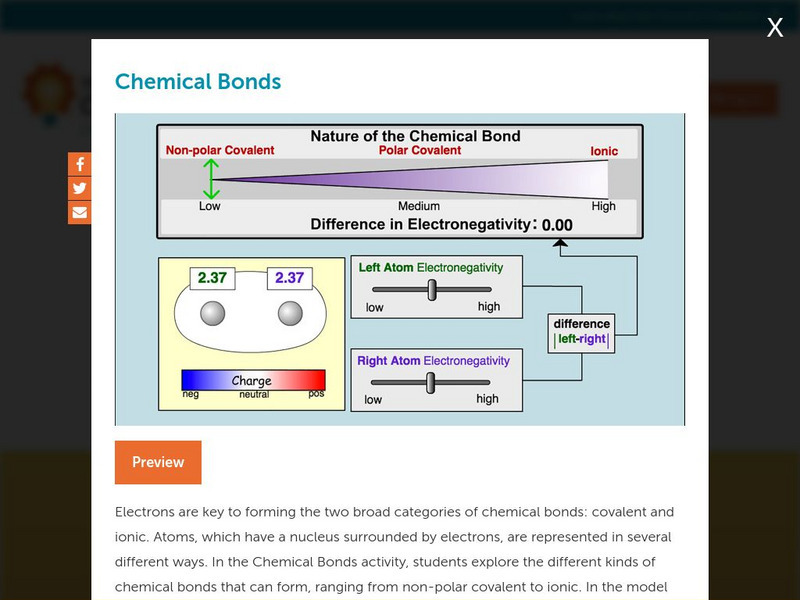
Concord Consortium: Stem Resources: Chemical Bonds
By working through this web-based activity, students differentiate between ionic, non-polar covalent, and polar covalent bonds. Specifically, distinctions are made between bonding types based on orbital shapes and electronegativity...

PBS
Pbs Learning Media: Molecular Shapes
In this interactive activity from ChemThink, students will learn about covalent molecules and how the VSEPR theory predicts the shapes of covalently-bonded molecules.
Concord Consortium
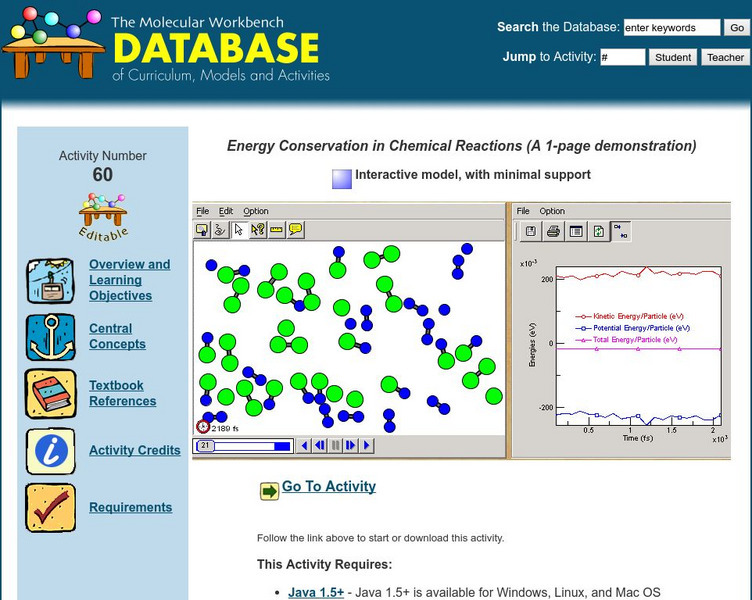
The Molecular Workbench Database: Energy Conservation in Chemical Reactions
Follow the energy conversion from potential to kinetic in this interactive activity that explores total energy in chemical reactions.
Concord Consortium
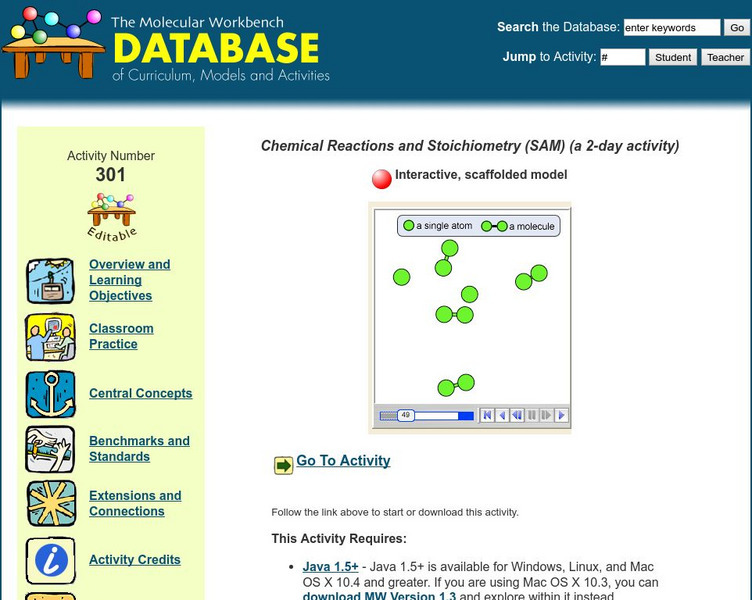
The Molecular Workbench Database: Chemical Reactions and Stoichiometry
This simulation helps students investigate the basics of chemical equations. Students will review stoichiometry and what effects their reaction rates.