Hi, what do you want to do?






Royal Society of Chemistry
Shapes of Molecules—Distortion from the Pure Geometry
Ready to introduce the realities of molecular geometry to chemistry pupils? Use a logic-based interactive! Perfect as individual practice, the puzzles explore the bond angles and repulsions present in three common molecular shapes.

Concord Consortium
Electron Geometry
It's time to whip your chemistry class into shape! Begin your study of molecular geometry with a colorful, 3-D interactive. The resource shows models of linear, trigonal planar, and tetrahedral molecules.

Royal Society of Chemistry
Shapes of Molecules—Geometry of Central Atom
How is a molecule's shape determined? Explore bond angles, lone pairs, and VSEPR theory through a logic-based activity. Chemists pull together information about the major molecular shapes, then use it to solve puzzles.

Concord Consortium
Unshared Electrons and the "Bent" Shape
Why is water always so bent out of shape? Scholars investigate the molecular geometry of the water molecule using a 3-D resource. The interactive features options such as rotation and the ability to view electron pairs.

Royal Society of Chemistry
Shapes of Molecules—Hybrid Orbitals
Take your chemistry class' knowledge of molecular geometry to the next level! Introduce orbital hybridization with a series of related games. Individuals complete a data table in the first activity, then solve Sudoku-like puzzles using...

Royal Society of Chemistry
Complex Ion Shapes
Things are really shaping up! Provide young chemists with polyatomic ion practice using an interesting interactive. Individuals complete puzzles focused on molecular geometry and complex ions.

Concord Consortium
Factors Affecting London Dispersion Attractions
How can non-polar molecules be attracted to one another? Introduce the phenomenon of London dispersion forces to young chemists through an entertaining interactive. Pupils choose from a variety of molecular shape combinations, then pull...

Concord Consortium
Elements and Polarity
Take a look at some molecules that are so cool, they're polar! Scholars examine the effect polarity has on a molecule's shape and charge. Change up the view and choose between an opaque or transparent molecular surface, complete with...

PhET
Molecule Shapes: Basics
In molecules, bonds rotate about the nucleus due to the repulsion of subatomic particles. In a simulation, learners manipulate the bonds of a molecule to meet the atoms' needs. They can then see the specific molecular shapes of five...

PhET
Molecule Shapes
The shape of a molecule is determined by the arrangement of atoms around the central atom and lone pairs of electrons. Scholars build models of molecules using single, double, and triple bonds. They can then see real molecules bond...
Concord Consortium
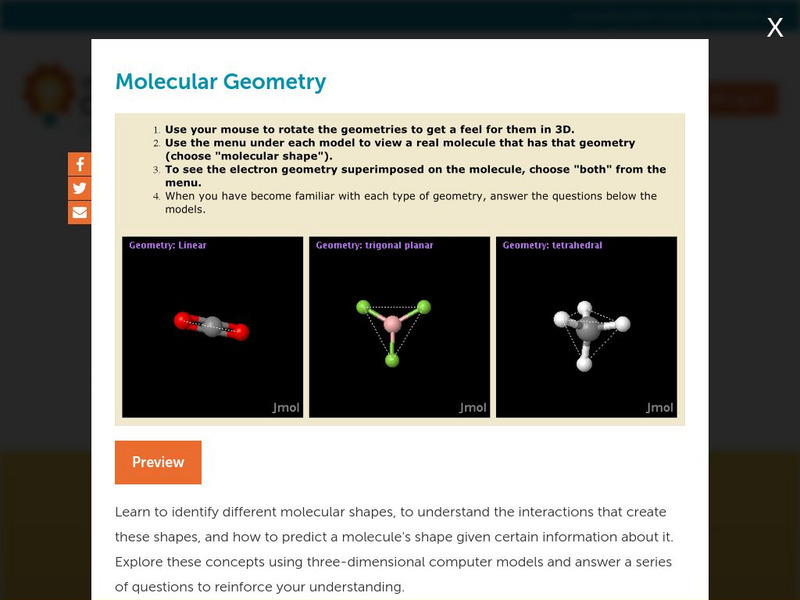
Concord Consortium: Stem Resources: Molecular Geometry
Students work through animated models showing the effects that electron repulsions have on the shape of a molecule in this web-based activity. In addition, shared and unshared electron pairs are demonstrated to define a molecule's shape....

CK-12 Foundation
Ck 12: Plix Series: Pi: Molecular Geometry
[Free Registration/Login Required] Use your knowledge of molecular geometry to analyze the structures, and determine which of them accurately illustrates the trigonal planar molecule Boron Trifluoride. Then answer two challenge questions...

PBS
Pbs Learning Media: Molecular Shapes
In this interactive activity from ChemThink, students will learn about covalent molecules and how the VSEPR theory predicts the shapes of covalently-bonded molecules.
Davidson College
Davidson College: Molecular Orbitals of Tetraamminecopper(ii)
A Java applet displays the Ligand Field Theory energy diagram for the Tetraamminecopper(II) ion. When an orbital in the diagram is clicked on, the isosurface is shown.
Davidson College
Davidson College: Molecular Orbitals of Diamminesilver(i)
A Java applet displays the Ligand Field Theory energy diagram for the Diamminesilver(I) ion. When an orbital in the diagram is clicked on, the isosurface is shown.
Chiral Publishing
Chiral Publishing: An Introduction to Chemistry: Molecular Structures: Tetrahedral Shape
Interact with molecules of methane, ammonia, and water, by manipulating colorful applets to see these molecules from all sides and observe their tetrahedral shapes.
University of Colorado
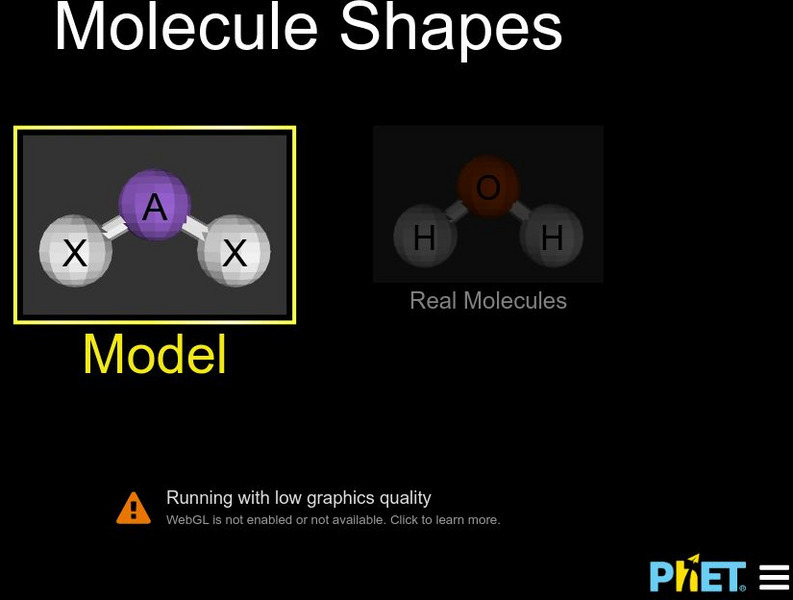
University of Colorado: Ph Et Interactive Simulations: Molecule Shapes
Build a molecule in 3-D. Add single, double, and triple bonds, or a lone pair of electrons to an atom, learn what the molecule's geometric name is, see the bond angles, and manipulate each molecule to view it from all sides. Then study a...
Davidson College
Davidson College: Valence Shell Electron Pair Repulsion (Vsepr) Model
Explains the principles of the Valence-Shell Electron-Pair Repulsion Model, and gives examples of the geometry. Requires Java.
Davidson College
Davidson College: Electronic Structure of Coordination Compounds
A list of five virtual chemistry topics with Java applets on the electronic structure of coordination compounds. Covers crystal field theory, CFT energy level splitting, color in gems, the spectrochemical series, and ligand properties.
Davidson College
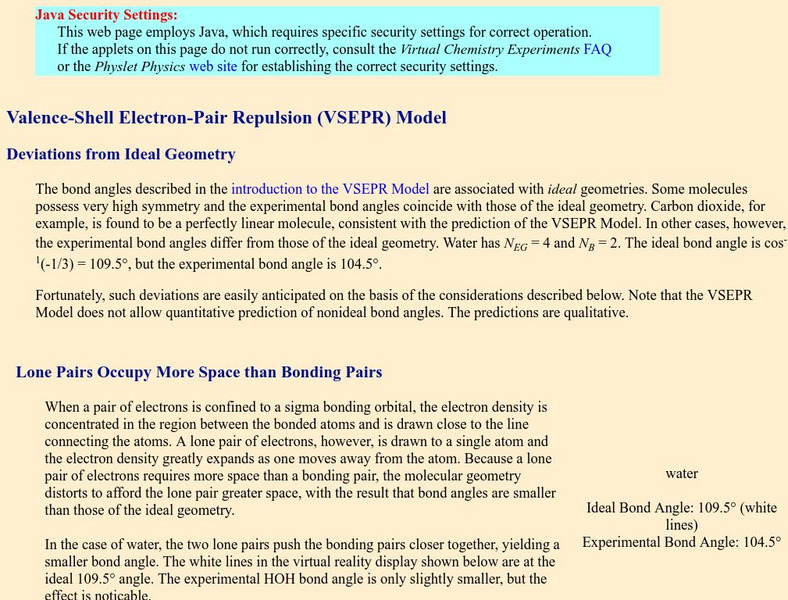
Davidson College: Valence Shell Electron Pair Repulsion (Vsepr) Model
Presents examples of molecules that do not match the expected bond angles in the Valence-Shell Electron-Pair Repulsion Model. Requires Java.

CK-12 Foundation
Ck 12: Plix Series: Gas Mixture and Molecular Speeds
[Free Registration/Login Required] Hike to the top of Mt. Everest and observe what happens to the amount of molecules pushing down on the surface of the Earth. After the activity, answer one challenge question about the topic.

CK-12 Foundation
Ck 12: Plix: Aspartame Molecule: Peptides
[Free Registration/Login Required] Given prior knowledge of bonding and the molecular make up of aspartame, examine the model and determine which color represents which atom. Drag the labels at the bottom to the appropriate colored atom...