Hi, what do you want to do?





Concord Consortium
Concord Consortium: Molecular Workbench: Atomic Orbitals
View the approximate locations of electrons in valence shells 1s through 4f.
Concord Consortium
Concord Consortium: Molecular Workbench: Water and Polar Substances
Adjust amounts of ionic charges in this simulation to see how water molecules react to polar substances in solution.
Concord Consortium
Concord Consortium: Molecular Workbench: Collision Theory of Chemical Reactions
Watch an animation of atoms and molecules colliding that shows how these particles combine during chemical reactions. Change levels of energy to see how reactions are affected.
Concord Consortium
Concord Consortium: Molecular Workbench: How Chemical Reactions Happen
View this collection of simulations to gain a better understanding of how chemical reactions happen.
Concord Consortium
The Concord Consortium: Molecular Workbench: Seeing Chemical Equilibrium
Observe a visual representation of the equilibrium of products and reactants in chemical reactions. Record data while the reactions are taking place and print out a report afterwards.
Concord Consortium
The Concord Consortium: Molecular Workbench: Catalyzed Reactions
Explore the purpose of catalysts in chemical reactions and how they affect the reaction pathways.
Concord Consortium
Concord Consortium: Molecular Workbench: Osmotic Pressure
View this simulation to observe the process of smaller particles moving through a semipermeable membrane. Temperature is adjustable. [Must download the simulation to engage in the activity]

Concord Consortium
Concord Consortium: Molecular Workbench: Experiment on Material Strength
Adjust the strength of interatomic interactions in this virtual bullet experiment. Observe how the adjustments in strength affect the material in the experiment.
Concord Consortium
Concord Consortium: Molecular Workbench: Shock Wave Propagation
Adjust variables in this shock wave propagation simulation. Observe the density and pressure waves.
Concord Consortium
Concord Consortium: Molecular Workbench: Sputtering
Adjust the incident ion variables in this simulation to observe the sputter yield from the target.
Concord Consortium
Concord Consortium: Molecular Workbench: Sorting Molecules With a Nano Conveyor
Observe how molecules can be sorted in a hypothetical nano conveyor-belt mechanism.
Concord Consortium
Concord Consortium: Molecular Workbench: Vapor Pressure Experiments
Use these virtual vapor pressure experiments to learn more about gases' reactions in various scenarios.
Concord Consortium
Concord Consortium: Molecular Workbench: Double Inverted Pendulum Oscillating
Adjust frequency, amplitude, and perturbation in this simulation to graph the trajectory of a mass at the end of each pendulum.

Museum of Science
The Atom's Family: Mighty Molecules
In this activity, students construct models of molecules using marshmallows and gum drops.
Chiral Publishing
Chiral Publishing: An Introduction to Chemistry: Molecular Structures: Olestra
View a 3-D model of olestra, and compare it to a similar structure of a triglyceride. Also see the molecules that make up olestra. All compounds can be manipulated and studied from every angle.
Concord Consortium
Concord Consortium: Molecular Workbench Showcase: Chemistry, States of Matter
See how gas, liquid, and solid molecules react to external pressure in this simulation. Also see a model of intermolecular motion through elliptical particles.
Other
Molecular Biology Notebook: Structure of Rna
Read about the structure of RNA, its components, and how they fit together. This source includes visual aids to help you and a list of the different kinds of RNA and their functions.
University of Sydney (Australia)
Thermal Physics Module: Ideal Gases [Pdf]
A molecular model of a gas is introduced and explained. Assumptions behind the ideal gas law are presented. The ideal gas law is stated. Charles' law and Boyle's law are derived from the ideal gas law.
University of Hamburg
University of Hamburg: Membranes: Diffusion, Permeability, Osmosis, Turgor, Active and Passive Transport and Transport
This cellular biology page presents extensive detail on the chemical nature of the cell membrane. Using the Chime plug-in, students can manipulate and study models of the membrane.
Other
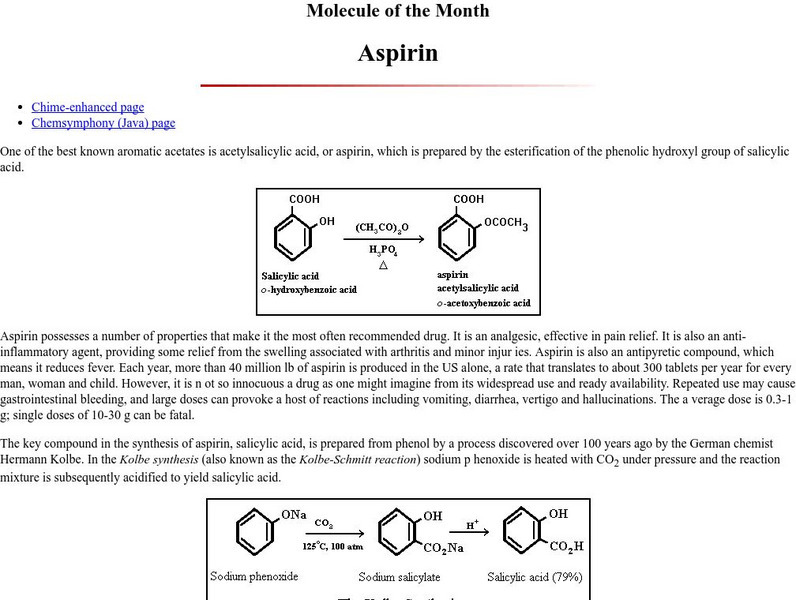
University of Bristol: Molecule of the Month
Great site which gives the chemical structure and reactions involved in aspirin production. If you have the CHIME plug-in then it links to a better site with a 3-D model you can manipulate. OR BETTER YET, if your browser has Java, then...
Concord Consortium
The Concord Consortium: Molecular Workbench: Dna Polymerase
Observe the animated model to see DNA being replicated.
Concord Consortium
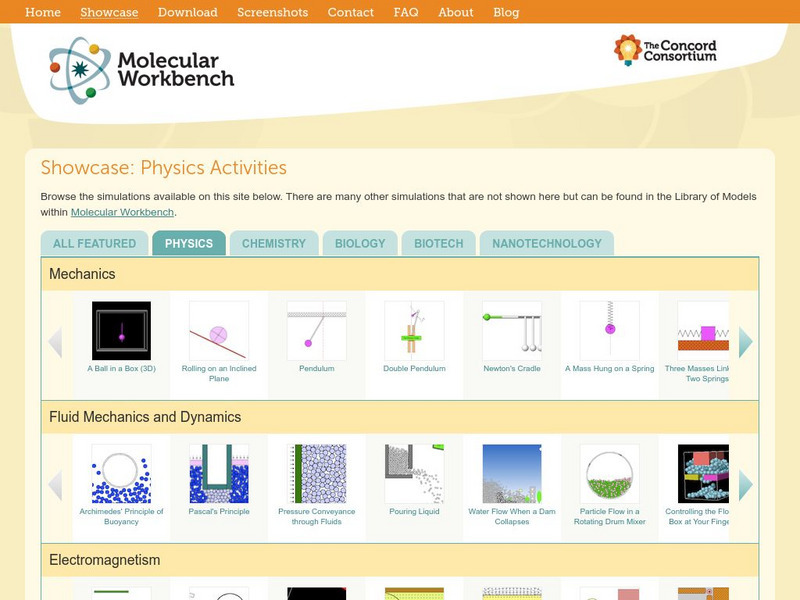
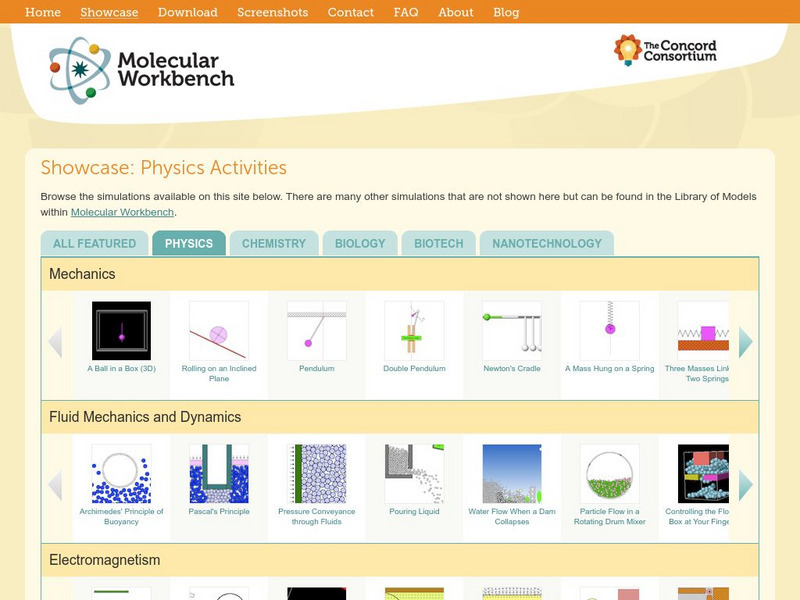
Concord Consortium: Molecular Workbench Showcase: Fluid Mechanics and Dynamics
Learn more about fluid mechanics and dynamics concepts through these animations.
Concord Consortium
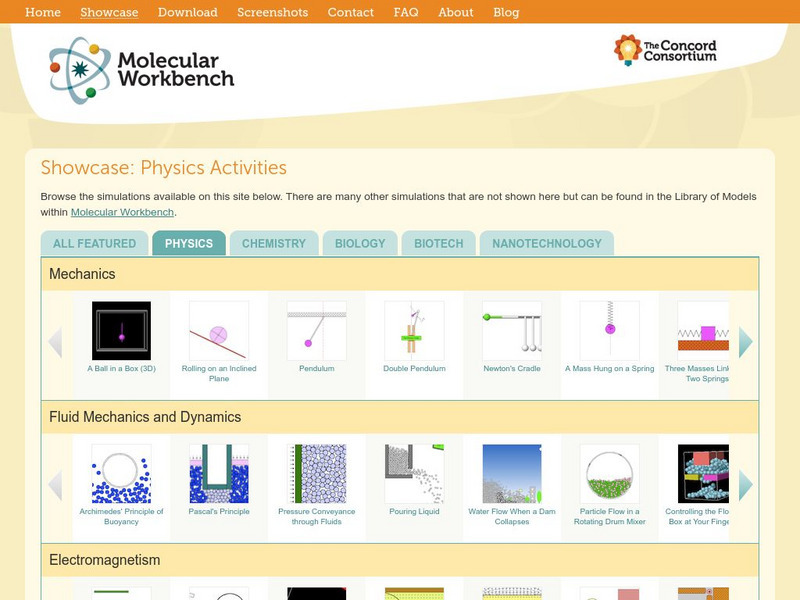
Concord Consortium: Molecular Workbench Showcase: Physics, Electromagnetism
Students can use these simulations to understand concepts in electromagnetism. Simulations are available on the following concepts: Lorentz Force, The Hall Effect, capacitor, conductor, transistor, cyclotron, static electricity....
Concord Consortium
Concord Consortium: Molecular Workbench Showcase: Physics, Quantum Physics
A collection of simulations to show the important topics of quantum physics.