Hi, what do you want to do?





Concord Consortium
The Concord Consortium: Molecular Workbench: Electric Field Distribution
Adjust the distance between plates in a parallel-plate capacitor in this simulation, and observe the effects on the electric field.

Chiral Publishing
Chiral Publishing: An Introduction to Chemistry: Resonance
This section from "An Introduction to Chemistry" describes how to draw resonance structures. A few examples are given. Also find links to 3-D molecular models of the examples.

Alabama Learning Exchange
Alex: Mirror, Mirror, on the Wall
This lesson covers chiral molecules, which are important in carbohydrate and protein chemistry. Understanding the difference in their structures helps with understanding the different biochemical properties of molecules with similar...
Chiral Publishing
Chiral Publishing: An Introduction to Chemistry: Molecular Structures: Esters
Investigate the structure of ethyl butanoate, a common ester, by manipulating a 3-D model. View the molecule from all sides and also visit the links to animations, tutorials, and power points about other chemistry topics.
University of Arizona
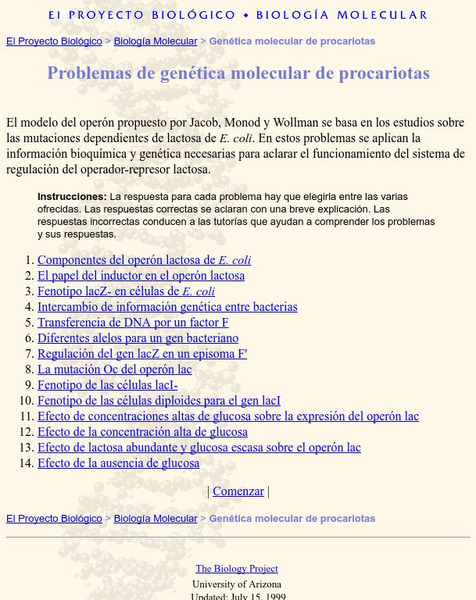
University of Arizona: Problemas De Genetic Molecular De Procariotas
Learn more about the operon model based on studies of lactose-dependent mutations of E. coli with the series of problems presented here. The correct answers have a brief explanation to reinforce the theories and incorrect answers are...
Wisc-Online
Wisc Online: Lewis Dot Structures of Covalent Compounds
Short slide show provides basic information about drawing Lewis dot structures for covalent compounds. Starts with anatomy of the atom, and then shows the relationship between atomic particles and the Periodic Table of Elements. Offers...
Chiral Publishing
Chiral Publishing: An Introduction to Chemistry: Types of Compounds
Discover different types of compounds such as binary covalent, binary ionic, binary acids, and oxyacids. Explore links that give information about writing names and formulas for different compounds.
American Chemical Society
Middle School Chemistry: Represent Bonding With Lewis Dot Diagrams
Find out how molecular bonding is represented by Lewis dot diagrams.
Concord Consortium
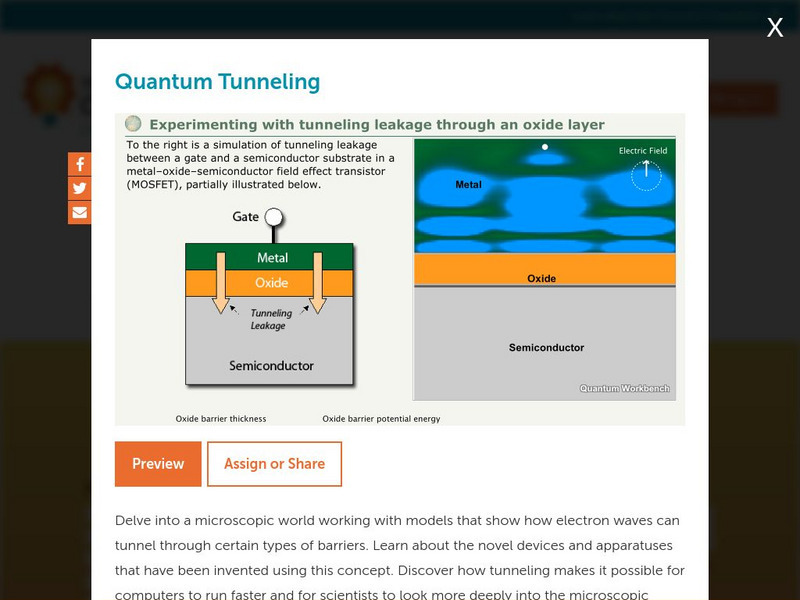
Concord Consortium: Quantum Tunneling
Delve into a microscopic world working with models that show how electron waves can tunnel through certain types of barriers. Learn about the novel devices and apparatuses that have been invented using this concept. Discover how...
Other
Beautiful Chemistry: Beautiful Structures: Quasicrystals
An interactive display of quasicrystals allows students to study the inner components and molecular make-up of these structures. Since the discovery of quasicrystals, a lot of efforts have been put on finding the locations of atoms...
Bryn Mawr College
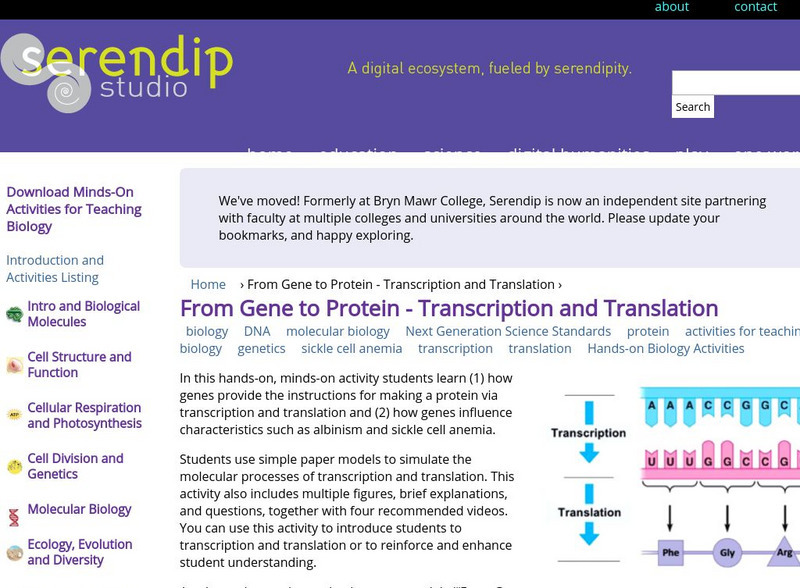
Serendip: From Gene to Protein Transcription and Translation
Brief text summary of what students learn in the Dragon Genetics II lab along with links to download Student Handouts in PDF and Word formats, and Teacher Preparation Notes in PDF format. Students use paper models to learn transcription...
Concord Consortium
Concord Consortium: Molecular Workbench Showcase: Chemistry, Thermodynamics
Explore some virtual experiments on gases and vapor pressure, the Maxwell speed distribution, the barometric formula, and heat and temperature.
Concord Consortium
Concord Consortium: Molecular Workbench Showcase: Chemistry, Vapor Pressure
A series of virtual experiments that show students the power and importance of evaporation.
Other
Antibody Resource Page
A very interesting molecular model of an antibody. Not much information is given, but the ribbon structure itself is worth a look.
BBC
Bbc: Gcse Bitesize: Covalent Bonds
A covalent bond is formed between non metal atoms, which combine together by sharing electrons. Covalent compounds have no free electrons and no ions so they don't conduct electricity.
Concord Consortium
The Concord Consortium: Molecular Workbench: When a Ladder Falls
View an animation of a ladder falling due to the force of gravity.
Concord Consortium
Concord Consortium: Molecular Workbench: Collision Between Molecular Particles
View the interactions between an atom of xenon and a buckyball when they collide.
Concord Consortium
The Concord Consortium: Molecular Workbench: Nodding Donkey (Pump Jack)
View a simulation of the mechanics that make an oil pump do its job.
Concord Consortium
The Concord Consortium: Molecular Workbench Micelle Formation
Watch how micelle formation changes in a solution with water compared to a solution consisting of oil.
Concord Consortium
The Concord Consortium: Molecular Workbench Lipids Forming a Monolayer
Interact with lipids and see how they form a monolayer in water and oil.
American Chemical Society
Middle School Chemistry: Heat, Temperature, and Conduction
Students observe, describe, and draw a model on the molecular level, showing how energy is transferred from one substance to another through conduction.
American Chemical Society
Middle School Chemistry: Lesson Plans: Why Does Water Dissolve Salt?
Learners use their own model of a salt crystal and water molecule to show how water dissolves salt. Then, they relate their observations to the structure of salt, water, and alcohol on the molecular level.
Texas Education Agency
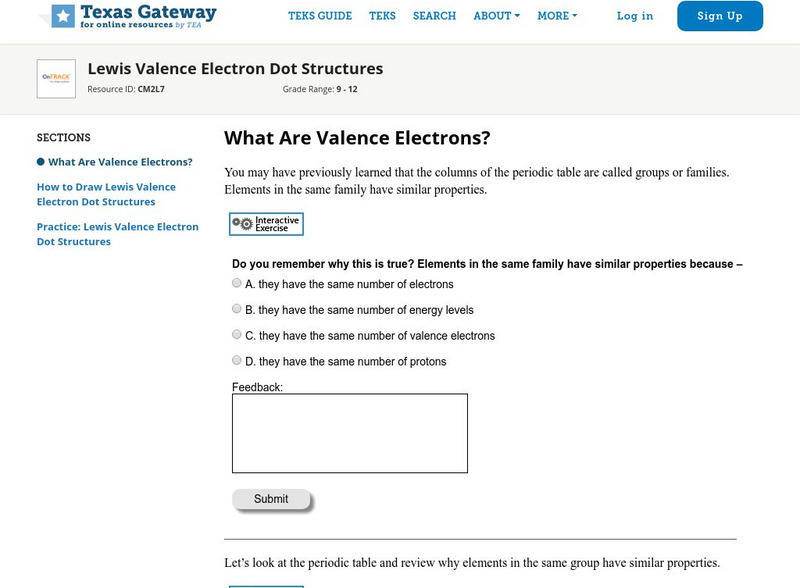
Texas Gateway: Lewis Valence Electron Dot Structures
This tutorial investigates how to draw Lewis valence electron dot structures.

CK-12 Foundation
Ck 12: Lewis Electron Dot Structures
[Free Registration/Login may be required to access all resource tools.] The following online tutorial describes how a covalent bond forms, including the energy change involved in the process.Students will be asked to use the octet rule...