Hi, what do you want to do?






American Chemical Society
Middle School Chemistry: The Ups and Downs of Thermometers
See how thermometers measure temperature by the molecular movement of the liquid inside.
Concord Consortium
The Concord Consortium: Molecular Workbench: Weight Balance on a Pulley
Watch how the placement of two weights attached to a chain on different sides of a pulley affect the movement of the system. You can adjust the heaviness of the weights.
Concord Consortium
The Concord Consortium: Molecular Workbench: Mass Connected to 2 Springs
Observe how friction affects a mass connected to two springs that are on opposite sides of the mass. Create a graph while the friction is on or off.
American Chemical Society
Middle School Chemistry: Lesson Plans: Does Temperature Affect Dissolving?
Students identify and control variables to design an experiment to see whether the temperature of a solvent affects the speed at which a solute dissolves.
Vision Learning
Vision Learning: States of Matter
Did you know the ancient Greeks first identified the three states of matter? Read about how the molecules differ in solids, liquids, gases, and plasma. View photographs and watch how the molecules move in each state. If you're really...
CK-12 Foundation
Ck 12: Temperature
[Free Registration/Login may be required to access all resource tools.] In this interactive tutorial students will learn the physics definition of temperature, how temperature is measured and how to convert the units of temperature...
Discovery Education
Discovery Education: 3 M Young Scientist Lab: Water Jug Race
First one to empty the jug wins! And it's not as easy as it sounds...
The Franklin Institute
Franklin Institute: The Science of Sound
This Franklin Institute webpage provides an introduction to understanding sound waves based on 5th grade science lessons.
American Chemical Society
Middle School Chemistry: Temperature and Rate of a Chemical Reaction
Watch molecules collide with enough energy that bonds break and form new bonds in a chemical reaction.
Concord Consortium
Concord Consortium: Micelles
Select an oil or water environment for molecules and observe how they are affected by interactions with their environment and each other.
Concord Consortium
Concord Consortium: Polar and Nonpolar Interface
Observe how molecules with hydrophilic and hydrophobic regions move in a mixture of oil and water, and pay attention to changes in potential energy over time. Move and rotate the molecules to see how they interact with their surrounding...
Concord Consortium
Concord Consortium: Mixing Liquids
Experiment with mixing liquids and observing the volume they take up.
Concord Consortium
Concord Consortium: Oil and Water
Mix polar and nonpolar molecules together and observe changes in potential energy.
Concord Consortium
Concord Consortium: Diffusion of a Drop
Explore the effect of temperature on diffusion.

Khan Academy
Khan Academy: What Is the Maxwell Boltzmann Distribution?
In a gas, there are lots of molecules traveling at lots of different speeds. Here's a framework for thinking about that.
Cosmo Learning
Cosmo Learning: General Chemistry
A collection of video lectures from a general chemistry course taught at the University of California, Berkeley. The course teaches periodic table, chemical bonds, molecular shape, phase changes, chemical reactions, stoichiometry,...

Concord Consortium
Concord Consortium: Heat and Temperature
Learn that temperature measures average kinetic energy, and heat is the transfer of energy from hot systems to cold systems. Consider what makes a good conductor. (Requires Java)
OpenSciEd
Open Sci Ed: Net Logo: Gas Particle Collisions Up Close
This simulation explores the relationship between particle kinetic energies during particle collisions.
Concord Consortium
The Concord Consortium: Molecular Workbench: Nodding Donkey (Pump Jack)
View a simulation of the mechanics that make an oil pump do its job.

Purdue University
General Chemistry Topic Review/heat
Heat is defined and explained; the concept of heat is related to the kinetic motion of particles and to temperature. Heat capacity and specific heat are explained. Sensible heat is compared to latent heat; reference is made to the heat...
TeachEngineering
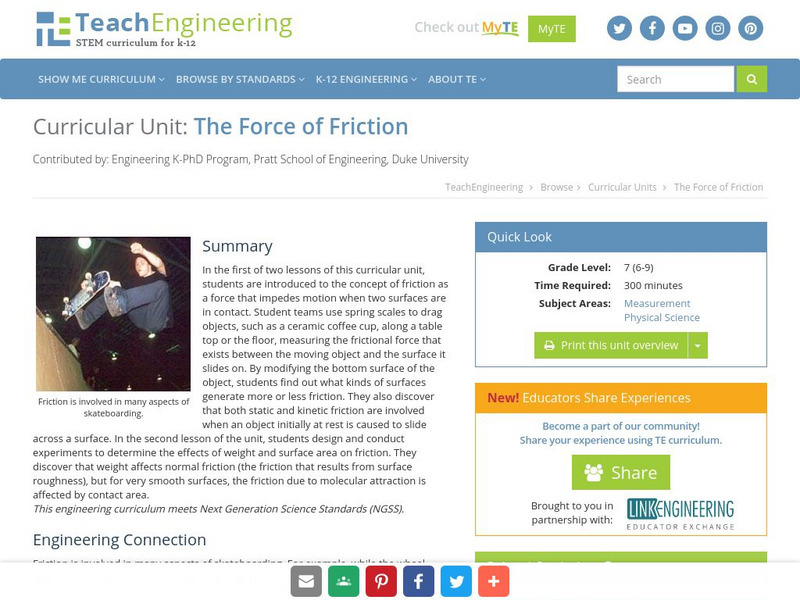
Teach Engineering: The Force of Friction
In the first of two lessons of this curricular unit, students are introduced to the concept of friction as a force that impedes motion when two surfaces are in contact. Student teams use spring scales to drag objects, such as a ceramic...
New York University
New York University: States of Water
Use this resource to learn about the three different phases of water; solid, liquid, and gas. What happens to water as it changes into a solid or gas? Includes short and easy to do activity.
Other
Classic Chemistry: Jean Perrin
An excerpt of Perrin's paper "Brownian Motion and Molecular Reality". Includes references.
Crescent Public Schools
The Internet Science Room: The Kinetic Theory & Phase Change
This tutorial helps students understand the Kinetic Theory, which explains the effects of temperature and pressure on matter as it goes through phase changes.