Hi, what do you want to do?






Other
Tele Universite, Universite Du Quebec a Montreal: Vr Molecules Pro
Visually inspect virtual molecules and their reactions to changes in energy levels and vibrations. Choose from 24 different molecules and adjust viewing angle, pace of simulation, and more. Create a presentation of your explorations as...
Simon Fraser University
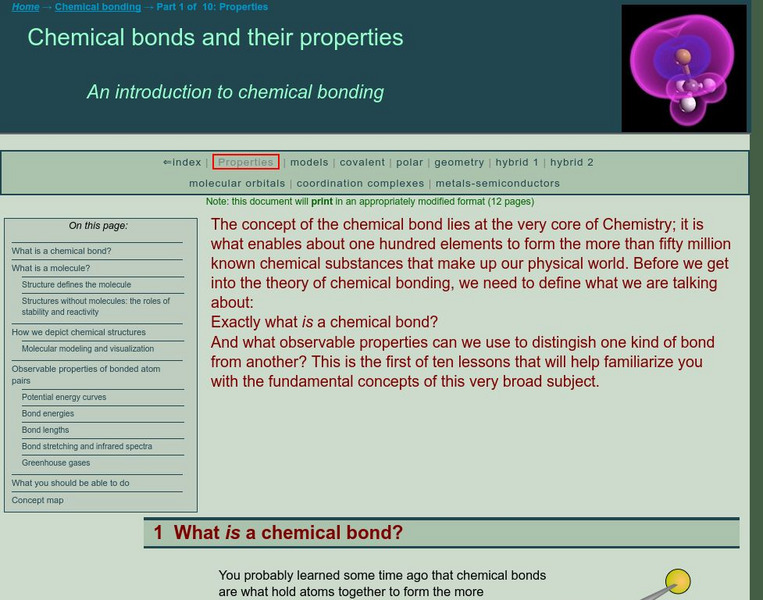
Chem1 Virtual Textbook: Molecules and the Properties of Bonded Atoms
College-level site goes into great detail about chemical bonding properties, as far as energies, structure, angles, and length. Infrared absorption, the greenhouse effect, and global warming are addressed to exemplify bond length...
Simon Fraser University
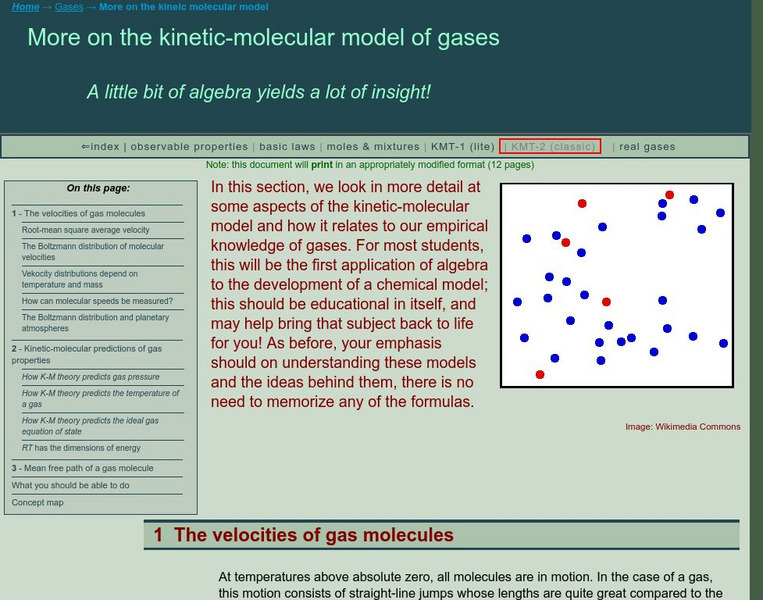
Chem1 Virtual Textbook: Velocities of Gas Molecules and Boltzmann Distribution
The General Chemistry Virtual Textbook, or Chem 1, is broken into several sections covering various aspects of topics related to chemistry. This section deals with both Boltzmann Distribution and the velocity of gas molecules.
American Chemical Society
Middle School Chemistry: Moving Molecules in a Solid
Explore the movement of the molecules in a solid.
Other
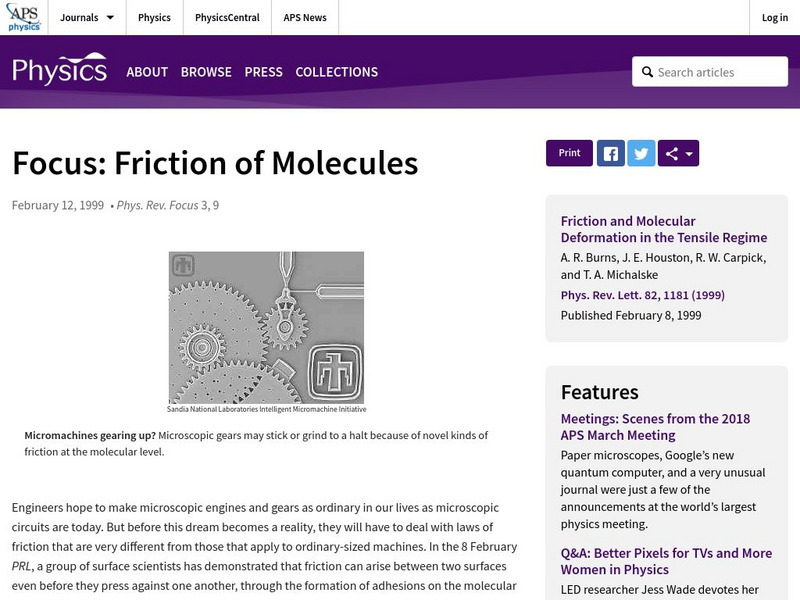
Focus Physical Review: Friction of Molecules
This is an article published by the American Physical Society on friction in microscopic gears that results from the adhesion of molecules. A great exploration of this new obstacle in science.
Simon Fraser University
Chem1 Virtual Textbook: How Molecules Take Up Thermal Energy
With an overview of topics related to chemical energetics, this site provides a foundation to a study of thermodynamics with information on thermal energy. Topics covered include heat capacity, temperature, translational motions of...
Chiral Publishing
Chiral Publishing: An Introduction to Chemistry: London Forces and Polar Molecules
Learn about London forces, which increase the attraction between polar molecules and the attraction between nonpolar molecules. Pictures and chemical structures allow for further understanding. Also find links for animations and...
National Health Museum
Access Excellence: Structure of the Dna Molecule
Read a history of the discovery and study of DNA and its structure. Links to a graphic, other references, and classroom activities.
Texas Education Agency
Texas Gateway: Atomic and Molecular Explanation of Pressure and Temperature
Learn how to calculate the kinetic energy of a gas molecule, describe the relationship between the temperature of a gas and the kinetic energy of atoms and molecule, and describe the distribution of speeds of molecules in a gas. The...
Texas Education Agency
Texas Gateway: The Ideal Gas Law
Explore the thermal behavior of gases, in particular, examine the characteristics of atoms and molecules that compose gases. Learn about the ideal law of gases in terms of molecules and moles. Multiple formulas and examples are provided.
University of Illinois
University of Illinois: The Photosynthetic Process
Site describes process of photosynthesis, including role of pigment molecules, electron transport, ATP synthesis, and carbohydrate synthesis. Includes links to illustrative graphics.
OpenStax
Open Stax: Anatomy & Physiology: Autonomic Reflexes and Homeostasis
Looks at how to determine the effect of the autonomic nervous system on the regulation of the various organ systems on the basis of the signaling molecules involved.

Alabama Learning Exchange
Alex: Mirror, Mirror, on the Wall
This lesson plan covers chiral molecules, which are important in carbohydrate and protein chemistry. Understanding the difference in their structures helps with understanding the different biochemical properties of molecules with similar...
Simon Fraser University
Chem1 Virtual Textbook: Chemical Energy
With an overview of topics related to chemical energetics, this site provides a foundation to a study of thermodynamics and molecules as energy carriers and converters. Topics covered include how molecules take up thermal energy,...
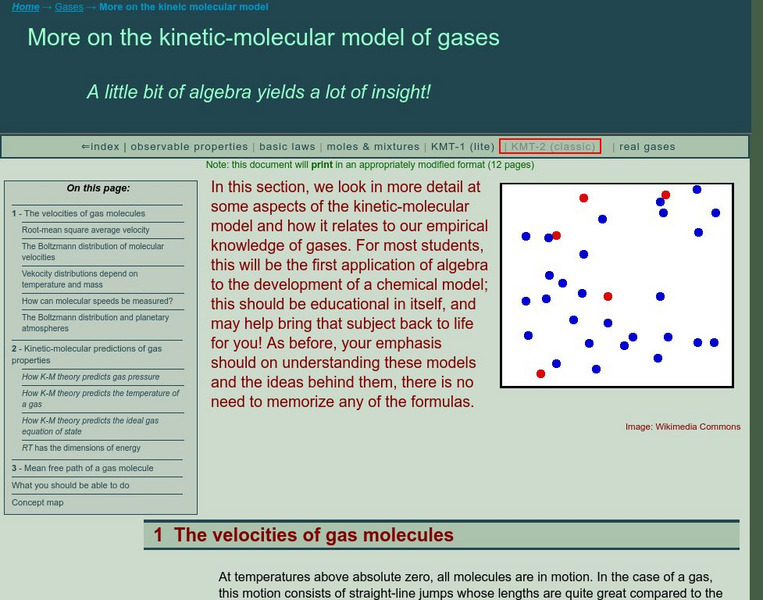
Simon Fraser University
Chem1 Virtual Textbook: Molecular Collision
The General Chemistry Virtual Textbook, or Chem 1, is broken into several sections covering various aspects of topics related to chemistry. This section seeks to answer the question, how far does a molecule travel between collisions?
Texas Education Agency
Texas Gateway: Kinetic Theory: Atomic & Molecular Explanation of Pressure & Temp
By the end of this section, you will be able to express the ideal gas law in terms of molecular mass and velocity; define thermal energy; calculate the kinetic energy of a gas molecule, given its temperature; describe the relationship...

Texas Education Agency
Texas Gateway: The Ideal Gas Law
By the end of this section, you will be able to state the ideal gas law in terms of molecules and in terms of moles; use the ideal gas law to calculate pressure change, temperature change, volume change, or the number of molecules or...
Khan Academy
Khan Academy: Active Transport
Learn about gradients of molecules that exist across cell membranes, how they can help or hinder transport, and how active transport mechanisms allow molecules to move against their gradients.

PBS
Nova: On Fire
This resource provides an overview of the basics of combustion. Explore how a fire ignites, how molecules rearrange themselves and what a flame is made of.

Khan Academy
Khan Academy: Photoelectron Spectroscopy
An explanation of how photoelectron spectroscopy can be used to detect electron structures in atoms or molecules.
Khan Academy
Khan Academy: Biology: Chemistry of Life: Chemical Bonds
Review over covalent, hydrogen, and ionic bonding in this article. Learn how molecules are held together by chemical bonds.

Khan Academy
Khan Academy: The Calvin Cycle
Learn about the three stages of the Calvin Cycle reactions: carbon fixation, reduction, and regeneration of the starting molecule. See how the products of the light reactions, ATP and NADPH, are used to fix carbon into sugars in this cycle.
Simon Fraser University
Chem1 Virtual Textbook: Understanding Entropy
As part of the General Chemistry Virtual Textbook, this site examines a variety of topics related to entropy. Other topics covered include how thermal energy is stored in molecules, quantum states, microstates and energy spreading, and...
Texas Education Agency
Texas Gateway: Atomic and Molecular Explanation of Pressure and Temperature
We gain a better understanding of pressure and temperature from the kinetic theory of gases, which assumes that atoms and molecules are in continuous random motion. Learn more about Kinetic Theory with the following detailed resource...
Other popular searches
- Atoms and Molecules
- Gumdrop Atoms and Molecules
- Atoms & Molecules
- Compounds and Molecules
- Water Molecules
- Organic Molecules
- Atoms Molecules
- Building Molecules
- Molecules of Life
- Gas Molecules
- Matter and Molecules
- Biological Molecules