Hi, what do you want to do?





Khan Academy
Khan Academy: Molecules and Compounds
Article defines and explains compounds which are either ionic or covalent and molecules which are the simplest unit of a covalent compound. Molecules can be represented in many different ways.

State University of New York
State University of New York: Compounds, Molecules, and the Mole
This simulation explores the relationship between mass, moles, molecules and atoms. Select one of the 6 compounds, set the mass of the compound, and release the scrollbar to calculate.
Upper Canada District School Board
Tom Stretton's Advanced Placement Chemistry: Atoms, Molecules and Ions
This online textbook chapter provides learners with advanced-level material on the structure and relationships between atoms, molecules and ions.
CK-12 Foundation
Ck 12: Chemistry: Naming Binary Molecular Compounds
[Free Registration/Login may be required to access all resource tools.] Covers molecular compound, binary molecular compound, molecules, and naming of binary molecular compounds.
TeachEngineering
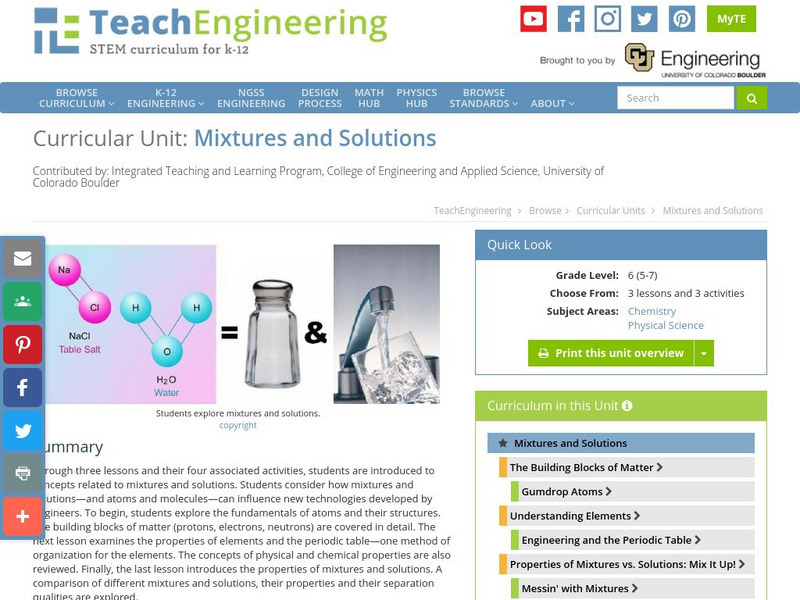
Teach Engineering: Mixtures and Solutions
This unit covers introductory concepts of mixtures and solutions. Students think about how mixtures and solutions, and atoms and molecules can influence new technologies developed by engineers. The first lesson explores the fundamentals...
Wisc-Online
Wisc Online: Lewis Dot Structures of Covalent Compounds
Short slide show provides basic information about drawing Lewis dot structures for covalent compounds. Starts with anatomy of the atom, and then shows the relationship between atomic particles and the Periodic Table of Elements. Offers...
Frostburg State University
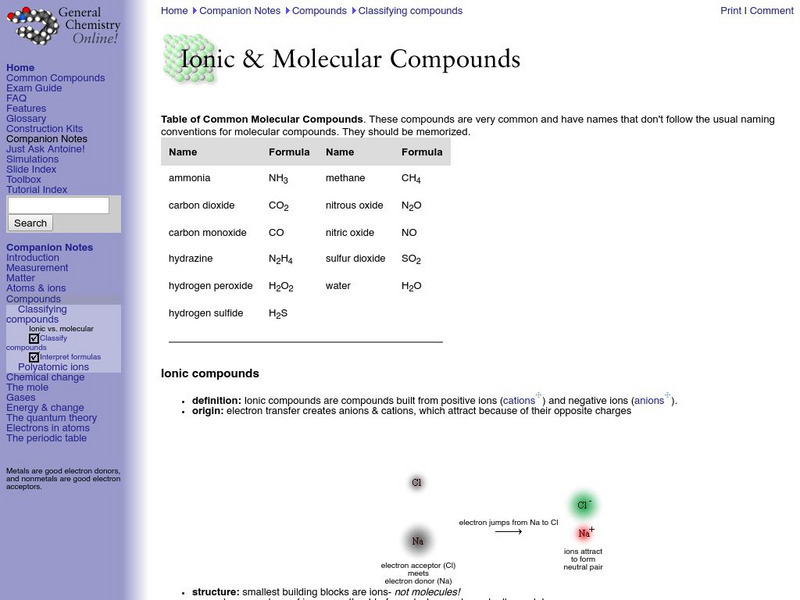
General Chemistry Online: Ionic and Molecular Compounds
Provides a good outline of the concepts involved in ionic and covalent bonding, with links to definition of terms. Features a list of common molecular compounds and a chart that compares ionic and molecular compounds.
CK-12 Foundation
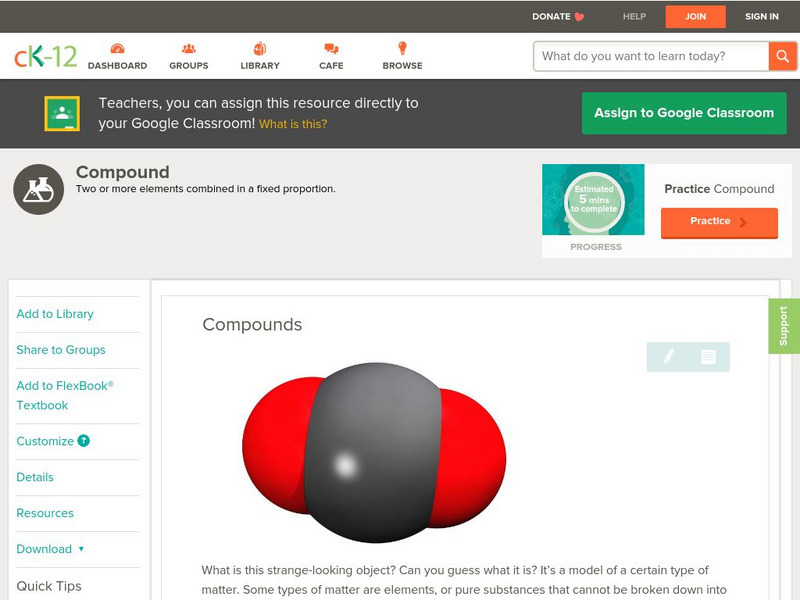
Ck 12: Physical Science: Compounds
[Free Registration/Login may be required to access all resource tools.] Explores compounds and their properties, the elements that form them, and their structure.
CK-12 Foundation
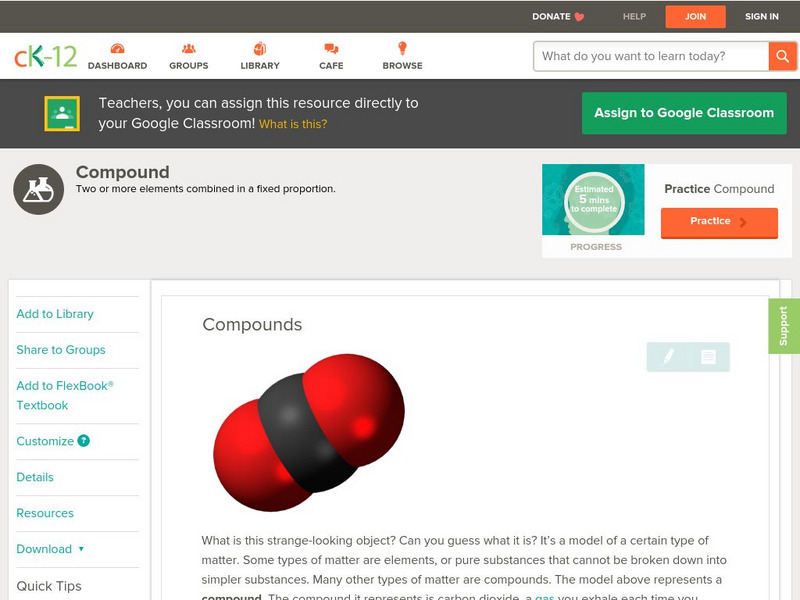
Ck 12: Physical Science: Compounds
[Free Registration/Login may be required to access all resource tools.] Investigates compounds and their properties, the elements that form them, and their structure.
Texas Instruments
Texas Instruments: Geometries and Polarities of Compounds
In this StudyCard activity, students are asked to describe the geometry and polarity of several molecules and ions. Geometries covered include linear, bent, trigonal planar, trigonal pyramidal, and tetrahedral. Students will need to have...
Ducksters
Ducksters: Kids Science: Molecules
Kid's learn about the science of the molecules. Tiny chemistry and compounds of atoms and elements make up all matter.

CK-12 Foundation
Ck 12: Life Science: Organic Compounds
[Free Registration/Login may be required to access all resource tools.] The main chemical components of living organisms are known as organic compounds and are built around the element carbon. Living things are made up of very large...
Science Education Resource Center at Carleton College
Serc: Using Properties to Identify Ionic and Molecular Compounds
A guided inquiry in which students test different physical properties, such as melting point or conductivity, to help them determine whether the compounds are ionic or molecular.

Chiral Publishing
Chiral Publishing: An Introduction to Chemistry: Molecular Compounds: Audio Book
Learn all about molecular structures in this easy-to-understand, audio book. See how valence electrons determine how atoms bond together, and look at the bonding inside some of the most common molecules around you.
CK-12 Foundation
Ck 12: Polarity and Intermolecular Forces
[Free Registration/Login may be required to access all resource tools.] The following online tutorial describes how the electronegativity difference between two atoms in a covalent bond results in the formation of a nonpolar covalent,...
Other
Science geek.net: Ions and Compound Formulas
A twenty-question multiple-choice exercise about chemical formulas. Quiz gives immediate feedback with the correct answer.
Sophia Learning
Sophia: Structure and Function of Macromolecules: Carbohydrates
An introduction to the structure and function of the energy-rich molecules, carbohydrates.

ClassFlow
Class Flow: Compounds and Molecules
[Free Registration/Login Required] This flipchart introduces fifth graders to compounds and molecules. It is part of a large unit on matter. Key concepts include compounds, molecules, and chemical formulas. Opportunities for student...
Soft Schools
Soft Schools: Cellular Functions of Organic Compounds Quiz
Take an interactive quiz over organic compounds. After completing the quiz, check your score, and then revisit any incorrect question for further review.

University of Alberta
The University of Alberta: Infrared Spectroscopy
Complete this interactive tutorial and learn about interpreting the infrared spectrum ("I" "R") that provides information about the functional groups in a molecule. Included are 12 labs and a quiz.
Chiral Publishing
Chiral Publishing: An Introduction to Chemistry: Binary Covalent Nomenclature Help
Learn everything you ever wanted to know about naming binary covalent compounds! See how scientists came up with systematic names for many common molecules and study the prefixes and roots for them.

ClassFlow
Class Flow: Comparing and Contrasting Matter
[Free Registration/Login Required] This flipchart is a guided activity to help students compare different types of matter: atoms and molecules, elements and compounds, mixtures and solutions. It corresponds to Virginia science SOL 5.4.
BBC
Bbc: Gcse Bitesize: Covalent Bonds
A covalent bond is formed between non metal atoms, which combine together by sharing electrons. Covalent compounds have no free electrons and no ions so they don't conduct electricity.
CK-12 Foundation
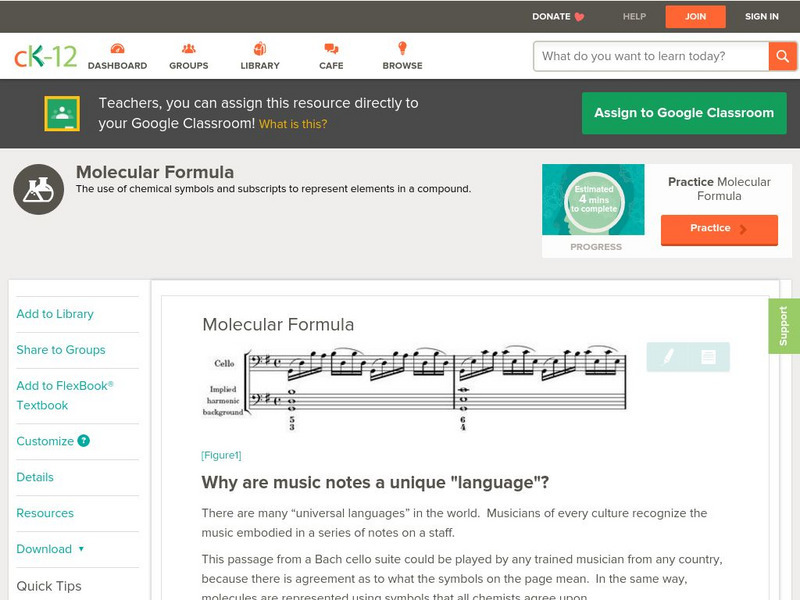
Ck 12: Chemistry: Molecular Formula
[Free Registration/Login may be required to access all resource tools.] Defines molecular formula and describes how to write molecular formulas.