Hi, what do you want to do?






Perkins School for the Blind
Mixtures and Solutions
Mixtures and solutions are different; one can be separated fairly easily and the other cannot. This hands-on experiment was written specifically for learners with visual impairments or blindness. They will use lemonade and trail mix to...

National Science Teachers Association
Ionic Molecular
Twelve compounds are named and each of their chemical formulas are printed on individual cards. Chemistry pupils place each beneath an Ionic or Molecular card, depending on which type of compound is represented.

Teach Engineering
Active and Passive Transport: Red Rover Send Particles Over
I can move about freely, but you cannot. The class models the movement through cell membranes by way of passive and active transport. Members of the class play the roles of various proteins, atoms, compounds, and cell actions and mimic...

Teach Engineering
Engineering and the Periodic Table
Elements, to the rescue! Scholars first review the periodic table, and then learn about the first 20 elements and their properties and uses in the fourth of six lessons in the Mixtures and Solutions unit. Applying their newfound...

University of California
You Are What You Eat: Testing for Organic Compounds in Foods
We have all heard that we are what you eat, but what are we eating? An informative lesson opens with a discussion of the foods pupils have recently eaten. Then, young scientists perform four experiments on seven...

Serendip
How Do Biological Organisms Use Energy?
When an organism eats, how does food become energy? Young biologists follow glucose through the process of cellular respiration to the creation of ADP using a discussion-based activity. The resource also highlights conservation of mass...

Serendip
Using Models to Understand Cellular Respiration
Energize biologists with colorful images in an activity that captivates the imagination while demystifying the subject of cellular respiration. Participants build comprehension skills and access core content knowledge by analyzing text...

Texas State Energy Conservation Office
Investigation: Chemical Models
Science teams make models of four different hydrocarbon compounds that we commonly use for fuel. Then they demonstrate chemical reactions that result when energy is produced. This can be used as an enrichment when your class is studying...

Howard Hughes Medical Institute
Lactose Intolerance: Fact or Fiction
Around the world, about 2/3 of adult humans are lactose intolerant. Scholars work in small groups to discuss a few statements about lactose intolerance. Then, they watch a video on the topic and readdress each statement. Whole-class...

American Chemical Society
Diapers: The Inside Story
There shouldn't be any accidents with this activity! An inquiry-based lesson has learners explore the absorption properties of the gel compound in diapers. After testing its properties, they learn the science of the molecules that make...

Curated OER
The Bio-fuel Project: Creating Bio-diesel
Students investigate bio-fuel. In this investigative lesson, students create bio-fuel from vegetable oil waste. Students will analyze, predict, collect and synthesize data from their experiments with bio-fuel.

Curated OER
Fun Polymer Activity
Students add borax to a latex polymer and play with it to see the characteristics it now contains. In this polymer lesson plan, students see if it stretches, if it's durable, if the molecules break easily, and more.
Texas Instruments
Texas Instruments: Geometries and Polarities of Compounds
In this StudyCard activity, students are asked to describe the geometry and polarity of several molecules and ions. Geometries covered include linear, bent, trigonal planar, trigonal pyramidal, and tetrahedral. Students will need to have...

Museum of Science
The Atom's Family: Mighty Molecules
In this activity, students construct models of molecules using marshmallows and gum drops.
Texas Instruments
Texas Instruments: Matter
This Study Card stack enables students to review the concepts of matter, the kinds and classes of mater including atoms, molecules, elements, compounds, pure substance, and mixtures.
NASA
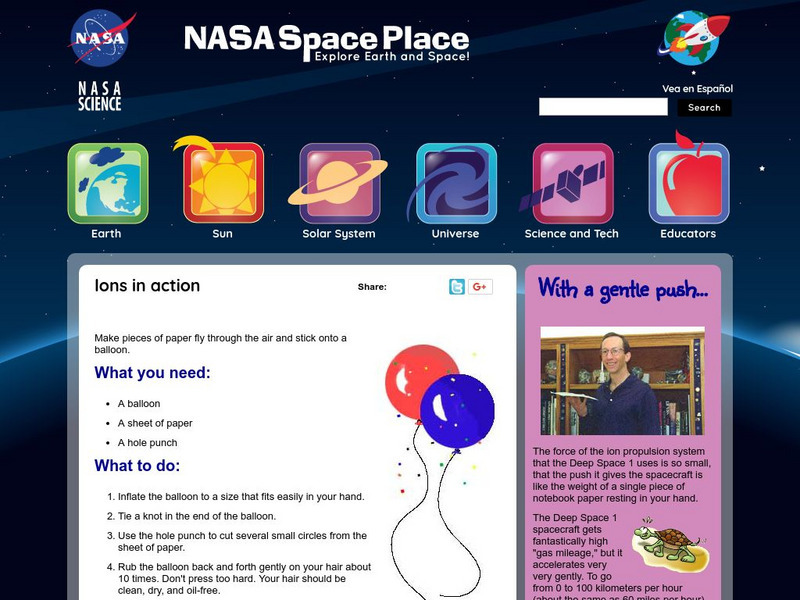
Nasa: The Space Place: Ions in Action
The page from NASA's The Space Place describes a simple activity, charging a balloon and making it move small pieces of paper. It then goes on to give an excellent explanation of how the activity works, and how it involves ions. This...
Science Buddies
Science Buddies: Paper Chromatography: Advanced Version 1
This project will teach you the basics of analytical chemistry, which is a must for students who want to go into chemistry or materials science. The molecules in objects we see all around us are constantly attracting each other....