Hi, what do you want to do?






Curated OER
You say Avocado, I say Avogadro
Students convert mole to mass to particles and vice versa. In this chemistry lesson, students discuss the importance of Avogadro's number. They apply what they have learned in a team competition.

Curated OER
WS 5.2 Kinetic Theory-Temperature and Volume
In this kinetic theory worksheet, students are given fifteen questions about gases and their kinetic energy, how temperature effects kinetic energy, and the results of changing conditions of gases on the kinetic energy. They convert from...

Curated OER
Practice Final
A full-fledged practice final prepares pupils for their general chemistry final exam. If they complete these 57 multiple-choice questions correctly, they will be well-prepared. Note: even though the questions are multiple-choice, there...

Curated OER
Ammonium Nitrate - Efficient Fertilizers
Students study the chemistry of ammonium nitrate and consider the advantages and disadvantages of this compound. They compare different fertilizers and calculate the molar mass and percent nitrogen in the different fertilizers.

Curated OER
From Molecules to Mole Day Do's
Students recognize methods used to define the mole. After converting various quantities to the mole, students provide a context for understanding the usefulness of scientific notation and the mole.

Curated OER
Avogadro's Law
Students study Avogadro's law and what it means in science. In this gaseous lesson students complete an Avogadro's law experiment.

Curated OER
Ideal Gas Problems
For this ideal gas worksheet, students review Boyle's law, Charles's law, and Avogadro's principle. Students use this information to complete 3 problems.

Curated OER
Stoichiometry
Balancing equations is a foundational skill for starting chemists. There are a few slides in this PowerPoint with colorful diagrams that help to explain how. Unfortunately, the presentation begins with an unrelated table of contents and...

Curated OER
Gas Stoichiometry
In this gas stoichiometry worksheet, students use the ideal gas law and balanced chemical equations to solve for unknown values such as volume and mass of gases.

Curated OER
Ideal Gas Law
In this gas law instructional activity, students review the Idea Gas Law equation and practice applying the equation to chemical reactions. Students write the balanced reaction, determine the limiting reagent, moles produced, and volume...

Virginia Department of Education
Molar Volume of a Gas
What is a chemist's favorite plant? Stoichiome Tree! Scholars produce hydrogen gas by reacting magnesium with hydrochloric acid. Then they calculate the molar volume of the gas produced before answering assessment questions.

Curated OER
Stoichiometry
Students research chemical formulas and balance chemical equations. For this chemical equations lesson students complete a class activity on chemical equations and answer questions.

Curated OER
Stoichiometry
In this stoichiometry worksheet, students identify types of reactions, show the products, and balance the equations. Students determine the limiting reagent, theoretical yield, and percent yield for given reactions. This worksheet has 5...

Curated OER
Chemistry Word Search
In this chemistry worksheet, students locate and identify various vocabulary terms related to chemistry. There are nine words/phrases located in the puzzle to find.

Khan Academy
Khan Academy: The Mole and Avogadro's Number
An explanation the mole (named for molecule) and Avogadro's Number. One mole of a substance is equal to 6.022 times 10 to 23rd power units of that substance (such as atoms, molecules, or ions). The number 6.022 time 10 to 23rd power is...
CK-12 Foundation
Ck 12: The Mole Concept
[Free Registration/Login may be required to access all resource tools.] In the following online tutorial students will identify three methods for measuring the amount of matter in a sample. They will define the mole and its relationship...
Simon Fraser University
Chem1 Virtual Textbook: Moles and Their Uses
As part of the "Basic Atomics" section of the Virtual Textbook, this site examines moles. The information presented defines moles in relation to Avogadro's number and then goes on to describe molar mass and molar volume.

TED Talks
Ted: Ted Ed: How Big Is a Mole? (Not the Animal, the Other One.)
Video describes how moles are used in chemistry and how their size is measured. [4:33] Followed by a short quiz and a list of additional resources to explore.

Vision Learning
Visionlearning: Atomic Theory and Structure: The Mole: Its History and Use
An introduction to the mole, a unit of measurement that quantifies atoms and molecules.
CK-12 Foundation
Ck 12: The Mole Concept
[Free Registration/Login may be required to access all resource tools.] In this learning module, students investigate the mole concept, and learn three ways scientists to quantify things as tiny as atoms.

CK-12 Foundation
Ck 12: Chemistry Simulation: Mole Carnival
[Free Registration/Login Required] In the mole carnival, students count the number of atoms and particles in different objects found at the carnival. As students work to find the number of particles, they practice counting particles by...
Other
National Mole Day Foundation: Mole Day
This is the official site for Mole Day. It contains many links, a definition, and the official mole pledge.
Other
Chris Johnson: Amedeo Avogadro
This site deals with Amedeo Avogadro, his life, his contributions to chemistry, and his famous number.
Sophia Learning
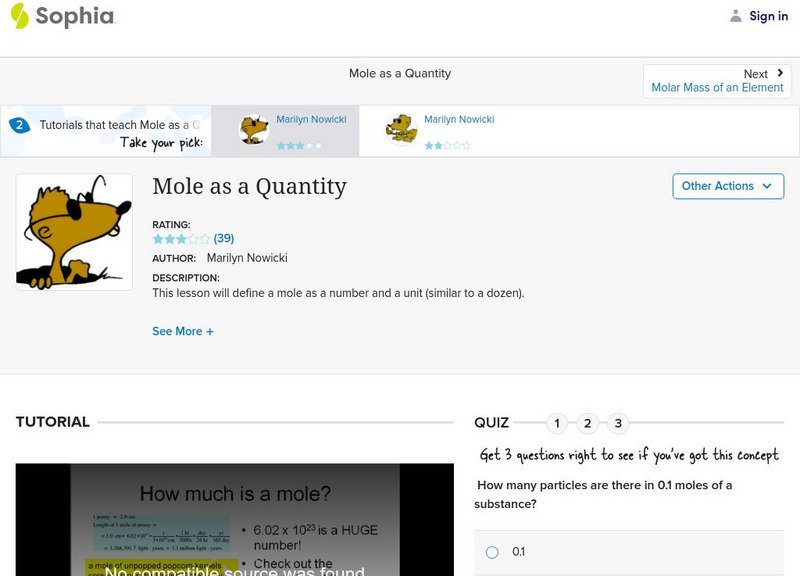
Sophia: Mole as a Quantity
Learn how to define a mole as a number, and estimate the size of a mole of some common objects. [3:18]