Hi, what do you want to do?






Curated OER
Excess Reactant
Junior chemists discover how to calculate excess reactants, handle limiting reactants, and determine percent yield. After background information is provided, step-by-step examples are solved. You can use this detailed slide show to teach...

Curated OER
Limiting Reactant Problems
In this chemical reaction worksheet, students determine the limiting reactant in the equations given plus determine the amount of moles of product produced. This worksheet has 6 problems to solve.

Curated OER
Working with Solutions
In this solutions instructional activity, students review how molarity is calculated and how to prepare a dilute solution. This instructional activity has 5 problems to solve.

Curated OER
Chemistry Review
In this chemistry overview worksheet, students review stoichiometry, states of matter, thermochemistry, gas laws, chemical bonding, molarity, chemical equilibria, and kinetics. This worksheet has 41 problems to solve.

Curated OER
Determination of Equivalent Weight of an Acid
In this chemistry worksheet, students look for the weight of acid and examine its mass using chemical equations and a laboratory procedure.

Curated OER
Reacting Masses Problems
In this chemical reactions worksheet, students follow steps to determine the mass of compounds formed by the combustion of an element. This worksheet has 5 problems to solve.

Virginia Department of Education
Molar Volume of a Gas
What is a chemist's favorite plant? Stoichiome Tree! Scholars produce hydrogen gas by reacting magnesium with hydrochloric acid. Then they calculate the molar volume of the gas produced before answering assessment questions.

Curated OER
Unit 2 Quantities Review
In this quantities in chemistry activity, students solve 13 review problems about percent composition, significant digits, the mole, simple and molecular formulas, balancing equations, stoichiometry, limiting reagents and percent yields.

Curated OER
Worksheet 2-2 Stoichiometric Tools
In this stoichiometry worksheet, students solve a variety of problems including finding empirical and molecular formulas, determining molarities of solutions, determining molecular weights of compounds and calculating the percent mass of...

Curated OER
Ideal Gas Law
High schoolers explain and use ideal gas law and use the law to solve problems. They use conversion factors to convert mass to mol. Also students use stoichiometry skills previously learned.
Frostburg State University
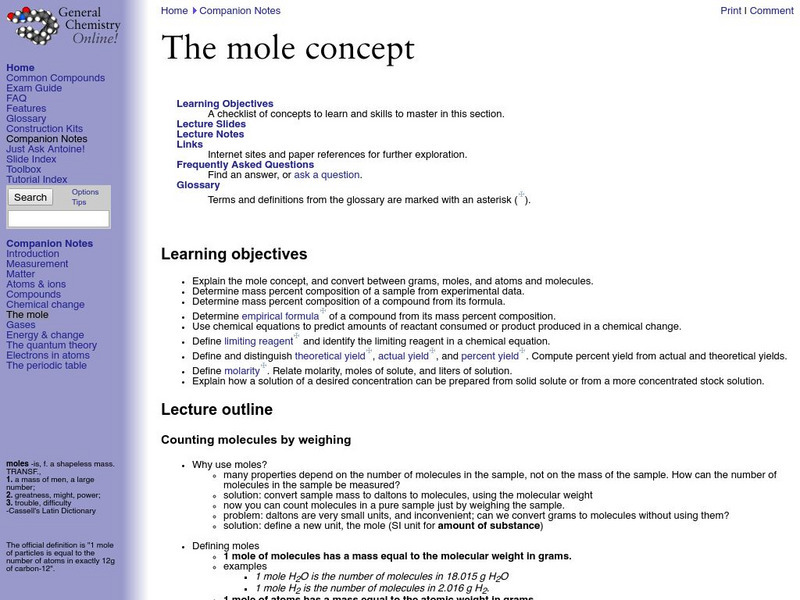
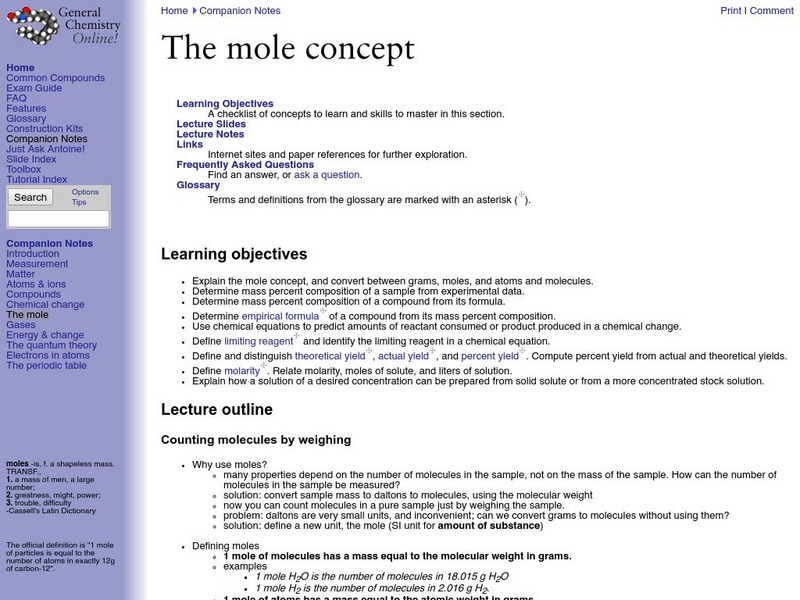
General Chemistry Online: The Mole Concept
Resource provides notes on Moles and Stoichiometry. Deals with all book-keeping aspects, including as section on yields and limiting reactants. Includes lesson plans, lecture slides and notes, links to related websites, and frequently...
Oswego City School District
Regents Exam Prep Center: Moles & Stoichiometry: Moles Resource
A nice page of links to follow for learning about moles. Contains links to sites that have explanations of moles and molar mass, practice problems, and more.
CK-12 Foundation
Ck 12: Ideal Gases and Gas Stoichiometry
[Free Registration/Login may be required to access all resource tools.] In the following online tutorial students will learn the Ideal Gas Law, and know which of the different values for the ideal gas constant to use in a given...
Georgia Department of Education
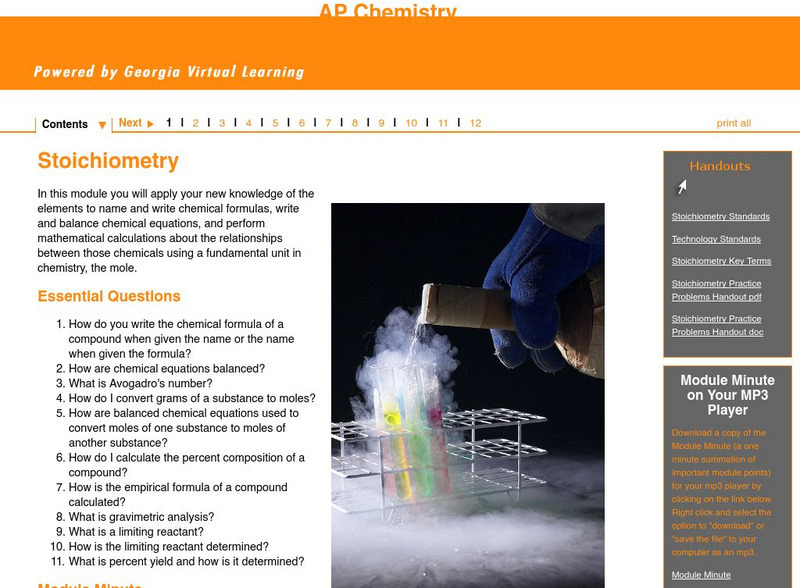
Ga Virtual Learning: Ap Chemistry: Stoichiometry
Students apply new knowledge of the elements to name and write chemical formulas, write and balance chemical equations, and perform mathematical calculations about the relationships between those chemicals, using a fundamental unit in...
CK-12 Foundation
Ck 12: Mole Ratios
[Free Registration/Login may be required to access all resource tools.] In this learning module, students will learn how to calculate and account for the amounts of reactants and products in a given chemical reaction.

Carnegie Mellon University
Chem Collective: Stoichiometry Bridge Course
This is a complete course in chemical stoichiometry, set in a scenario that shows how stoichiometry calculations are used in real-world situations. This course has been designed to not only help you strengthen your skills with...
Chemistry Collective
Chem Collective: Stoichiometry Tutorials: Dimensional Analysis
Watch a short tutorial showing the conversion between the amount of a substance expressed in number of molecules to the amount of a substance expressed in moles of molecules, and then try some dimensional analysis practice problems.

Georgia Department of Education
Ga Virtual Learning: Chemistry: Stoichiometry
Through informational text, interactive practice problems, video clips, and real-world application, students are introduced to the science of Stoichiometry.
CK-12 Foundation
Ck 12: Mole Ratios
[Free Registration/Login may be required to access all resource tools.] In this online tutorial students will relate balanced chemical equations to everyday analogies, such as a recipe. They will also define stoichiometry and use mole...
Other
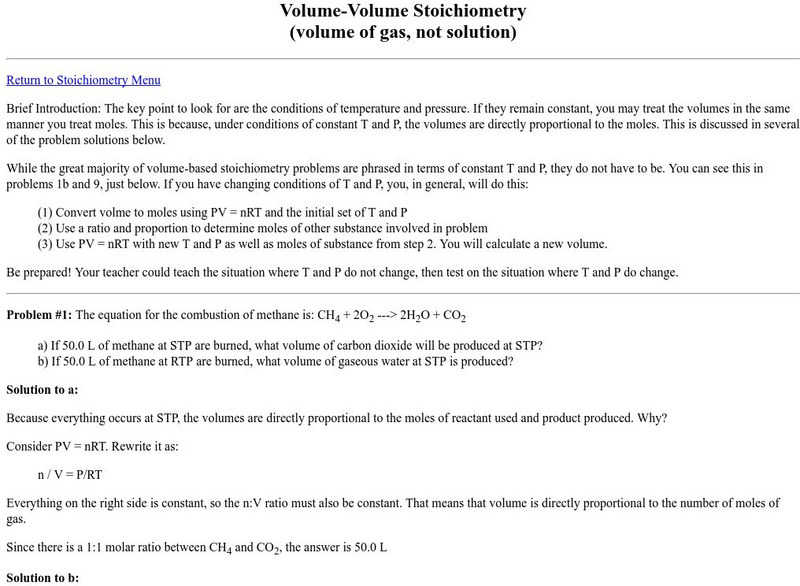
Chem Team: Stoichiometry: Volume Volume Stoichiometry
Understand volume-volume stoichiometry with these volume-based example problems worked with solutions and explanations.
Frostburg State University
General Chemistry Online: Faq the Mole Concept
This FAQ site over general chemistry concepts presents the question: "Why are moles used?" It explains what moles are and how they can be used to count molecules and how grams can be turned into moles.
Upper Canada District School Board
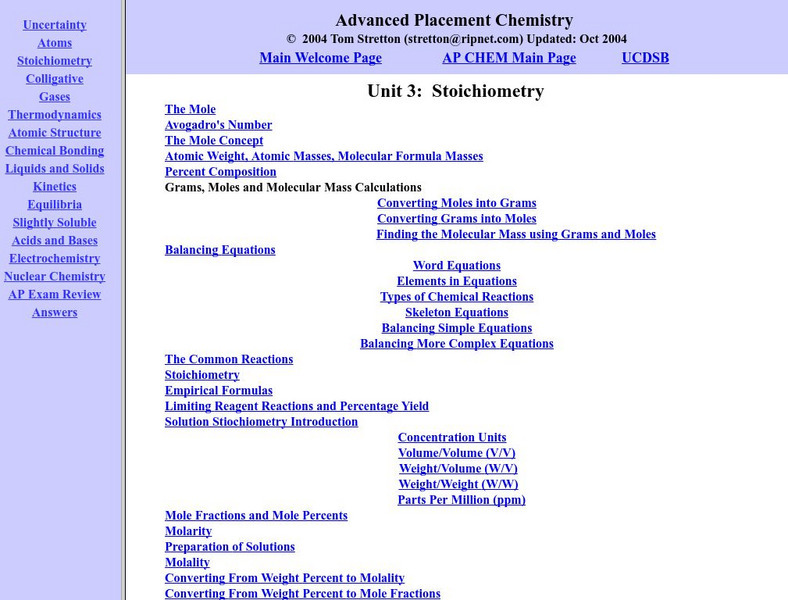
Tom Stretton's Advanced Placement Chemistry: Stoichiometry
This online textbook chapter provides learners with advanced-level reading and practice material on stoichiometry

CK-12 Foundation
Ck 12: Plix Series: Gas Density: Mass, Volume and the Mole
[Free Registration/Login Required] Find out what mathematical function to perform when converting between particles and moles. Then answer one challenge question about the topic.
Towson University
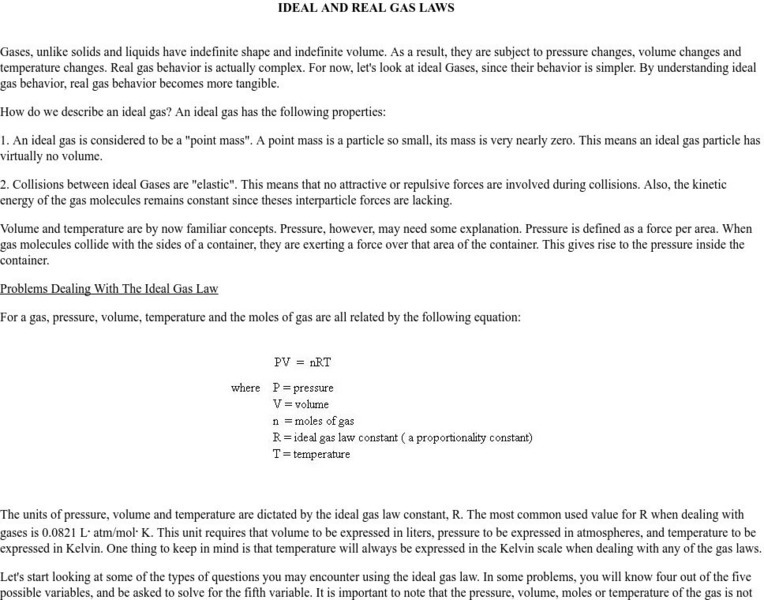
Towson University: Ideal and Real Gas Laws
The ideal gas law is stated and explained at this site from the Towson University. It is then used to derive the other gas laws (Charles, Boyle's, Gay-Lussac's, Avogadro's, combined, etc.). Other gas law relationships are discussed....